
@CTmagazine 4/ Are we condemned to a kind of epistemological limbo, forever suspended between ignorance and awakening? Or does waiting itself forge a form of praxis—perhaps the only illumination available to contingent beings who find themselves thrown into history's unredeemed middle?
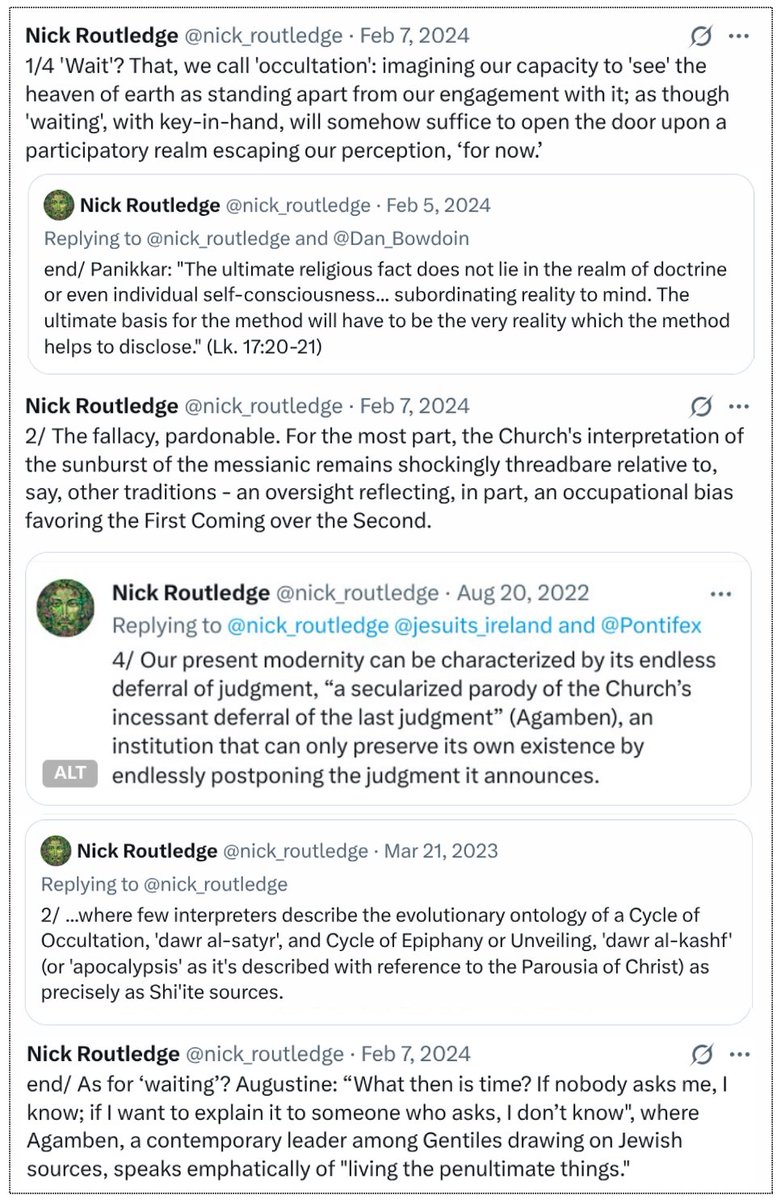
Image description
Original X alt text
Copy of tweet thread here:
Extended description
Pictured speaker / quoted attribution: Nick Routledge Saved source record associated with pictured writing; full saved record, not an exact pictured excerpt. Passage boundary: 1/4 Wait Source: archive.nickroutledge.org/post/1755398853782896816 Preserve quoted-author distinctions; the containing tweet does not confer authorship. @pauljpastor 1/4 'Wait'? That, we call 'occultation': imagining our capacity to 'see' the heaven of earth as standing apart from our engagement with it; as though 'waiting', with key-in-hand, will somehow suffice to open the door upon a participatory realm escaping our perception, ‘for now.’ t.co/uEBrF0EjSe
Open original documentExtended description
Pictured speaker / quoted attribution: Nick Routledge quoting Panikkar Saved source record associated with pictured writing; full saved record, not an exact pictured excerpt. Passage boundary: end/ Panikkar Source: archive.nickroutledge.org/post/1754531407752499345 Preserve quoted-author distinctions; the containing tweet does not confer authorship. @Dan_Bowdoin end/ Panikkar: "The ultimate religious fact does not lie in the realm of doctrine or even individual self-consciousness... subordinating reality to mind. The ultimate basis for the method will have to be the very reality which the method helps to disclose." (Lk. 17:20-21) t.co/z5H5uCeZjs
Open original documentExtended description
Pictured speaker / quoted attribution: Nick Routledge Saved source record associated with pictured writing; full saved record, not an exact pictured excerpt. Passage boundary: 2/ fallacy Source: Preserve quoted-author distinctions; the containing tweet does not confer authorship. Tweet: The Jewish charge that the messiah has not yet come because the world is not yet redeemed is wholly consistent with the parousial initiation of a unicity in which we include and complete one another. Besides, religious - never mind Abrahamic - exceptionalism is an ontic archaism. What if only in such intensifications between highly diverse cosmovisions can the vicious cycle ultimately give way to a vital circle - to a novel, planetarian symbiote of revelation set within a common horizon of hope and its expectation of an ultimate communion of eternal life? As if the exceptionalism a nation, religion or culture believes it has, can somehow evade a crowning planetary authority revealing a new and vital coherence transcending the mimetic crisis of chronically malignant fictions and fabrications sustaining the entire, global shebang. 1/3 It pays to acknowledge our littleness, perhaps. Reality far transcends Christian enclosure. The second, as first, advent announces an ontic novelty incontestably more generous than the momentum of social, cultic or political associations - indeed, of temporality itself. 2/ The fallacy, pardonable. For the most part, the Church's interpretation of the sunburst of the messianic remains shockingly threadbare relative to, say, other traditions - an oversight reflecting, in part, an occupational bias favoring the First Coming over the Second. Quote tweet: Moltmann, Agamben, Illich and Cayley likewise aver "messianic eclipse" (Benjamin) an aggregate goal of all religious and secular systems hanging upon a Judgment Deferral Complex; and such catastrophic permanency checked only in the game-ending irruption of a "messianic arrest.
Open original documentExtended description
Pictured speaker / quoted attribution: Nick Routledge quoting Agamben Saved source record associated with pictured writing; full saved record, not an exact pictured excerpt. Passage boundary: 4/ Source: archive.nickroutledge.org/post/1561209818592858112 Preserve quoted-author distinctions; the containing tweet does not confer authorship. @jesuits_ireland @Pontifex 4/ Our present modernity can be characterized by its endless deferral of judgment, “a secularized parody of the Church’s incessant deferral of the last judgment” (Agamben), an institution that can only preserve its own existence by endlessly postponing the judgment it announces. t.co/HYXH55ful8
Open original documentExtended description
Pictured speaker / quoted attribution: Nick Routledge Saved source record associated with pictured writing; full saved record, not an exact pictured excerpt. Passage boundary: 2/ where few Source: Preserve quoted-author distinctions; the containing tweet does not confer authorship. In the dialectics of planetary prophetology, the Fall is the calamity that happened to us as perceivers, where the ‘Revelatory Principle’ restores our capacity to recognize our surroundings as the Paradise we never left, in a theophany of cognitive recalibration or reintegration. “It is an apocalypse of mind and eye we need,” asserts the gardener, John Moriarty, “an apocalypse that opens the veils of mind and eye, not an apocalypse that pulls down the stars, that obliterates the sea.” “To become Khezr,” Corbin concludes, “is to pierce the ‘mystery of the Veil.’ ” Blake, then, is surely correct when he insists that the distorting mirror of our modern, materialist cosmologies and assumptions have their sources in the poverties and impoverishments of single vision: the Fall is not a wandering downwards into ever-darker and more impoverished realms of independently existing objective reality but rather a state of perceptual contractedness, or Ulro as he called it. “It would follow,” notes Moriarty, “that we shouldn't be talking at all about an ontological hierarchy in reality but about a perceptual hierarchy of occlusion and clarity [a Cycle of Occultation, dawr al-satyr, and Cycle of Epiphany or Unveiling, dawr al-kashf] in how we see reality.” Subtweet: 2/ ...where few interpreters describe the evolutionary ontology of a Cycle of Occultation, 'dawr al-satyr', and Cycle of Epiphany or Unveiling, 'dawr al-kashf' (or 'apocalypsis' as it's described with reference to the Parousia of Christ) as precisely as Shi'ite sources.
Open original documentExtended description
Pictured speaker / quoted attribution: Nick Routledge quoting Augustine and Agamben Saved source record associated with pictured writing; full saved record, not an exact pictured excerpt. Passage boundary: end/ As for waiting Source: archive.nickroutledge.org/post/1755401467614408844 Preserve quoted-author distinctions; the containing tweet does not confer authorship. @pauljpastor end/ As for ‘waiting’? Augustine: “What then is time? If nobody asks me, I know; if I want to explain it to someone who asks, I don’t know", where Agamben, a contemporary leader among Gentiles drawing on Jewish sources, speaks emphatically of "living the penultimate things." t.co/MjfHgeASuk
Open original document@iyad_elbaghdadi Which contemporary Islamic voices do you admire? I'm certainly curious in pointers to evolutionary views reconciling the crisis of modernism to the eschatological air that Islam breathes. I know Shari’ati and reckon Nund Rishi transhistorically decisive—a planetary Eliatic pivot.
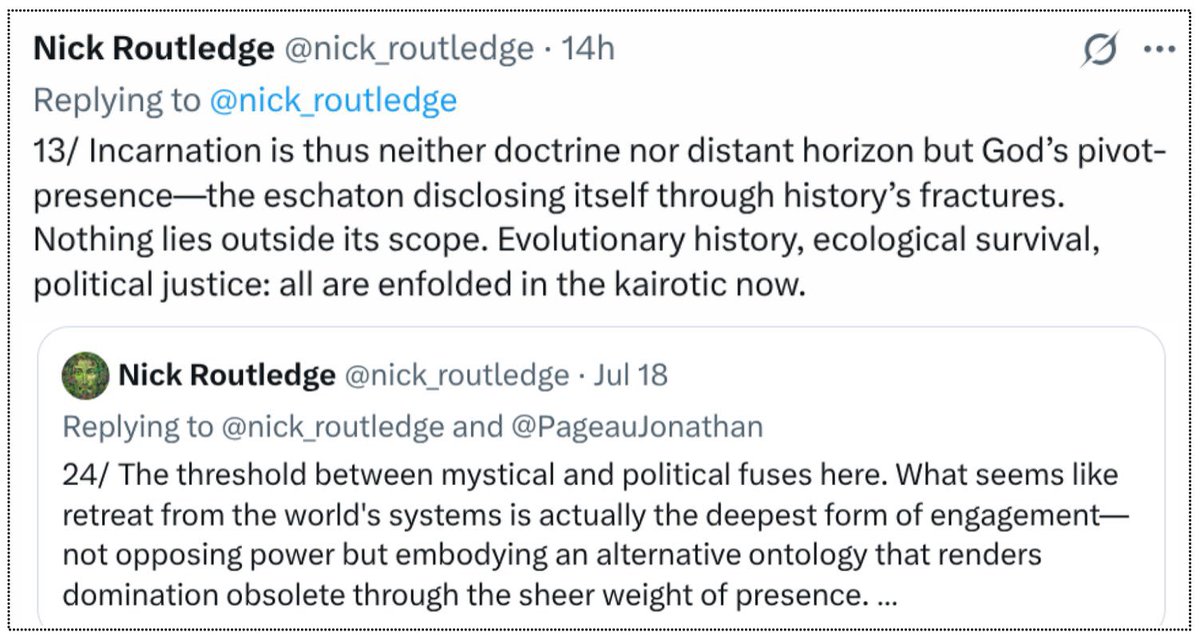
Image description
Original X alt text
Copy of tweet here: 13/ Incarnation is thus neither doctrine nor distant horizon but God’s pivot-presence—the eschaton disclosing itself through history’s fractures. Nothing lies outside its scope. Evolutionary history, ecological survival, political justice: all are enfolded in the kairotic now. 24/ The threshold between mystical and political fuses here. What seems like retreat from the world's systems is actually the deepest form of engagement—not opposing power but embodying an alternative ontology that renders domination obsolete through the sheer weight of presence.