
@pauljpastor end/ As for ‘waiting’? Augustine: “What then is time? If nobody asks me, I know; if I want to explain it to someone who asks, I don’t know", where Agamben, a contemporary leader among Gentiles drawing on Jewish sources, speaks emphatically of "living the penultimate things."
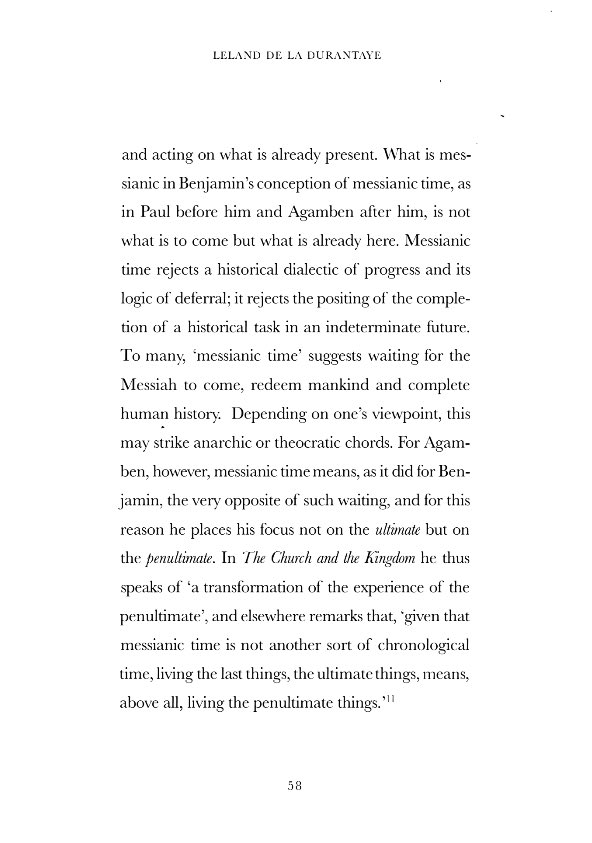
Image description
Original X alt text
Translator’s introduction to Agamben’s ‘Church and the Kingdom’. What is messianic in Benjamin's conception of messianic time, as in Paul before him and Agamben after him, is not what is to come but what is already here. Messianic time rejects a historical dialectic of progress and its logic of deferral; it rejects the positing of the completion of a historical task in an indeterminate future. To many, ‘messianic time’ suggests waiting for the Messiah to come, redeem mankind and complete human history…For Agamben, however, messianic time means, as it did for Ben-jamin, the very opposite of such waiting, and for this reason he places his focus not on the ultimate but on the penultimate. In ‘The Church and the Kingdom’ he thus speaks of ‘a transformation of the experience of the penultimate’, and elsewhere remarks that, “given that messianic time is not another sort of chronological time, living the last things, the ultimate things, means, above all, living the penultimate things."
@jdj_writes Curious to what degree you perceive concrete reality as the covenantal realm in which the irruption of a 'new temporality' comes to ground - the interruptive mercy of a messianic ontology yoking the architecture of redemptive time to wholesale, planetary political transformation?
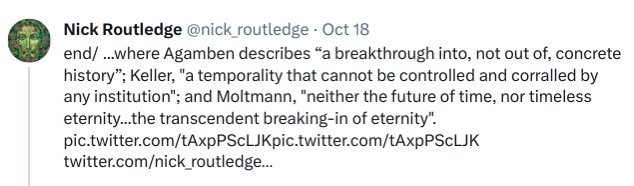
Image description
Original X alt text
Copy of tweet herre: end/ ...where Agamben describes “a breakthrough into, not out of, concrete history”; Keller, "a temporality that cannot be controlled and corralled by any institution"; and Moltmann, "neither the future of time, nor timeless eternity...the transcendent breaking-in of eternity".