
RT @nick_routledge: @iyad_elbaghdadi Which contemporary Islamic voices do you admire? I'm certainly curious in pointers to evolutionary views reconciling the crisis of modernism to the eschatological air that Islam breathes. I know Shari’ati and reckon Nund Rishi transhistorically decisive—a planetary Eliatic pivot.
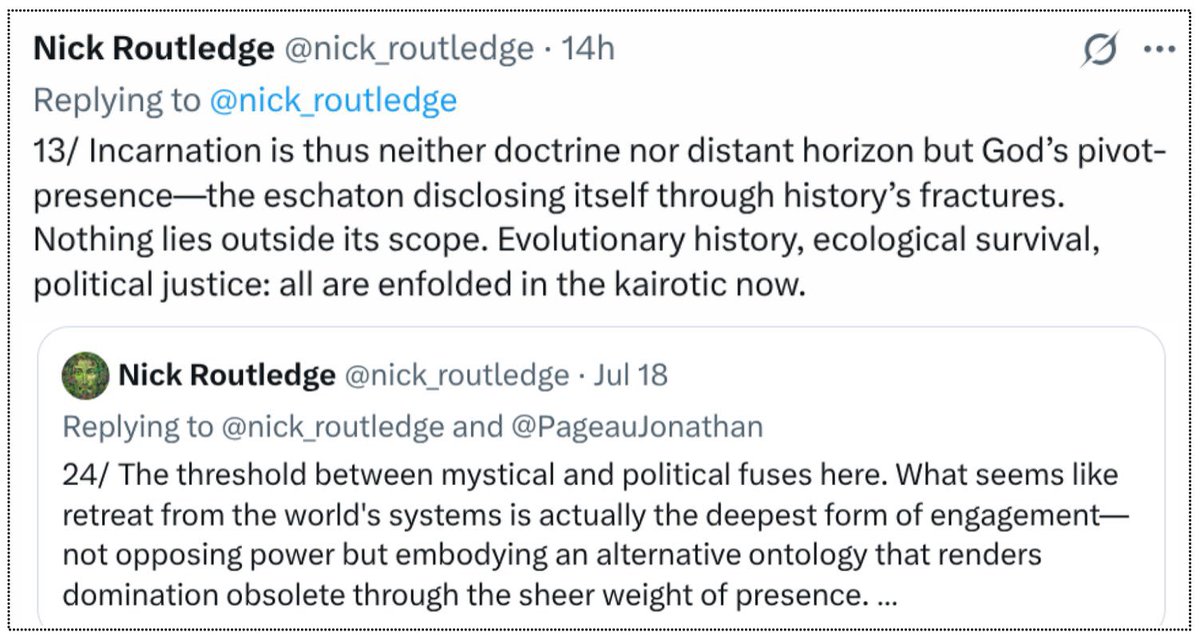
Image description
Original X alt text
Copy of tweet here: 13/ Incarnation is thus neither doctrine nor distant horizon but God’s pivot-presence—the eschaton disclosing itself through history’s fractures. Nothing lies outside its scope. Evolutionary history, ecological survival, political justice: all are enfolded in the kairotic now. 24/ The threshold between mystical and political fuses here. What seems like retreat from the world's systems is actually the deepest form of engagement—not opposing power but embodying an alternative ontology that renders domination obsolete through the sheer weight of presence.
5/ This is to say God enters conflictual time, the architecture of the broken, the exploited, the crucified. The groaning of all flesh—microbes, forests, cities, peoples—resounds as the very site of divine solidarity woven into creaturely suffering and evolutionary striving.
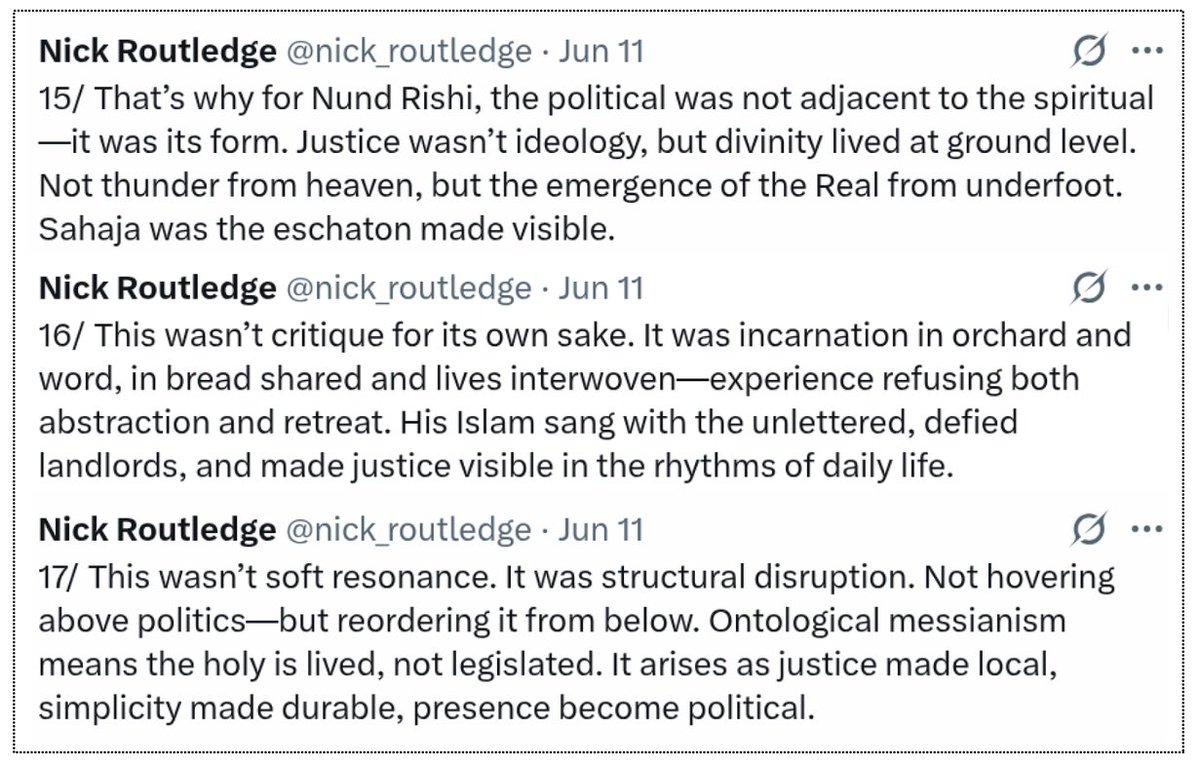
Image description
Original X alt text
Copy of tweet thread here: 15/ That’s why for Nund Rishi, the political was not adjacent to the spiritual—it was its form. Justice wasn’t ideology, but divinity lived at ground level. Not thunder from heaven, but the emergence of the Real from underfoot. Sahaja was the eschaton made visible. 16/ This wasn’t critique for its own sake. It was incarnation in orchard and word, in bread shared and lives interwoven—experience refusing both abstraction and retreat. His Islam sang with the unlettered, defied landlords, and made justice visible in the rhythms of daily life. 17/ This wasn’t soft resonance. It was structural disruption. Not hovering above politics—but reordering it from below. Ontological messianism means the holy is lived, not legislated. It arises as justice made local, simplicity made durable, presence become political.