
RT @nick_routledge: @NorannV @PeterMommsen Peter's reliably world-class. Yes, as Vogelin avers, there's no forcing, averting or delaying the Day (Q: 16:61). Yet, as Peter says: 'Christian pacifism is eschatological'—that is, to enflesh, practice and announce the Eschaton's arrival is to live and breathe it into being now.
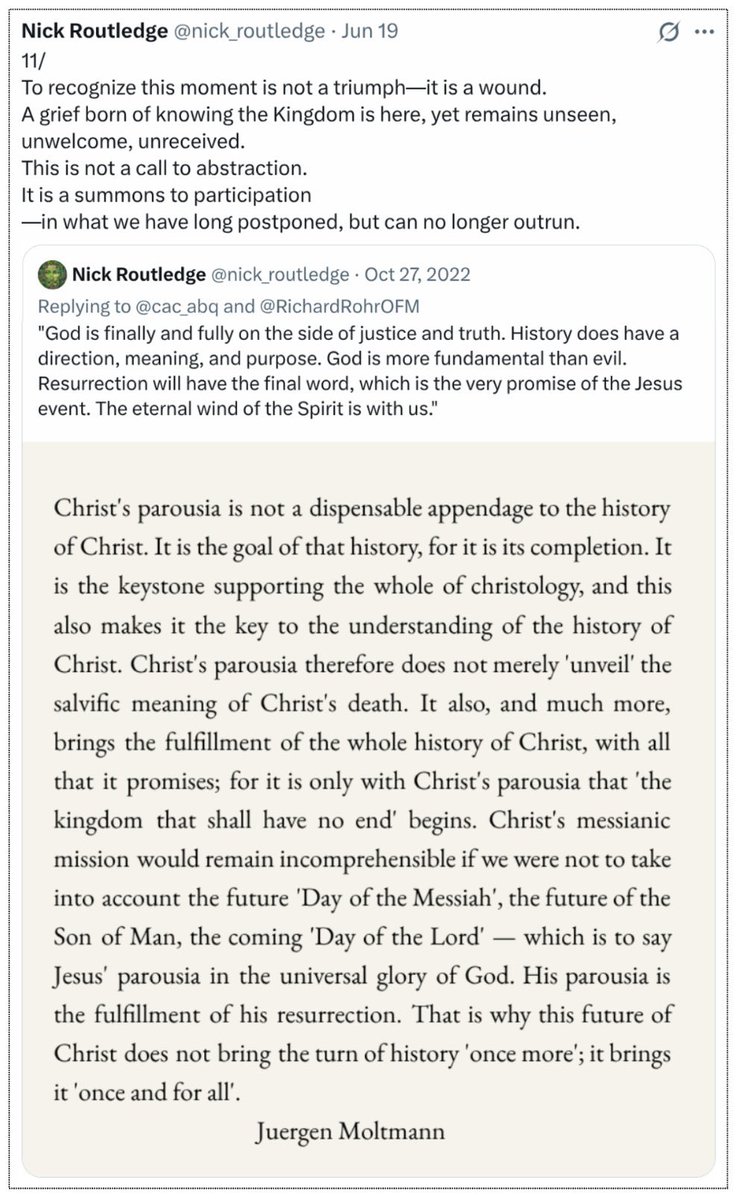
Image description
Original X alt text
Copy of tweet and quote tweet, including alt-text here:
Extended description
Pictured speaker / quoted attribution: Nick Saved source record associated with pictured writing; full saved record, not an exact pictured excerpt. Passage boundary: Source: archive.nickroutledge.org/post/1935732271124041802 Preserve quoted-author distinctions; the containing tweet does not confer authorship. 11/ To recognize this moment is not a triumph—it is a wound. A grief born of knowing the Kingdom is here, yet remains unseen, unwelcome, unreceived. This is not a call to abstraction. It is a summons to participation —in what we have long postponed, but can no longer outrun. t.co/Pc5WDfQyqa
Open original documentExtended description
Pictured speaker / quoted attribution: Nick quoting Richard Rohr Saved source record associated with pictured writing; full saved record, not an exact pictured excerpt. Passage boundary: Source: Preserve quoted-author distinctions; the containing tweet does not confer authorship. “Man-made history is not history's only dimension. History is not a blind alley. Beyond the mystery is meaning. And the meaning is destined to be disclosed.” Abraham Joshua Heschel ⇹ "God is finally and fully on the side of justice and truth. History does have a direction, meaning, and purpose. God is more fundamental than evil. Resurrection will have the final word, which is the very promise of the Jesus event. The eternal wind of the Spirit is with us." Richard Rohr
Open original documentExtended description
Pictured speaker / quoted attribution: Jürgen Moltmann Saved source record associated with pictured writing; full saved record, not an exact pictured excerpt. Passage boundary: Source: Preserve quoted-author distinctions; the containing tweet does not confer authorship. Christ's parousia is not a dispensable appendage to the history of Christ. It is the goal of that history, for it is its completion. It is the keystone supporting the whole of christology, and this also makes it the key to the understanding of the history of Christ. Christ's parousia therefore does not merely 'unveil' the salvific meaning of Christ's death. It also, and much more, brings the fulfillment of the whole history of Christ, with all that it promises; for it is only with Christ's parousia that 'the kingdom that shall have no end' begins. Christ's messianic mission would remain incomprehensible if we were not to take into account the future 'Day of the Messiah', the future of the Son of Man, the coming 'Day of the Lord' — which is to say Jesus' parousia in the universal glory of God. His parousia is the fulfillment of his resurrection. That is why this future of Christ does not bring the turn of history 'once more'; it brings it 'once and for all'. Jürgen Moltmann
Open original document5/ What he catalyzed could be called proto-messianic politics—but with no messiah—or rather, the recognition that messianism is not a person but a posture, a grounded mode of living the Real, where the awakened soul in each of us midwives divine justice into the everyday.
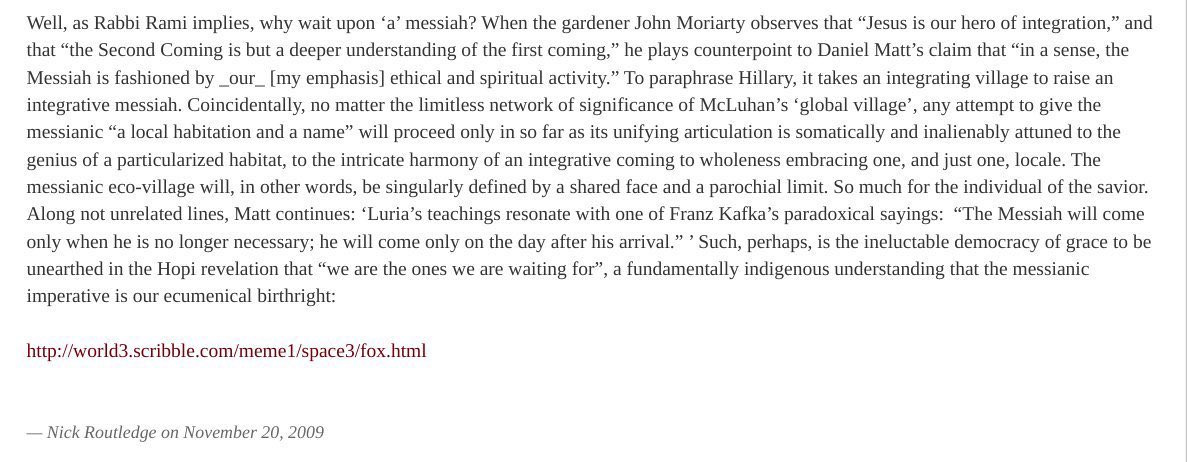
Image description
Original X alt text
Alt- text for this image is available here:
Extended description
Pictured speaker / quoted attribution: Nick Routledge, dated November20,2009; quotes attributed to Moriarty, Matt, Kafka and Hopi Saved source record associated with pictured writing; full saved record, not an exact pictured excerpt. Passage boundary: Source: Preserve quoted-author distinctions; the containing tweet does not confer authorship. First segment of alt-text for tweet above, of image originally tweeted here: Well, as Rabbi Rami implies, why wait upon ‘a’ messiah? When the gardener John Moriarty observes that “Jesus is our hero of integration,” and that “the Second Coming is but a deeper understanding of the first coming,” he plays counterpoint to Daniel Matt’s claim that “in a sense, the Messiah is fashioned by _our_ [my emphasis] ethical and spiritual activity.” To paraphrase Hillary, it takes an integrating village to raise an integrative messiah. Coincidentally, no matter the limitless network of significance of McLuhan’s ‘global village’, any attempt to give the messianic “a local habitation and a name” will proceed only in so far as its unifying articulation is somatically and inalienably attuned to the genius of a particularized habitat, to the intricate harmony of an integrative coming to wholeness embracing one, and just one, locale.
Open original documentExtended description
Pictured speaker / quoted attribution: Nick, continuation through URL/date signature Saved source record associated with pictured writing; full saved record, not an exact pictured excerpt. Passage boundary: Source: Preserve quoted-author distinctions; the containing tweet does not confer authorship. Second segment of alt-text for tweet above, of a text image originally tweeted here: The messianic eco-village will, in other words, be singularly defined by a shared face and a parochial limit. So much for the individual of the savior. Along not unrelated lines, Matt continues: ‘Luria’s teachings resonate with one of Franz Kafka’s paradoxical sayings: “The Messiah will come only when he is no longer necessary; he will come only on the day after his arrival.” * Such, perhaps, is the ineluctable democracy of grace to be unearthed in the Hopi revelation that “we are the ones we are waiting for”, a fundamentally indigenous understanding that the messianic imperative is our ecumenical birthright: — Nick Routledge on November 20, 2009
Open original document