
Nick Routledge@nick_routledge
Reply to @AimeTim

@AimeTim Now _that's_ what Twitter's for. Sublime, Tim. Thank you so much. And a perfect correlative, naturally, in terms of 'the postponing of an infinite dimension' (Panikkar) ultimately transcended only in the interruptive mercy of a 'new temporality' come to ground.
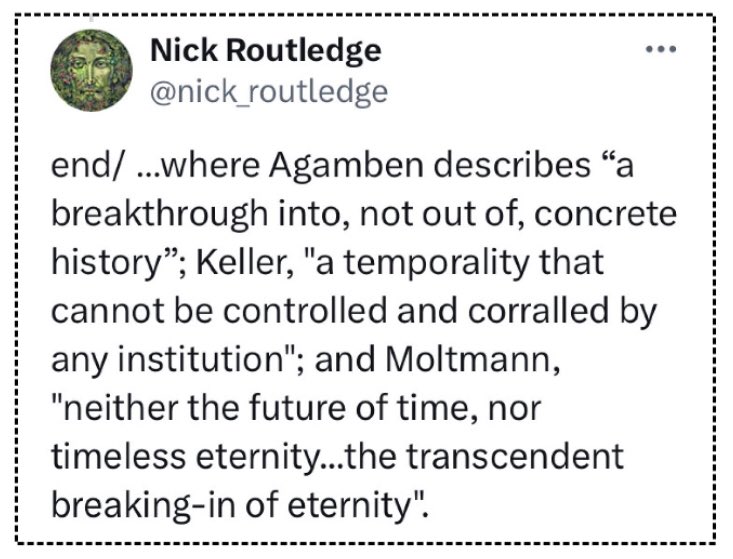
Copy of tweet here:

end/ ...where Agamben describes “a breakthrough into, not out of, concrete history”; Keller, "a temporality that cannot be controlled and corralled by any institution"; and Moltmann, "neither the future of time, nor timeless eternity...the transcendent breaking-in of eternity".
Image description

Original X alt text

Copy of tweet here: end/ ...where Agamben describes “a breakthrough into, not out of, concrete history”; Keller, "a temporality that cannot be controlled and corralled by any institution"; and Moltmann, "neither the future of time, nor timeless eternity...the transcendent breaking-in of eternity".

Quoted or linked post

Nick Routledge@nick_routledge · 3 Jun 2024

@johnmilbank3 Blake: "Time is the mercy of eternity." Michael Kirwan SJ: "Time, the mercy of the Messiah." Raimon Pannikar, particularly incisive on temporality as the deepest aspect of secularity and its ultimate character. "There may be no more formidable problem than the problem of time."

View this post’s context →

Context in the archive

Quoted byRT @nick_routledge: @pauljpastor Panikkar and Guénon claim temporality itself constitutes secular modernity's deepest, ultimate corruption of Being. Put another way, tempieternity is the mercy of the Messiah. Moltmann: "The Kingdom does not come out of the future into the present. It comes from heaven to earth."Quoted by@pauljpastor Panikkar and Guénon claim temporality itself constitutes secular modernity's deepest, ultimate corruption of Being. Put another way, tempieternity is the mercy of the Messiah. Moltmann: "The Kingdom does not come out of the future into the present. It comes from heaven to earth."