
@SophiaCycles 5/ Needs be said, even as the illumination born of inwardly 'silencing down’ is profound in itself, avant-garde contemplatives tend to emphasize an 'eyes-open approach'. Hakuin: "Zen practice pursued within activity is a million times superior to that pursued in tranquility."
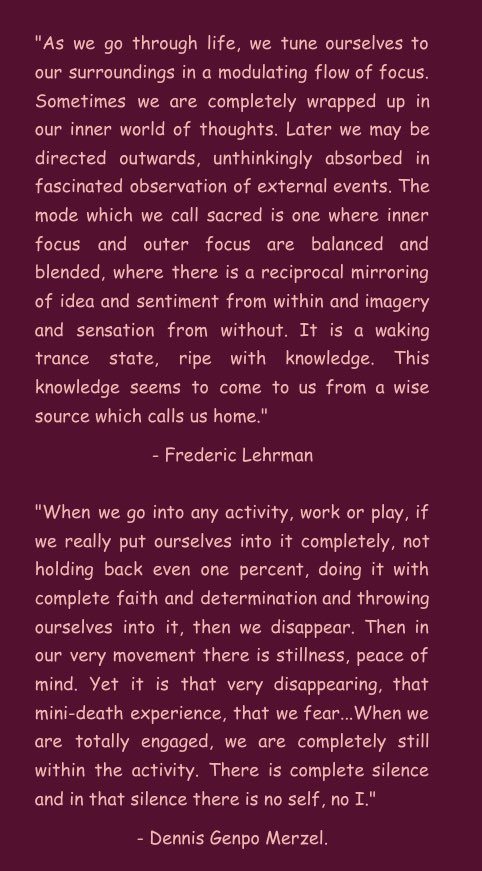
Image description
Original X alt text
As we go through life, we tune ourselves to our surroundings in a modulating flow of focus. Sometimes we are completely wrapped up in our inner world of thoughts. Later we may be directed outwards, unthinkingly absorbed in fascinated observation of external events. The mode we call sacred is one where inner focus and outer focus are balanced and blended, a reciprocal mirroring of idea and sentiment from within and imagery and sensation from without. A waking trance state, ripe with knowledge. This knowledge seems to come to us from a wise source which calls us home. When we go into any activity, work or play, if we really put ourselves into it, not holding back even one percent, doing it with complete faith and determination and throwing ourselves into it, then we disappear. Then in our very movement there is stillness, peace of mind. When we are totally engaged, we are completely still within the activity. There is complete silence and in that silence there is no self, no I.
@SophiaCycles I'd planned on a rewrite: you got to me first! I apologize. Yes, I admit I can sound hard naming a universalist tendency I perceive, for professional contemplatives to declare the relative *primacy* of cushioned mysticism to dropping an awakened shoulder. Of course it's both/and.
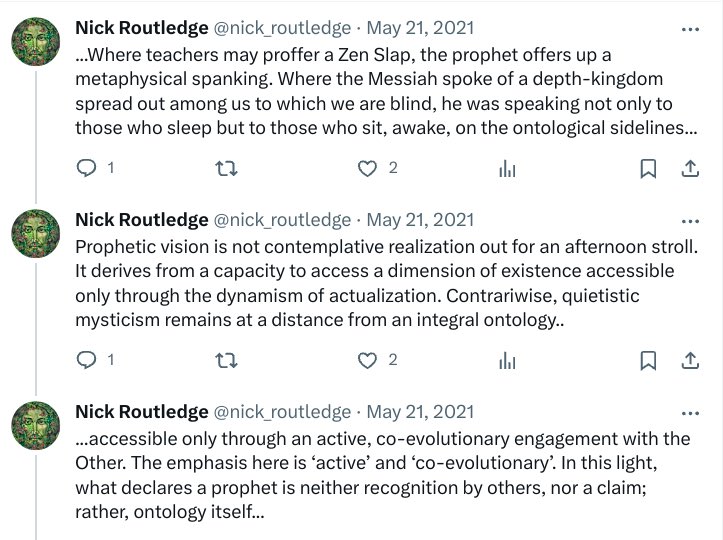
Image description
Original X alt text
Copy of tweet thread here: ...Where teachers may proffer a Zen Slap, the prophet offers up a metaphysical spanking. Where the Messiah spoke of a depth-kingdom spread out among us to which we are blind, he was speaking not only to those who sleep but to those who sit, awake, on the ontological sidelines... Prophetic vision is not contemplative realization out for an afternoon stroll. It derives from a capacity to access a dimension of existence accessible only through the dynamism of actualization. Contrariwise, quietistic mysticism remains at a distance from an integral ontology ...accessible only through an active, co-evolutionary engagement with the Other. The emphasis here is ‘active’ and ‘co-evolutionary’. In this light, what declares a prophet is neither recognition by others, nor a claim; rather, ontology itself...
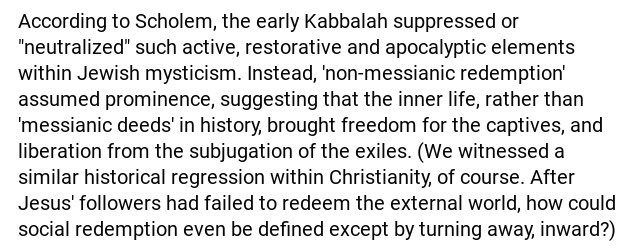
Image description
Original X alt text
Copy of text linked to here: According to Scholem, the early Kabbalah suppressed or "neutralized" such active, restorative and apocalyptic elements within Jewish mysticism. Instead, 'non-messianic redemption' assumed prominence, suggesting that the inner life, rather than 'messianic deeds' in history, brought freedom for the captives, and liberation from the subjugation of the exiles. (We witnessed a similar historical regression within Christianity, of course. After Jesus' followers had failed to redeem the external world, how could social redemption even be defined except by turning away, inward?)