
@ceisenstein I note little in the way of timely alert and promotion for the live link here, on Twitter, nor any record of it. Any chance you could include us here, also, next time, dear soul? The 5th most visited website in the world certainly needs your voice. Twitter, holy too. Much love.
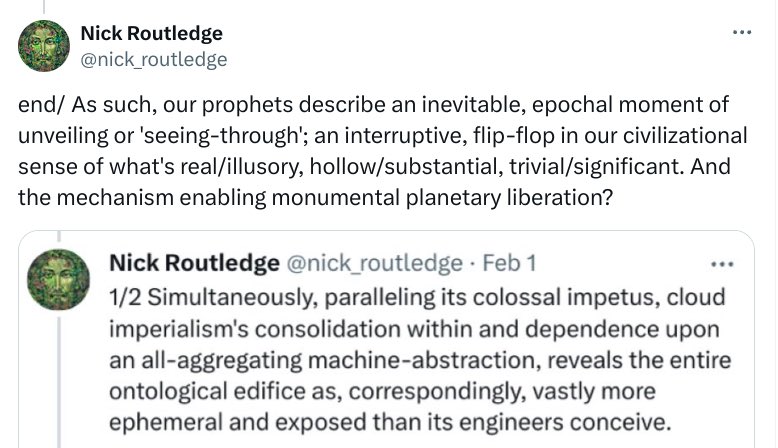
Image description
Original X alt text
Copy of tweet here: end/ As such, our prophets describe an inevitable, epochal moment of unveiling or 'seeing-through'; an interruptive, flip-flop in our civilizational sense of what's real/illusory, hollow/substantial, trivial/significant. And the mechanism enabling monumental planetary liberation? 1/2 Simultaneously, paralleling its colossal impetus, cloud imperialism's consolidation within and dependence upon an all-aggregating machine-abstraction, reveals the entire ontological edifice as, correspondingly, vastly more ephemeral and exposed than its engineers conceive.
@pauljpastor end/ As for ‘waiting’? Augustine: “What then is time? If nobody asks me, I know; if I want to explain it to someone who asks, I don’t know", where Agamben, a contemporary leader among Gentiles drawing on Jewish sources, speaks emphatically of "living the penultimate things."
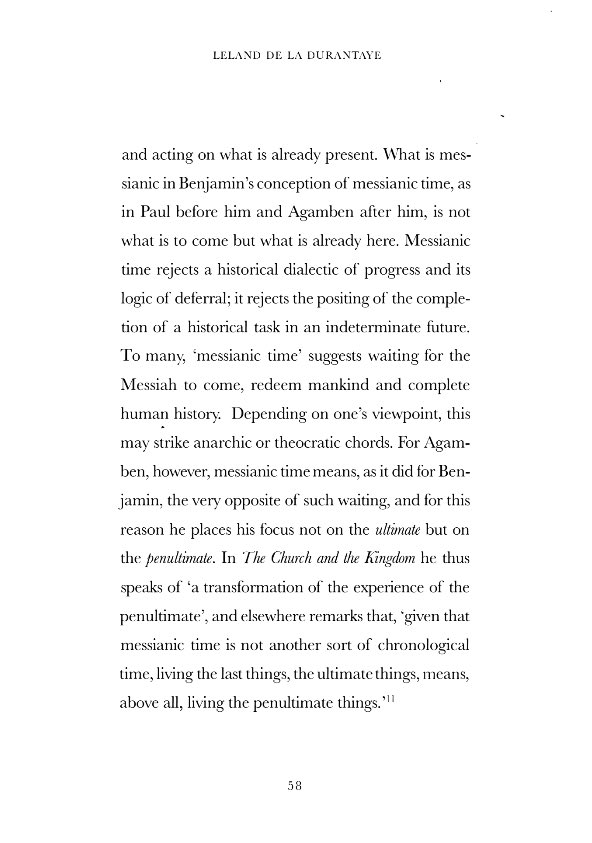
Image description
Original X alt text
Translator’s introduction to Agamben’s ‘Church and the Kingdom’. What is messianic in Benjamin's conception of messianic time, as in Paul before him and Agamben after him, is not what is to come but what is already here. Messianic time rejects a historical dialectic of progress and its logic of deferral; it rejects the positing of the completion of a historical task in an indeterminate future. To many, ‘messianic time’ suggests waiting for the Messiah to come, redeem mankind and complete human history…For Agamben, however, messianic time means, as it did for Ben-jamin, the very opposite of such waiting, and for this reason he places his focus not on the ultimate but on the penultimate. In ‘The Church and the Kingdom’ he thus speaks of ‘a transformation of the experience of the penultimate’, and elsewhere remarks that, “given that messianic time is not another sort of chronological time, living the last things, the ultimate things, means, above all, living the penultimate things."