
@pauljpastor end/ Frankly, I don’t see why awakening can’t be both/either, religious/mystical, gradual/sudden, efforted/spontaneous, solo/corporate. Besides, what if both complements are finally necessary? What, indeed, of the irrevocable wakeup of the planetary sunburst of the Second Advent?
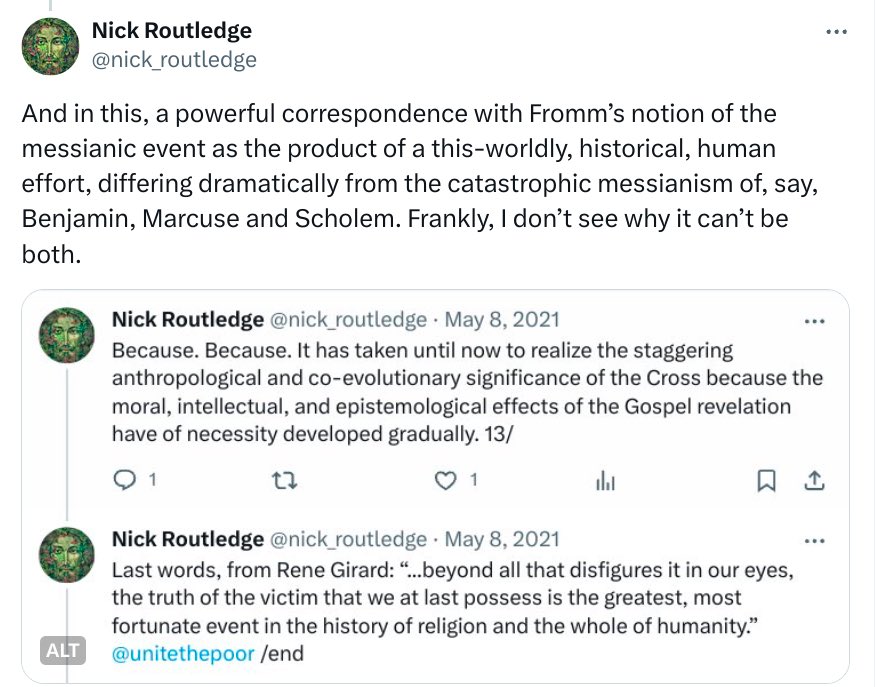
Image description
Original X alt text
Copy of tweet there: And in this, a powerful correspondence with Fromm’s notion of the messianic event as the product of a this-worldly, historical, human effort, differing dramatically from the catastrophic messianism of, say, Benjamin, Marcuse and Scholem. Frankly, I don’t see why it can’t be both. Because. Because. It has taken until now to realize the staggering anthropological and co-evolutionary significance of the Cross because the moral, intellectual, and epistemological effects of the Gospel revelation have of necessity developed gradually. 13/ Nick Routledge · Last words, from Rene Girard: “...beyond all that disfigures it in our eyes, the truth of the victim that we at last possess is the greatest, most fortunate event in the history of religion and the whole of humanity.” /end
@brianmclaren Matthew Fox got me started. And yet, there comes a time, for the sake of all, where the pragmatic reconciliation of 'religion' and 'mysticism' occurs, in God's time, as an advent of wholeness made possible (only) by the supersession of the messianic. ?s=20
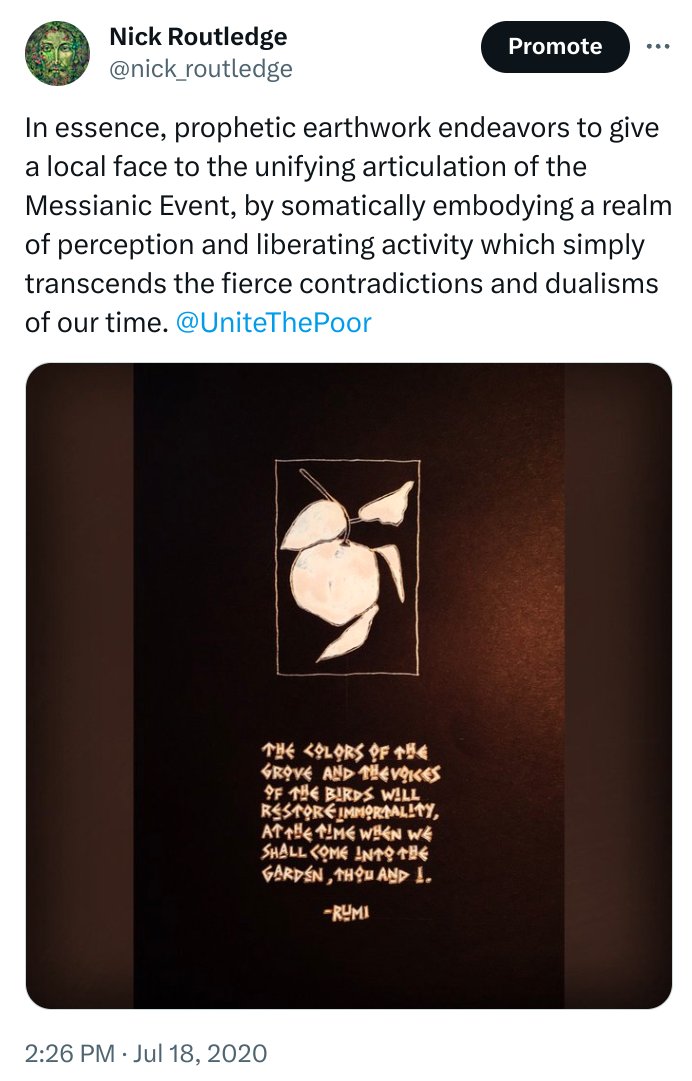
Image description
Original X alt text
Copy of tweet: Nick Routledge In essence, prophetic earthwork endeavors to give a local face to the unifying articulation of the Messianic Event, by somatically embodying a realm of perception and liberating activity which simply transcends the fierce contradictions and dualisms of our time. With art and calligraphy reading, "The colors of the grove and voices of the birds will restore immortality at the time when we shall come into the garden, thou and I. - Rumi"