
At one level, we subscribe to traditional approaches to cultivar stewardship of large, isolated, homogeneous populations at scale; at another, the bio-cultural realpolitik of non-profit, grassroots, seed stewardship points to an evolution in the very notion of 'varietal concept'.
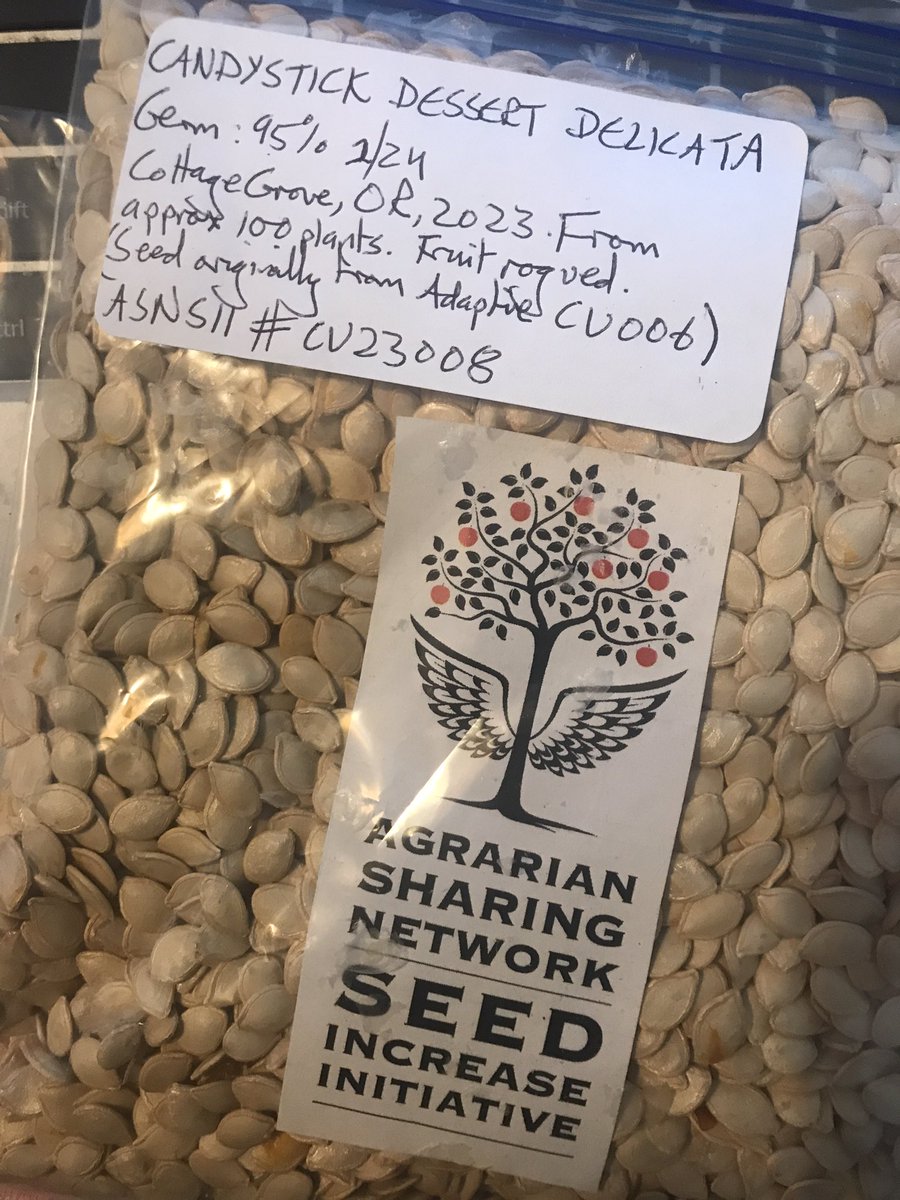
Image description
Extended description
Visual reading of the saved image — not recovered original X ALT. CANDYSTICK DESSERT DELICATA Germ: 95% 2/24 Cottage Grove, OR, 2023. From approx 100 plants. Fruit rogued. Seed originally from Adaptive (CV006) ASNSII # CV23008 Agrarian Sharing Network Seed Increase Initiative logo.
Open original document
Image description
Original X alt text
For example, this winter we supplied one of our volunteers with a large, urban garden with a highly-diverse leaf Brassica population consisting of our finest European and Russo-Siberian kales, asking them to select and save seed on the whole lot as 'one.' In other words the saved seed represents a multi-species (B. 'oleraceae' and 'B. napus') physical mix as distinct from an inter-specific ('crossed up') unified genepool. Did we break anything? Except for convention, nope. We've already got 'B. napus' x 'B. rapa' synthesized at a genetic level in one population we carry - 'Gulag Stars' (one of Tim Peters' remarkable plant-breeding achievements) and, in a similar vein, Frank Morton's 1984 gene-pool release of his Russo-Siberian cross (a population still segregating to this day) totally redefined our understanding of what a 'variety' actually is. The diversity and ecological resilience represented in these three very different but wholly unorthodox populations is quite extraordinary.
Image description
Original X alt text
What matters above all is that we raise and distribute seed folk _trust_. One of many ways we maintain trust in seed increases, in the face of practical ecological constraints that might otherwise keep small-scale folk and gardens from participation, or hurt confidence in the seed they produce, is by morphing attitudes about what a stewarded accession actually means. Freed from Market diktats, for example, a plant population can be a great deal more elastic and dynamic than a conventional variety fitted to industrial values and approval. We're only just beginning to explore a radical iteration in food plant stewardship, driven by a bio-cultural ecology that’s naturally 'looser' in character. All sorts of synergies are showing themselves. When a local collard successfully navigates a minus ten degree weather event, word gets out to the community and so does the seed. Sometimes, I feel as though ASN and the folks at goingtoseed.org are waving the mother of all starter's flags.
@ewahlwriting There are more, of course. Tangentially, you might consider goingtoseed.org/. Friends, allies and cohorts leading the way in terms of participatory, adaptive agriculture. Truth be told, it's where the kool kids hang. If you want support, lemme know. So much fun to be had!
View this post’s context →