
As the grassroots-based, applied-biodiversity movement gathers impetus Stateside, we're sharing intelligence. A common, pivotal refrain? Providing volunteer growers with transplants-ready-to-go, rather than seeds, supports a tipping point for effective engagement at scale.
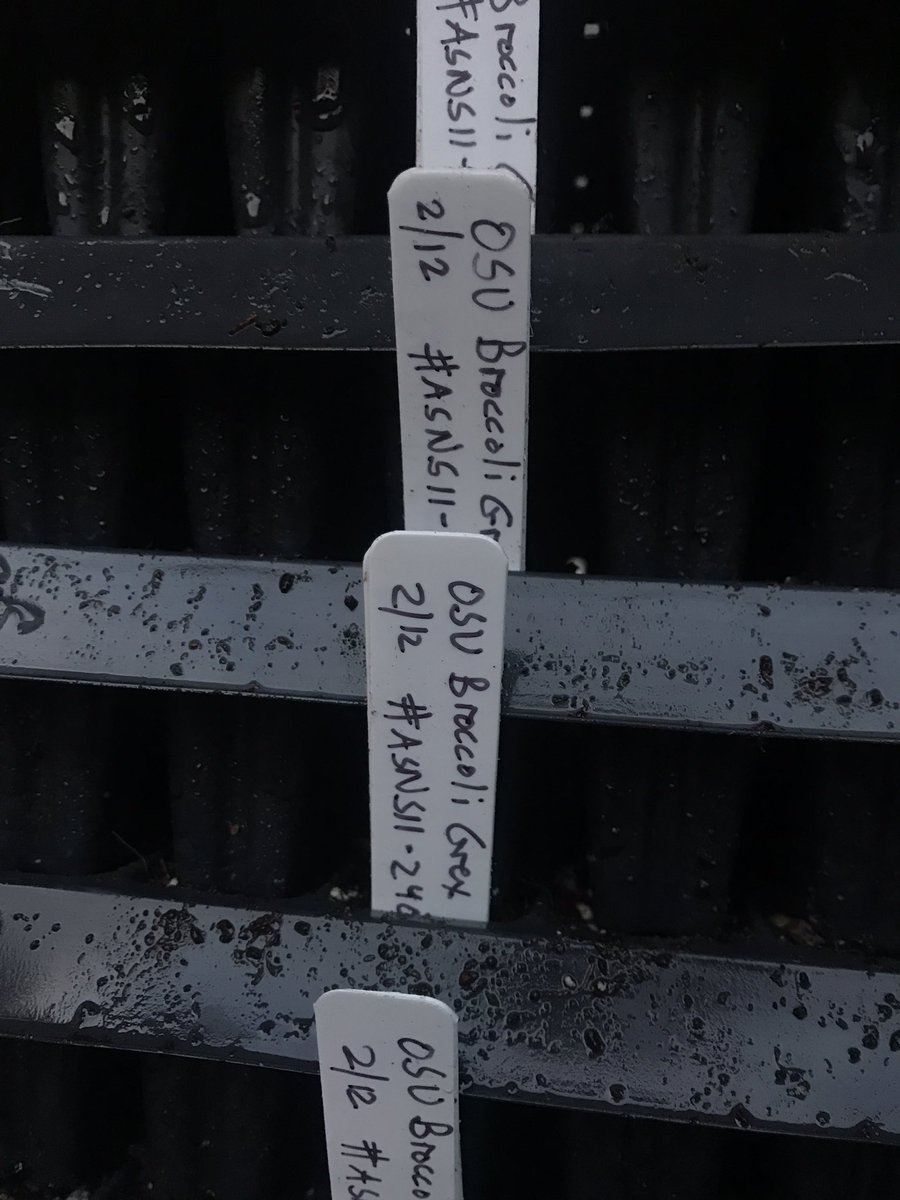
Image description
Original X alt text
Photograph of flats seeded today, with labels in them describing the OSU Broccoli Grex.
Image description
Original X alt text
escription We already have commitments from experienced seed growers to raise Broccoli at scale. The seed? The closest thing we have in the PNW to a functional Broccoli ‘grex’ or ‘landrace’. This legendary breeding population was first assembled by OSU’s Jim Myers in 1997 and has evolved extensively in the decades since - at the hands of OSU plant breeders and others. Indeed, ‘Solstice’, the highly regarded cultivar developed by Jonathan Spero, an Oregon-based pillar of the independent, organic plant breeding movement was born of this population. 'Umpqua', another OP Broccoli standard familiar to many of us in the PNW, and developed by Tim Peters - also an Oregon-based, independent plant breeder - emerged from the Broccoli breeding population created by Jim' Myers' predecessor, Jim Baggett. Clearly, we enjoy a local tradition of freelance, grassroots plant stewards standing upon the shoulders of world-class, public-domain, scientific plant-breeders. The shoulders of giants, no less.
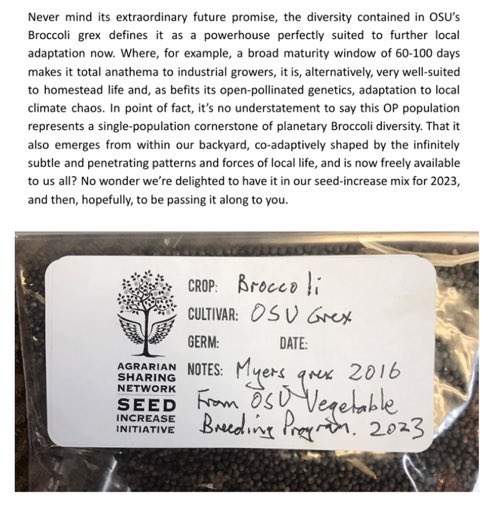
Image description
Original X alt text
Never mind its extraordinary future promise, the diversity contained in OSU’s Broccoli grex defines it as a powerhouse perfectly suited to further local adaptation now. Where, for example, a broad maturity window of 60-100 days makes it total anathema to industrial growers, it is, alternatively, very well-suited to homestead life and, as befits its open-pollinated genetics, adaptation to local climate chaos. In point of fact, it’s no understatement to say this OP population represents a single-population cornerstone of planetary Broccoli diversity. That it also emerges from within our backyard, co-adaptively shaped by the infinitely subtle and penetrating patterns and forces of local life, and is now freely available to us all? No wonder we’re delighted to have it in our seed-increase mix for 2023, and then, hopefully, to be passing it along to you. Photograph of Agrarian Sharing Network seed, labeled: Broccoli OSU Grex Myers grex 2016 From OSU Vegetable Breeding Program, 2023
A veteran of 25 years repeatedly endeavoring and failing to catalyze co-ordinated, community-based seed-increases, I'm treasuring a long-awaited turning of the tide. We've now placed eleven unique B. oleraceae accessions in isolated ground at population sizes ca. 125-250 plants.
View this post’s context →