
@BrianZahnd 'Might', of course, "expresses a subjunctive mood which just means that things are hypothetical." The redemption of the future from the power of history no longer waits on us. The Second Advent, the full arrival of God in history, must now be Reckoned with. #NoToEthnicCleansing
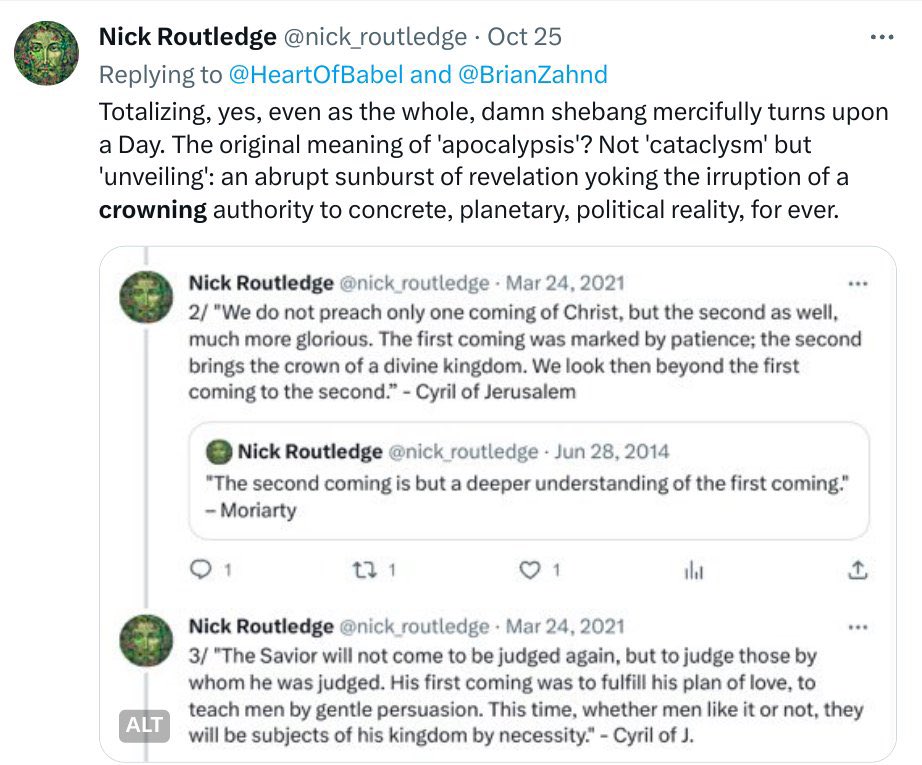
Image description
Original X alt text
Copy of tweet, image and quote tweet here:
Extended description
Pictured speaker / quoted attribution: Nick Routledge Saved source record associated with pictured writing; full saved record, not an exact pictured excerpt. Passage boundary: Totalizing yes Source: Preserve quoted-author distinctions; the containing tweet does not confer authorship. @HeartOfBabel @BrianZahnd Totalizing, yes, even as the whole, damn shebang mercifully turns upon a Day. The original meaning of 'apocalypsis'? Not 'cataclysm' but 'unveiling': an abrupt sunburst of revelation yoking the irruption of a crowning authority to concrete, planetary, political reality, for ever. t.co/nRcpwYLNso
Open original documentExtended description
Pictured speaker / quoted attribution: Nick Routledge quoting Cyril of Jerusalem and Moriarty in three bodies Saved source record associated with pictured writing; full saved record, not an exact pictured excerpt. Passage boundary: 2 We do not / second coming / 3 The Savior Source: archive.nickroutledge.org/post/1740094484321575030 Preserve quoted-author distinctions; the containing tweet does not confer authorship. 4/ The apocalypse that began in Jesus breaks into planetary consciousness as unveiling—and it doesn’t stop there. It irrupts into the symbolic order, desire, and social reality, forcing the entire order of meaning to be reread from the standpoint of resurrection. Quote tweet: The Second Advent, then, as a _planetary_ pedagogical method equal to the gospel transmission of a radical transformation in the meaning of power in the unitive core of the human being, whereby all the heart’s quests are revalued and hierarchies of history reversed. A 2/ "We do not preach only one coming of Christ, but the second as well, much more glorious. The first coming was marked by patience; the second brings the crown of a divine kingdom. We look then beyond the first coming to the second.” - Cyril of Jerusalem Quote tweet: "The second coming is but a deeper understanding of the first coming." – Moriarty 3/ "The Savior will not come to be judged again, but to judge those by whom he was judged. His first coming was to fulfill his plan of love, to teach men by gentle persuasion. This time, whether men like it or not, they will be subjects of his kingdom by necessity." - Cyril of J.
Open original document@Dan_Bowdoin Ilia Delio invites us to consider Christmas as a call to the messianic ontology of full incarnation: "If God has already come to us, what are we waiting for? If God has already become incarnate in Jesus what are we waiting for? And I think that’s a really interesting question..."
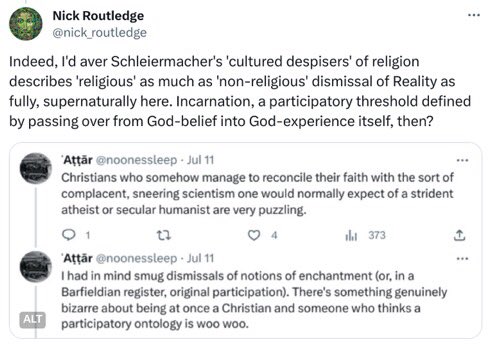
Image description
Original X alt text
Copy of tweet here: Indeed, I'd aver Schleiermacher's 'cultured despisers' of religion describes 'religious' as much as 'non-religious' dismissal of Reality as fully, supernaturally here. Incarnation, a participatory threshold defined by passing over from God-belief into God-experience itself, then? Aṭṭār Christians who somehow manage to reconcile their faith with the sort of complacent, sneering scientism one would normally expect of a strident atheist or secular humanist are very puzzling. I had in mind smug dismissals of notions of enchantment (or, in a Barfieldian register, original participation). There's something genuinely bizarre about being at once a Christian and someone who thinks a participatory ontology is woo woo.