
@CACRadicalGrace @RichardRohrOFM "God is finally and fully on the side of justice and truth. History does have a direction, meaning, and purpose. God is more fundamental than evil. Resurrection will have the final word, which is the very promise of the Jesus event. The eternal wind of the Spirit is with us."
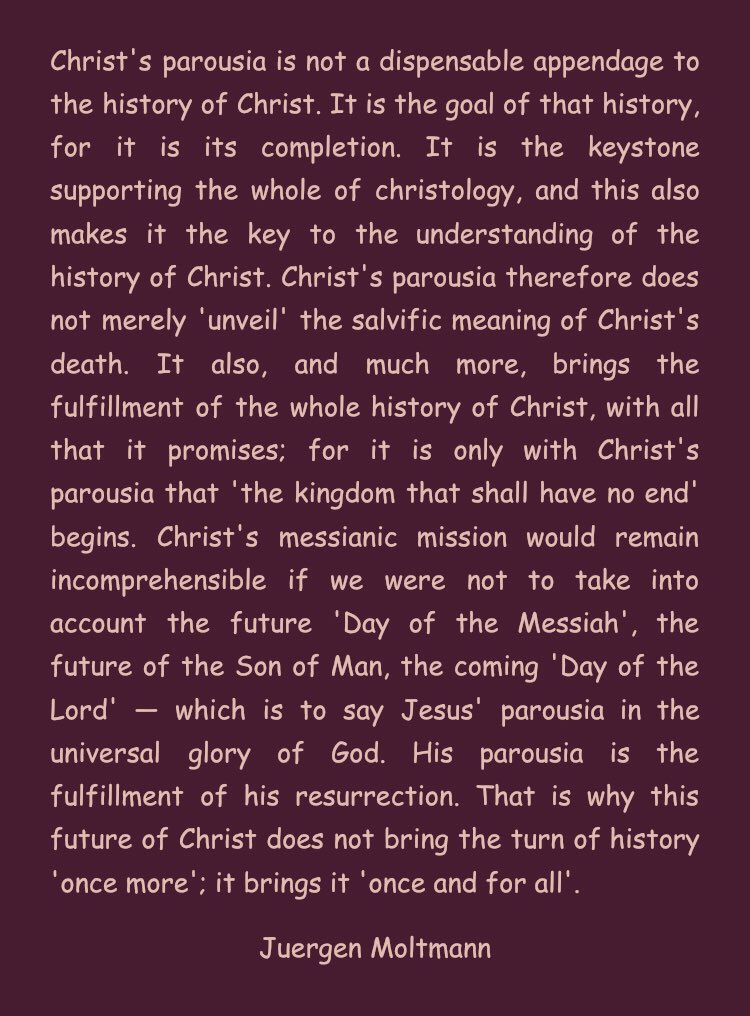
Image description
Original X alt text
Christ's parousia is not a dispensable appendage to the history of Christ. It is the goal of that history, for it is its completion. It is the keystone supporting the whole of christology, and this also makes it the key to the understanding of the history of Christ. Christ's parousia therefore does not merely 'unveil' the salvific meaning of Christ's death. It also, and much more, brings the fulfillment of the whole history of Christ, with all that it promises; for it is only with Christ's parousia that 'the kingdom that shall have no end' begins. Christ's messianic mission would remain incomprehensible if we were not to take into account the future 'Day of the Messiah', the future of the Son of Man, the coming 'Day of the Lord' — which is to say Jesus' parousia in the universal glory of God. His parousia is the fulfillment of his resurrection. That is why this future of Christ does not bring the turn of history 'once more'; it brings it 'once and for all'. Juergen Moltmann
@johnrobb 2/ Only when the fat lady sings, and not a moment before, will a bifurcation point, long anticipated as a seismic evolutionary threshold and surge, advance a sunburst of revelation transcending the mystery of history. "Teilhard’s noosphere is alive and well.” – Jean Houston
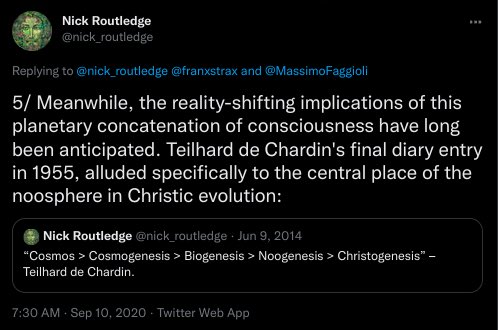
Image description
Original X alt text
Quote tweet: Nick Routledge · and 5/ Meanwhile, the reality-shifting implications of this planetary concatenation of consciousness have long been anticipated. Teilhard de Chardin's final diary entry in 1955, alluded specifically to the central place of the noosphere in Christic evolution: Quote Tweet Nick Routledge · “Cosmos > Cosmogenesis > Biogenesis > Noogenesis > Christogenesis” – Teilhard de Chardin.