
@Andrew__Roth end/ Which brings us to the dirt under the fingernails of these, my transmitting fingers, uniting us all, root and branch, flesh and blood, off-screen and on-screen, in the dynamic interplay of a single helix of Presence. It is time, friends. "Eternity utters a day." - Heschel
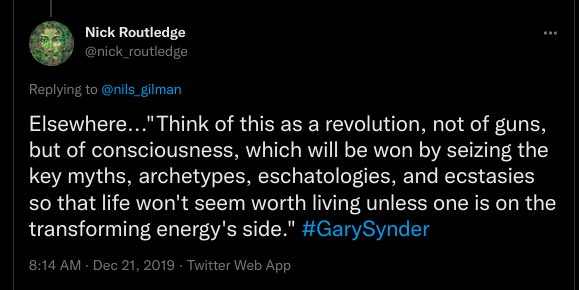
Image description
Original X alt text
Copy of tweet: Elsewhere..."Think of this as a revolution, not of guns, but of consciousness, which will be won by seizing the key myths, archetypes, eschatologies, and ecstasies so that life won't seem worth living unless one is on the transforming energy's side." #GarySynder
@jesuits_ireland @Pontifex 4/ Our present modernity can be characterized by its endless deferral of judgment, “a secularized parody of the Church’s incessant deferral of the last judgment” (Agamben), an institution that can only preserve its own existence by endlessly postponing the judgment it announces.
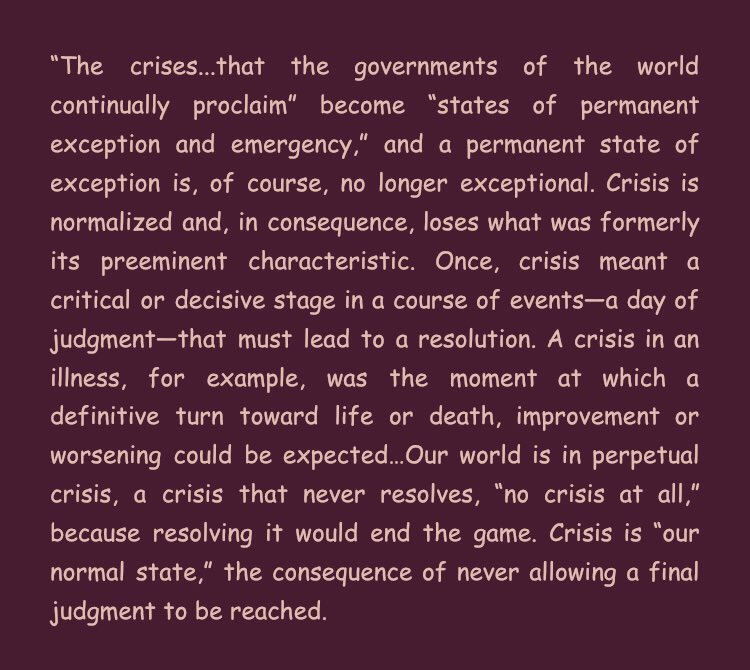
Image description
Original X alt text
“The crises...that the governments of the world continually proclaim” become “states of permanent exception and emergency,” and a permanent state of exception is, of course, no longer exceptional. Crisis is normalized and, in consequence, loses what was formerly its preeminent characteristic. Once, crisis meant a critical or decisive stage in a course of events—a day of judgment—that must lead to a resolution. A crisis in an illness, for example, was the moment at which a definitive turn toward life or death, improvement or worsening could be expected…Our world is in perpetual crisis, a crisis that never resolves, “no crisis at all,” because resolving it would end the game. Crisis is “our normal state,” the consequence of never allowing a final judgment to be reached.
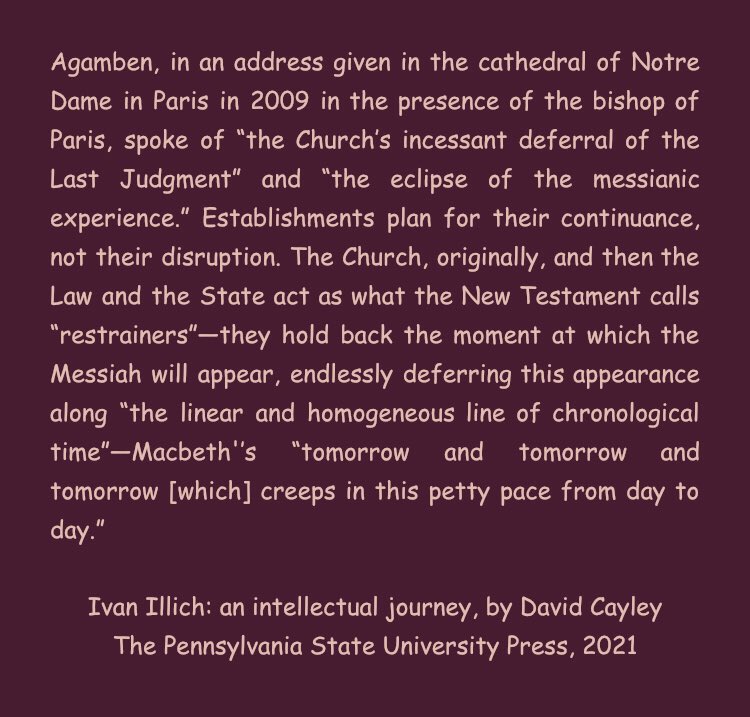
Image description
Original X alt text
Agamben, in an address given in the cathedral of Notre Dame in Paris in 2009 in the presence of the bishop of Paris, spoke of “the Church’s incessant deferral of the Last Judgment” and “the eclipse of the messianic experience.” Establishments plan for their continuance, not their disruption. The Church, originally, and then the Law and the State act as what the New Testament calls “restrainers”—they hold back the moment at which the Messiah will appear, endlessly deferring this appearance along “the linear and homogeneous line of chronological time”—Macbeth'’s “tomorrow and tomorrow and tomorrow [which] creeps in this petty pace from day to day.” Ivan Illich: an intellectual journey, by David Cayley The Pennsylvania State University Press, 2021

Image description
Original X alt text
Portrait of Giorgio Agamben
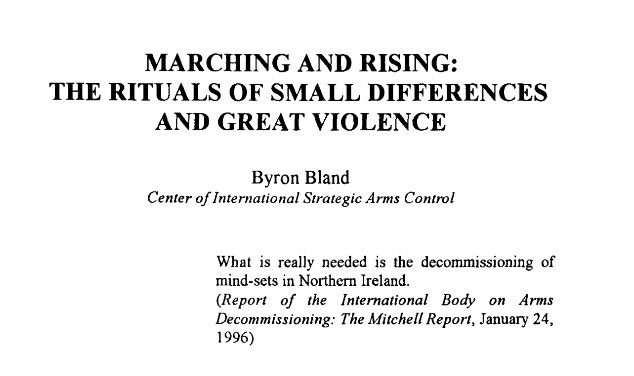
Image description
Original X alt text
Frontspiece to a paper by Byron Bland of the Center of Strategic Arms Control titled, 'Marching and Rising: The Rituals of Small Differences and Great Violence.' With the quotation subhead: "What is really needed is the decommissioning of mind-sets in Northern Ireland." (Report of the International Body in Arms Decommissioning: The Mitchell Report, January 24, 1996)