
@commentmag 2/ Without an answer to what virtue is for, the best-resourced environment can out-cultivate us. No wonder the Feed is 'winning.' The older Christian claim is that virtues are a sharing in what is eternal. Practice prepares us to receive the virtues, but it cannot generate them.
@herbert_pfostl @holdengraber Let go the anxious grasp, lose the owner’s grip, and gain the giver’s hands—our life returned as common bread. Not moral technique but dying into a shared life where virtues become the stable form of love learning to breathe eternity in ordinary time. Immortality in wholeness.
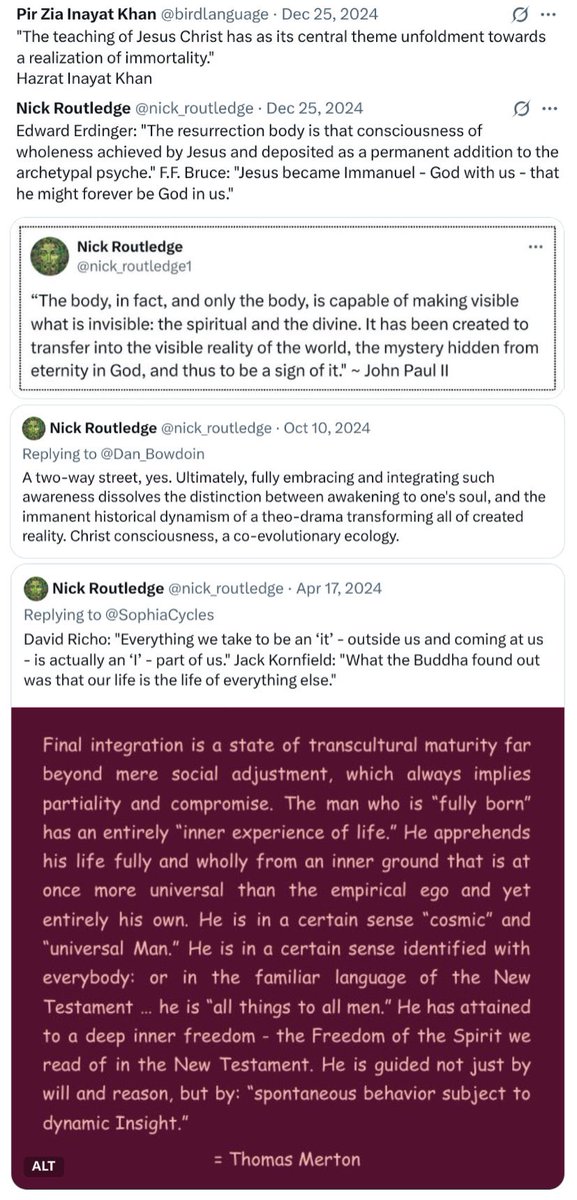
Image description
Extended description
Thread and quote tweets here: "The teaching of Jesus Christ has as its central theme unfoldment towards a realization of immortality." Hazrat Inayat Khan Edward Erdinger: "The resurrection body is that consciousness of wholeness achieved by Jesus and deposited as a permanent addition to the archetypal psyche." F.F. Bruce: "Jesus became Immanuel - God with us - that he might forever be God in us." John Paul II: “The body, in fact, and only the body, is capable of making visible what is invisible: the spiritual and the divine. It has been created to transfer into the visible reality of the world, the mystery hidden from eternity in God, and thus to be a sign of it." Quote tweets: A two-way street, yes. Ultimately, fully embracing and integrating such awareness dissolves the distinction between awakening to one's soul, and the immanent historical dynamism of a theo-drama transforming all of created reality. Christ consciousness, a co-evolutionary ecology. David Richo: "Everything we take to be an ‘it’ - outside us and coming at us - is actually an ‘I’ - part of us." Jack Kornfield: "What the Buddha found out was that our life is the life of everything else." Final integration is a state of transcultural maturity far beyond mere social adjustment, which always implies partiality and compromise. The man who is “fully born” has an entirely “inner experience of life.” He apprehends his life fully and wholly from an inner ground that is at once more universal than the empirical ego and yet entirely his own. He is in a certain sense “cosmic” and “universal Man.” He is in a certain sense identified with everybody: or in the familiar language of the New Testament … he is “all things to all men.” He has attained to a deep inner freedom - the Freedom of the Spirit we read of in the New Testament. He is guided not just by will and reason, but by: “spontaneous behavior subject to dynamic Insight.” - Thomas Merton
Open original document