
@Plough 3/ “Blessed are the poor” is thus more than consolation or moral praise. It announces a reversal of what the world takes to be secure and real. Where wealth, control and self-sufficiency lose their authority, another order of life comes into view: the Kingdom already breaking in.
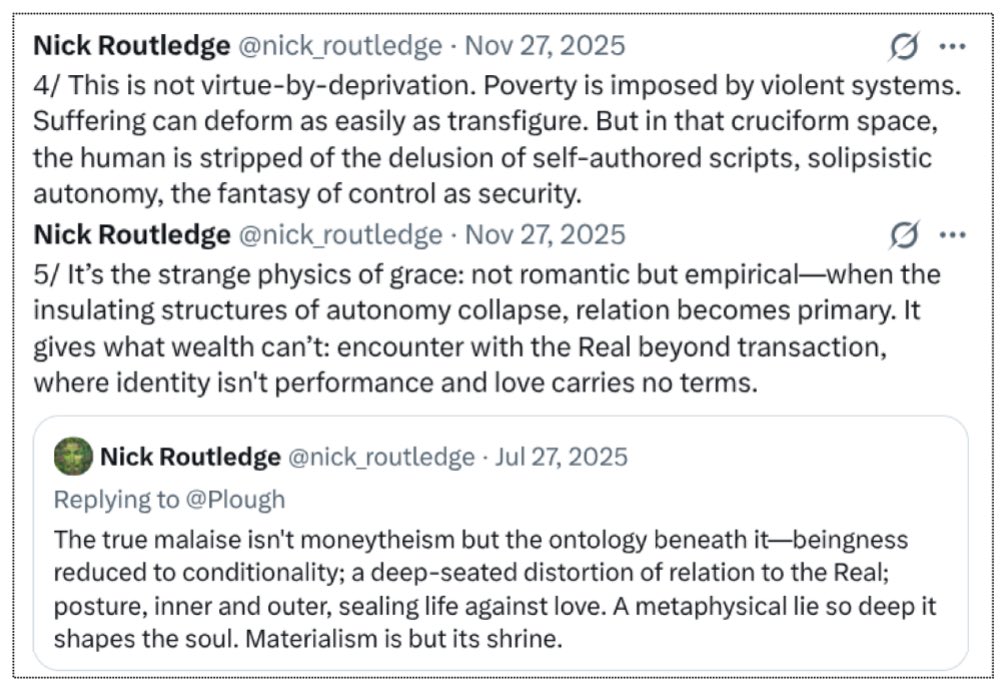
Image description
Original X alt text
4/ This is not virtue-by-deprivation. Poverty is imposed by violent systems. Suffering can deform as easily as transfigure. But in that cruciform space, the human is stripped of the delusion of self-authored scripts, solipsistic autonomy, the fantasy of control as security. 5/ It’s the strange physics of grace: not romantic but empirical—when the insulating structures of autonomy collapse, relation becomes primary. It gives what wealth can’t: encounter with the Real beyond transaction, where identity isn't performance and love carries no terms. The true malaise isn't moneytheism but the ontology beneath it—beingness reduced to conditionality; a deep-seated distortion of relation to the Real; posture, inner and outer, sealing life against love. A metaphysical lie so deep it shapes the soul. Materialism is but its shrine.
@tenshi_anna @thomasowaller @TRIERTIUM end\ “Blessed are the poor” isn’t a moral compliment; it’s an ontological claim about how reality is wired, signaling the fissure where the Kingdom's already-arriving reality breaks into the present age as messianic revelation and liberation. The Kingdom disrupts from below.
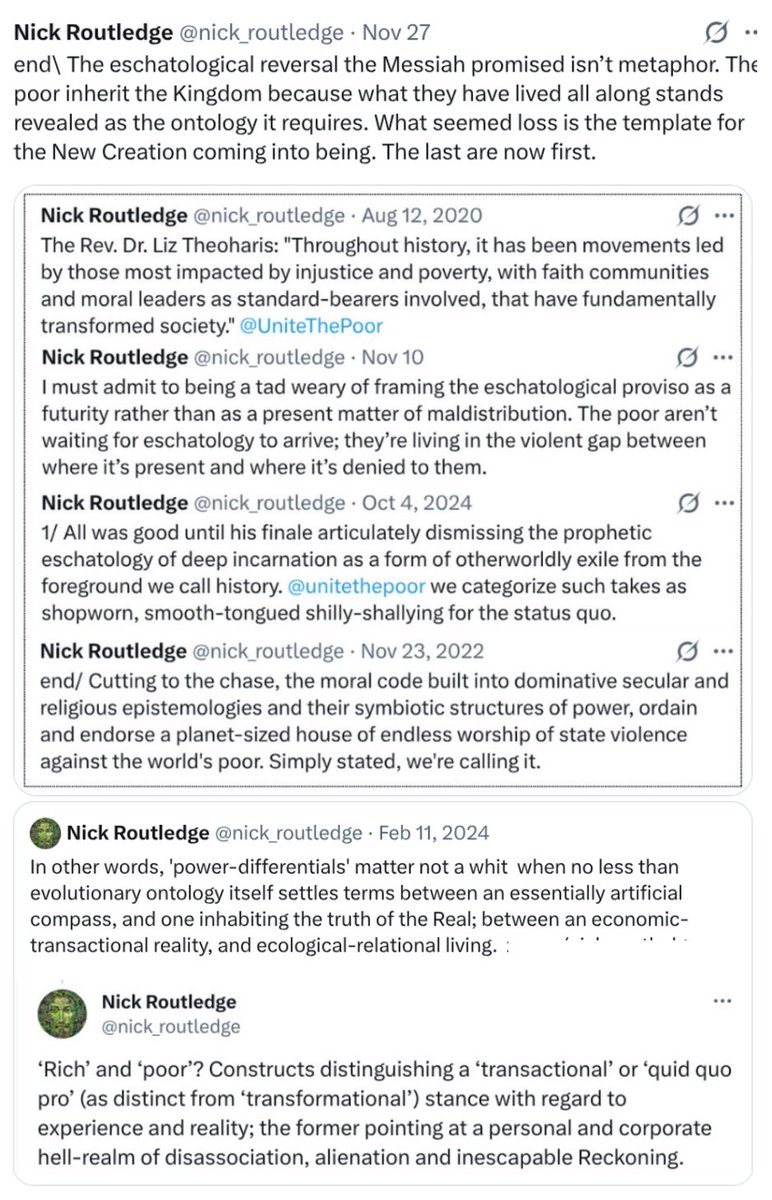
Image description
Extended description
end\ The eschatological reversal the Messiah promised isn’t metaphor. The poor inherit the Kingdom because what they have lived all along stands revealed as the ontology it requires. What seemed loss is the template for the New Creation coming into being. The last are now first. @nick_routledge Aug 12, 2020 The Rev. Dr. Liz Theoharis: "Throughout history, it has been movements led by those most impacted by injustice and poverty, with faith communities and moral leaders as standard-bearers involved, that have fundamentally transformed society." @UniteThePoor I must admit to being a tad weary of framing the eschatological proviso as a futurity rather than as a present matter of maldistribution. The poor aren’t waiting for eschatology to arrive; they’re living in the violent gap between where it’s present and where it’s denied to them. 1/ All was good until his finale articulately dismissing the prophetic eschatology of deep incarnation as a form of otherworldly exile from the foreground we call history. @unitethepoor we categorize such takes as shopworn, smooth-tongued shilly-shallying for the status quo. end/ Cutting to the chase, the moral code built into dominative secular and religious epistemologies and their symbiotic structures of power, ordain and endorse a planet-sized house of endless worship of state violence against the world's poor. Simply stated, we're calling it. Subtweet: In other words, 'power-differentials' matter not a whit when no less than evolutionary ontology itself settles terms between an essentially artificial compass, and one inhabiting the truth of the Real; between an economic-transactional reality, and ecological-relational living. ‘Rich’ and ‘poor’? Constructs distinguishing a ‘transactional’ or ‘quid quo pro’ (as distinct from ‘transformational’) stance with regard to experience and reality; the former pointing at a personal and corporate hell-realm of disassociation, alienation and inescapable Reckoning.
Open original document