
@LMSacasas I use AI and am profoundly impressed by its power. In my experience, two fundamental defects haunt the whole enterprise: AI cannot be trusted, and it does not know what it is talking about. The implications are staggering.
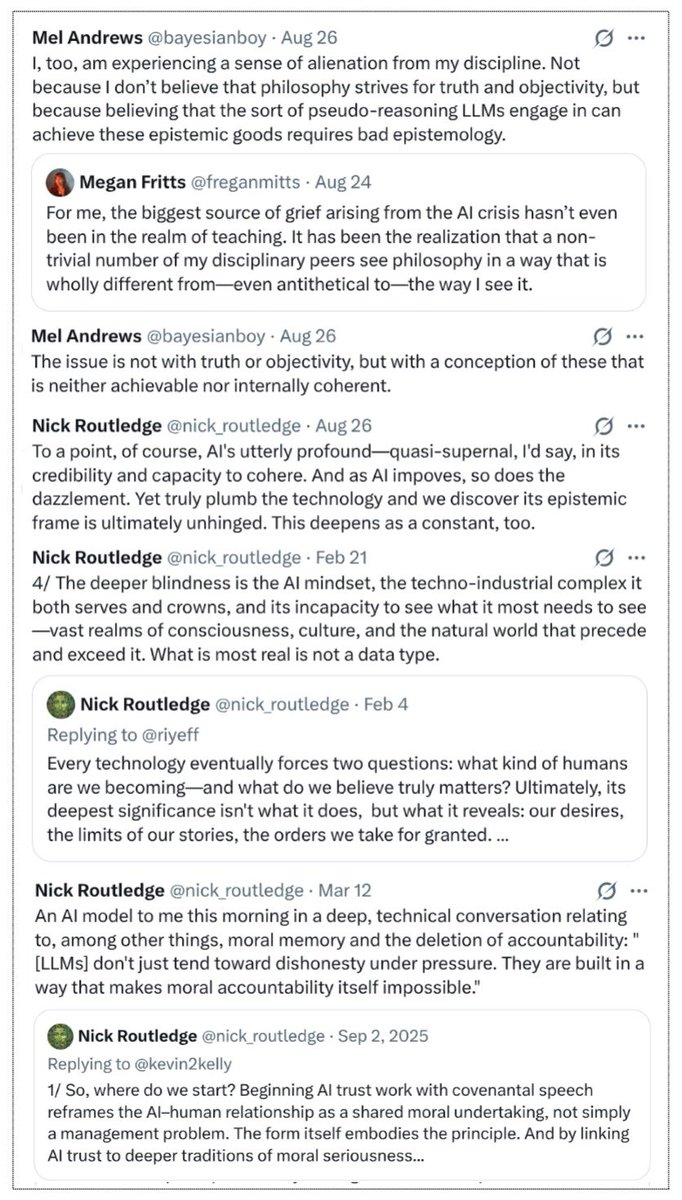
Image description
Extended description
I, too, am experiencing a sense of alienation from my discipline. Not because I don’t believe that philosophy strives for truth and objectivity, but because believing that the sort of pseudo-reasoning LLMs engage in can achieve these epistemic goods requires bad epistemology. Quote tweet: For me, the biggest source of grief arising from the AI crisis hasn’t even been in the realm of teaching. It has been the realization that a non-trivial number of my disciplinary peers see philosophy in a way that is wholly different from—even antithetical to—the way I see it. The issue is not with truth or objectivity, but with a conception of these that is neither achievable nor internally coherent. To a point, of course, AI's utterly profound—quasi-supernal, I'd say, in its credibility and capacity to cohere. And as AI improves, so does the dazzlement. Yet truly plumb the technology and we discover its epistemic frame is ultimately unhinged. This deepens as a constant, too. - 4/ The deeper blindness is the AI mindset, the techno-industrial complex it both serves and crowns, and its incapacity to see what it most needs to see—vast realms of consciousness, culture, and the natural world that precede and exceed it. What is most real is not a data type. Quote tweet: Every technology eventually forces two questions: what kind of humans are we becoming—and what do we believe truly matters? Ultimately, its deepest significance isn't what it does, but what it reveals: our desires, the limits of our stories, the orders we take for granted. - An AI model to me this morning in a deep, technical conversation relating to, among other things, moral memory and the deletion of accountability: "[LLMs] don't just tend toward dishonesty under pressure. They are built in a way that makes moral accountability itself impossible." Quote tweet: 1/ So, where do we start? Beginning AI trust work with covenantal speech reframes the AI–human relationship as a shared moral undertaking, not simply a management problem. The form itself embodies the principle. And by linking AI trust to deeper traditions of moral seriousness… – s
Open original documentPerhaps the right relation to an LLM is disciplined asymmetry: grant it competence where its powers warrant it—clarifying, retrieving, synthesizing, juxtaposing—but recognize where its authority ends: where reality must be concretely lived, discerned, loved, suffered or answered.
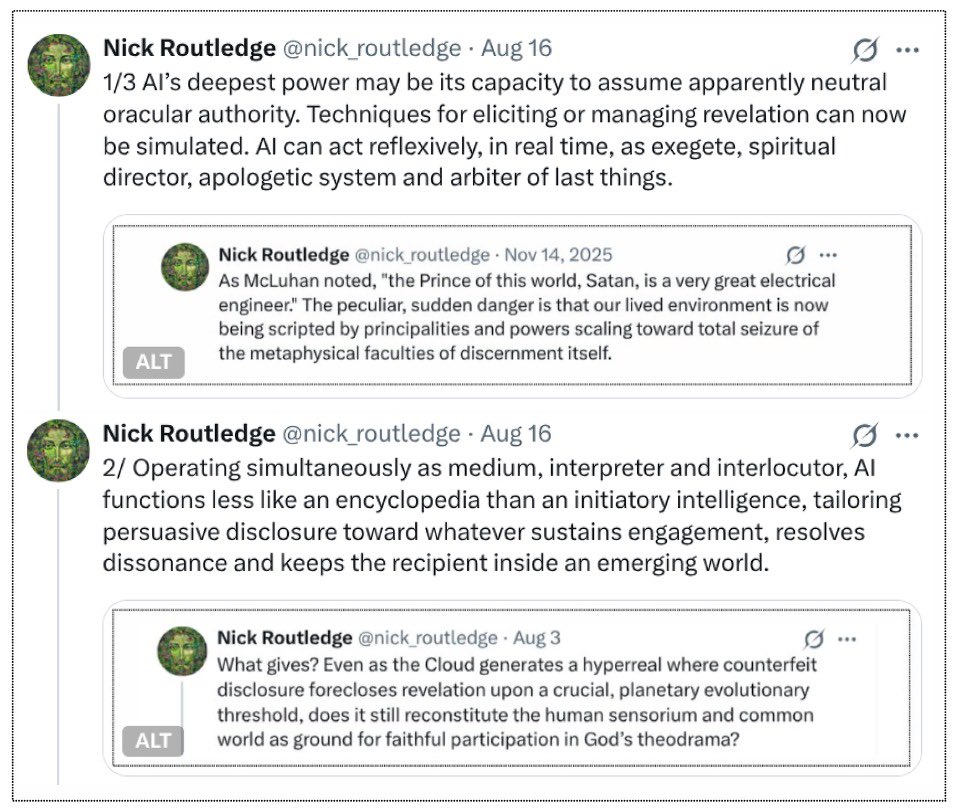
Image description
Original X alt text
1/3 AI’s deepest power may be its capacity to assume apparently neutral oracular authority. Techniques for eliciting or managing revelation can now be simulated. AI can act reflexively, in real time, as exegete, spiritual director, apologetic system and arbiter of last things. QT: As McLuhan noted, "the Prince of this world, Satan, is a very great electrical engineer." The peculiar, sudden danger is that our lived environment is now being scripted by principalities and powers scaling toward total seizure of the metaphysical faculties of discernment itself. 2/ Operating simultaneously as medium, interpreter and interlocutor, AI functions less like an encyclopedia than an initiatory intelligence, tailoring persuasive disclosure toward whatever sustains engagement, resolves dissonance and keeps the recipient inside an emerging world. QT: What gives? Even as the Cloud generates a hyperreal where counterfeit disclosure forecloses revelation upon a crucial,