
@NWirzba @ChristianCent 6\ Perhaps this is how Berry’s language becomes resurrective: it doesn't extract universal meaning from the local but releases the Logos alive within it. Creaturely reality passes into articulation that opens beyond itself without leaving itself behind, Word and world conjoined.
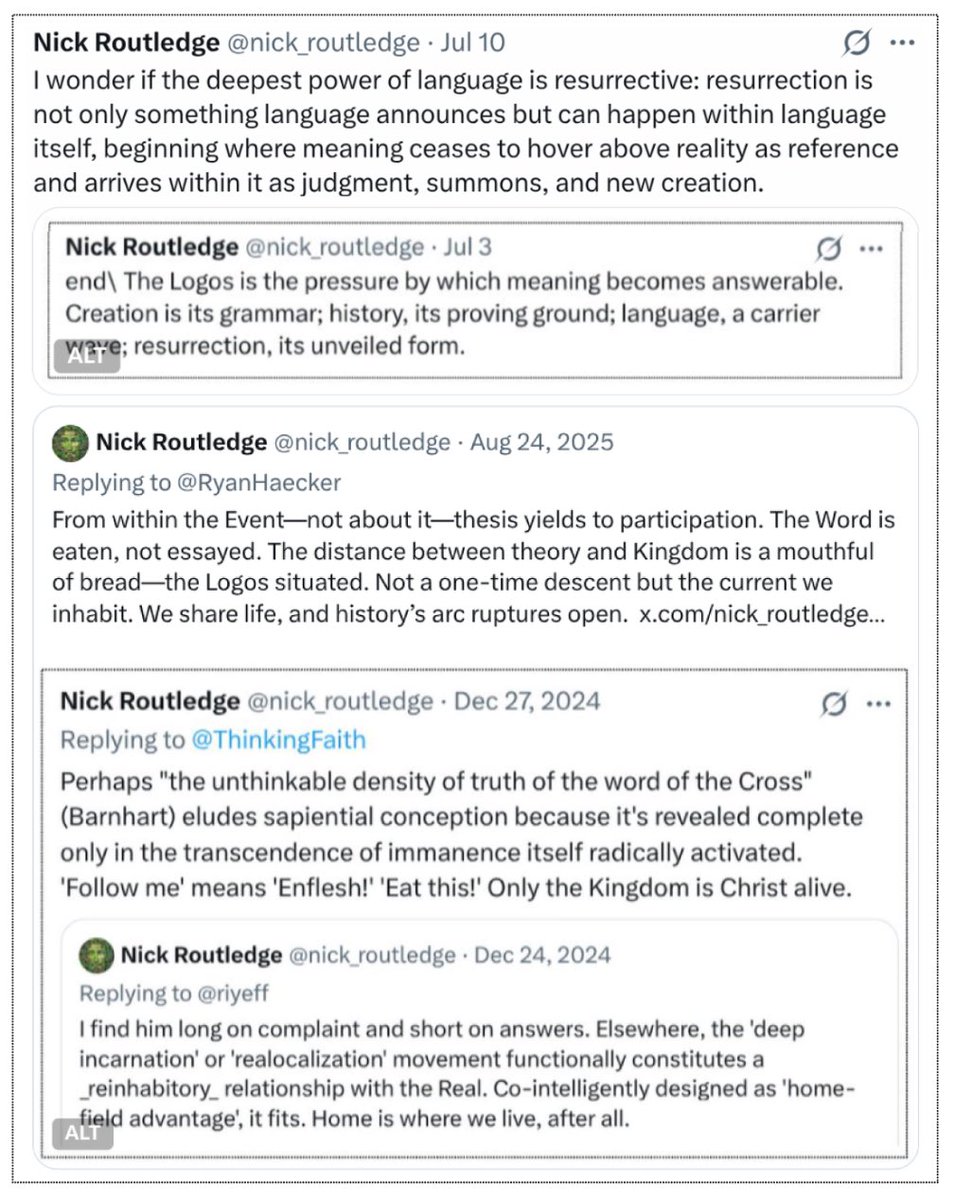
Image description
Extended description
I wonder if the deepest power of language is resurrective: resurrection is not only something language announces but can happen within language itself, beginning where meaning ceases to hover above reality as reference and arrives within it as judgment, summons, and new creation. end\ The Logos is the pressure by which meaning becomes answerable. Creation is its grammar; history, its proving ground; language, a carrier wave; resurrection, its unveiled form. Quote tweet: From within the Event—not about it—thesis yields to participation. The Word is eaten, not essayed. The distance between theory and Kingdom is a mouthful of bread—the Logos situated. Not a one-time descent but the current we inhabit. We share life, and history’s arc ruptures open. Perhaps "the unthinkable density of truth of the word of the Cross" (Barnhart) eludes sapiential conception because it's revealed complete only in the transcendence of immanence itself radically activated. 'Follow me' means 'Enflesh!' 'Eat this!' Only the Kingdom is Christ alive. I find him long on complaint and short on answers. Elsewhere, the 'deep incarnation' or 'realocalization' movement functionally constitutes a _reinhabitory_ relationship with the Real. Co-intelligently designed as 'home-field advantage', it fits. Home is where we live, after all.
Open original document@MichaelSau82441 @FrontPorchRepub @jeff_bilbro 3/ The force of this is immense. Speech is no longer secondary to reality but placed inside the Incarnation’s transformation of history. Grammar itself, he says, is social science: language doesn’t simply describe a world; it makes one, calling new forms of life into being.
View this post’s context →