
3/ The Feast then is more than metaphor: abundance cultivated, gathered and shared gives that entanglement eschatological form—soil, seed, cultivator, stranger and God gathered at one table, where diversity itself becomes fructifying: nourishment, common life and plenitude.
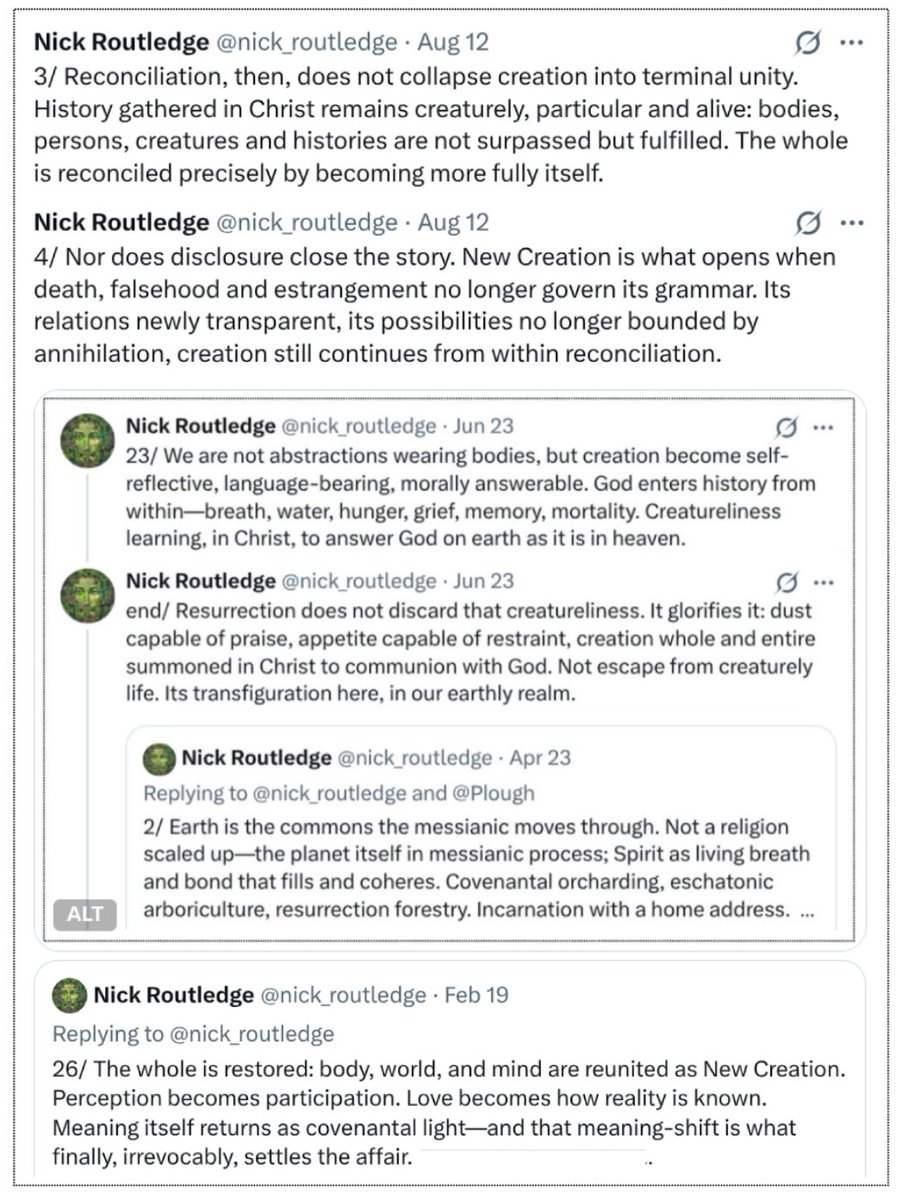
Image description
Extended description
3/ Reconciliation, then, does not collapse creation into terminal unity. History gathered in Christ remains creaturely, particular and alive: bodies, persons, creatures and histories are not surpassed but fulfilled. The whole is reconciled precisely by becoming more fully itself. 4/ Nor does disclosure close the story. New Creation is what opens when death, falsehood and estrangement no longer govern its grammar. Its relations newly transparent, its possibilities no longer bounded by annihilation, creation still continues from within reconciliation. 23/ We are not abstractions wearing bodies, but creation become self-reflective, language-bearing, morally answerable. God enters history from within—breath, water, hunger, grief, memory, mortality. Creatureliness learning, in Christ, to answer God on earth as it is in heaven. end/ Resurrection does not discard that creatureliness. It glorifies it: dust capable of praise, appetite capable of restraint, creation whole and entire summoned in Christ to communion with God. Not escape from creaturely life. Its transfiguration here, in our earthly realm. 2/ Earth is the commons the messianic moves through. Not a religion scaled up—the planet itself in messianic process; Spirit as living breath and bond that fills and coheres. Covenantal orcharding, eschatonic arboriculture, resurrection forestry. Incarnation with a home address. Quote tweet: 26/ The whole is restored: body, world, and mind are reunited as New Creation. Perception becomes participation. Love becomes how reality is known. Meaning itself returns as covenantal light—and that meaning-shift is what finally, irrevocably, settles the affair.
Open original document@ThinkingFaith Might entanglement supply the bridge here? The relationship between Creator and Creation takes incarnate form within our entanglement in creation: a vertical relation disclosed and lived through the horizontal bonds by which creatures become, sustain and answer for one another.
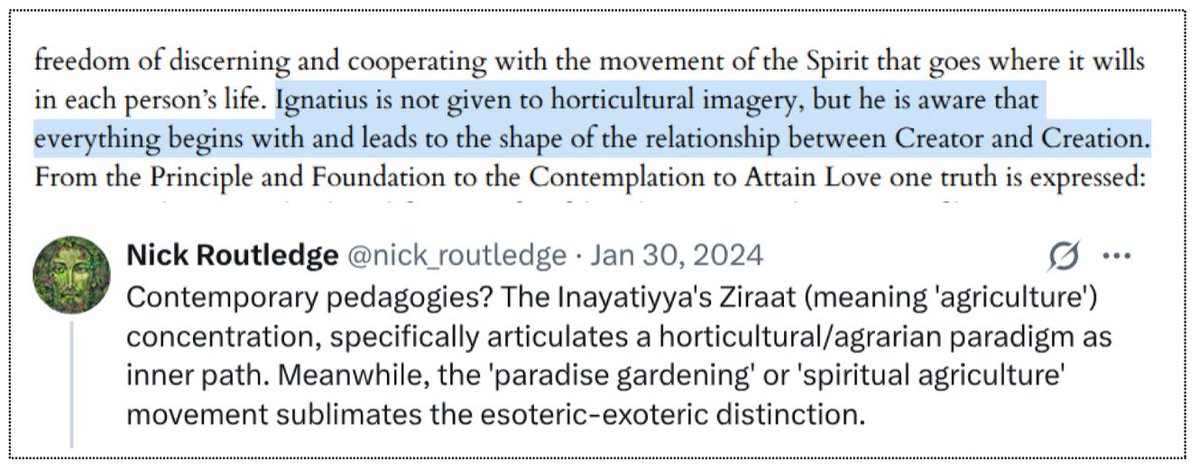
Image description
Original X alt text
Ignatius is not given to horticultural imagery, but he is aware that everything begins with and leads to the shape of the relationship between Creator and Creation. Contemporary pedagogies? The Inayatiyya's Ziraat (meaning 'agriculture') concentration, specifically articulates a horticultural/agrarian paradigm as inner path. Meanwhile, the 'paradise gardening' or 'spiritual agriculture' movement sublimates the esoteric-exoteric distinction.