
11/ Ordinary material practices are not temporary moral exercises, but meaningful forms of participation in a future already inaugurated by Christ. Husbandry, Sabbath, repair and sharing belong to God's Kingdom, the New Creation already breaking into and transforming the present.
@commentmag 2/ "Heaven and earth in biblical cosmology are not two different locations within the same continuum of space or matter...They are the twin interlocking spheres of God's single created reality...designed for a symbiotic relationship within an ongoing purpose." @profntwright
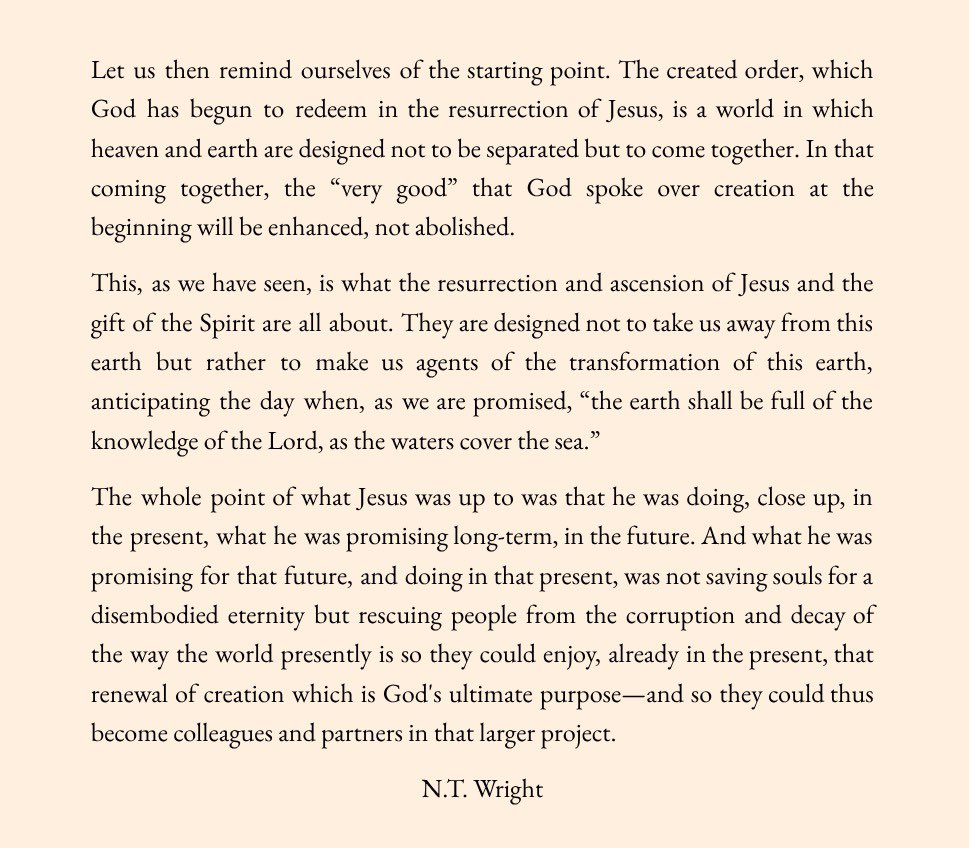
Image description
Extended description
Let us then remind ourselves of the starting point. The created order, which God has begun to redeem in the resurrection of Jesus, is a world in which heaven and earth are designed not to be separated but to come together. In that coming together, the “very good” that God spoke over creation at the beginning will be enhanced, not abolished. This, as we have seen, is what the resurrection and ascension of Jesus and the gift of the Spirit are all about. They are designed not to take us away from this earth but rather to make us agents of the transformation of this earth, anticipating the day when, as we are promised, “the earth shall be full of the knowledge of the Lord, as the waters cover the sea.” The whole point of what Jesus was up to was that he was doing, close up, in the present, what he was promising long-term, in the future. And what he was promising for that future, and doing in that present, was not saving souls for a disembodied eternity but rescuing people from the corruption and decay of the way the world presently is so they could enjoy, already in the present, that renewal of creation which is God's ultimate purpose—and so they could thus become colleagues and partners in that larger project. N.T. Wright
Open original document