
@becauselangpod @sophiasgaler @penguinrandom I'd say language can't be fully revived apart from restoring the world to which it answers. And that means reinhabiting the co-evolutionary circuit in which agrobiodiversity generatively conjoins place, language and peoples, each continually encountering and modifying the others.
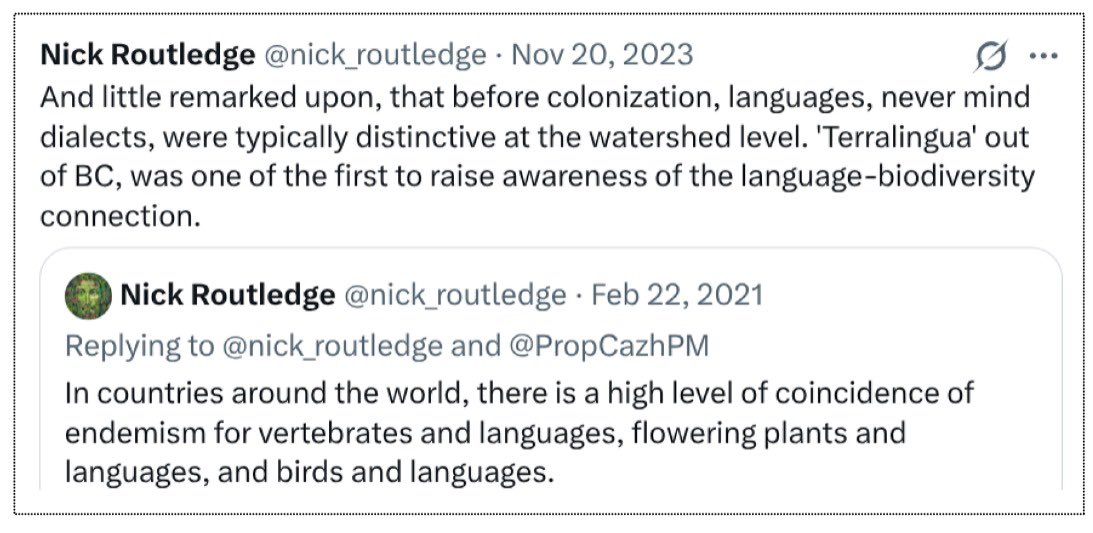
Image description
Original X alt text
And little remarked upon, that before colonization, languages, never mind dialects, were typically distinctive at the watershed level. 'Terralingua' out of BC, was one of the first to raise awareness of the language-biodiversity connection. Quote In countries around the world, there is a high level of coincidence of endemism for vertebrates and languages, flowering plants and languages, and birds and languages.
@AgroBioDiverse 1/2 Guarino’s provocation reinforces a core objective for agrobiodiversity work: shared diversity ramifying locally. Crops, ecologies, knowledge and communities shape one another anew; biological, ecological and cultural diversities resume their co-evolutionary entanglement.
View this post’s context →