
RT @nick_routledge: @FrontPorchRepub The orcharding piece? I wonder if "terminal elegy" has now become its own late-capitalist genre—the aesthetic consolation of another beautifully written death sentence, itself part of our accommodation to extinction. The messianic question is what might interrupt the sentence.
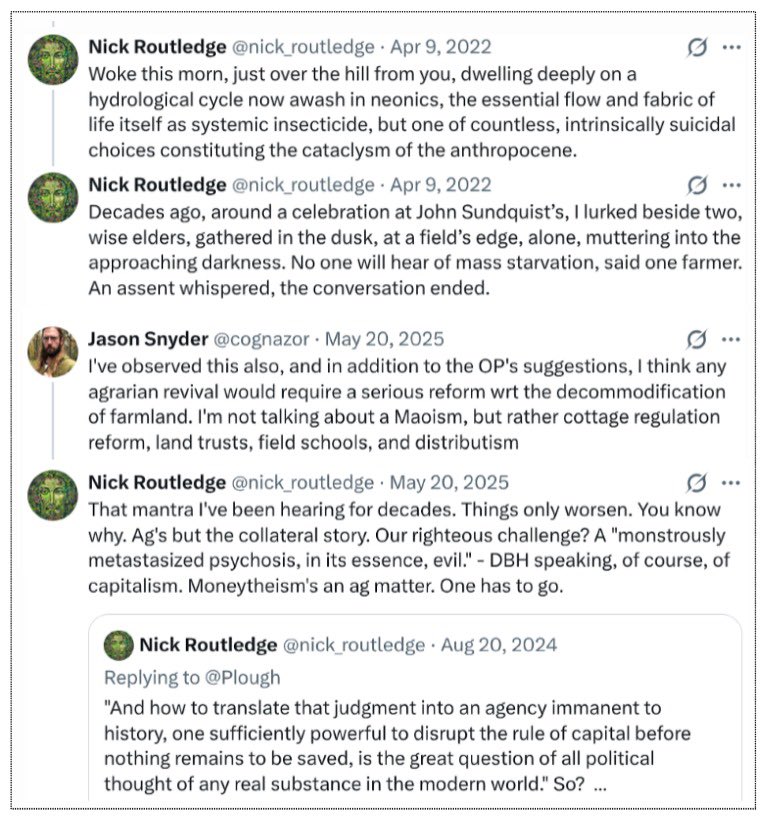
Image description
Extended description
Woke this morn, just over the hill from you, dwelling deeply on a hydrological cycle now awash in neonics, the essential flow and fabric of life itself as systemic insecticide, but one of countless, intrinsically suicidal choices constituting the cataclysm of the anthropocene. Decades ago, around a celebration at John Sundquist’s, I lurked beside two, wise elders, gathered in the dusk, at a field’s edge, alone, muttering into the approaching darkness. No one will hear of mass starvation, said one farmer. An assent whispered, the conversation ended. I've observed this also, and in addition to the OP's suggestions, I think any agrarian revival would require a serious reform wrt the decommodification of farmland. I'm not talking about a Maoism, but rather cottage regulation reform, land trusts, field schools, and distributism That mantra I've been hearing for decades. Things only worsen. You know why. Ag's but the collateral story. Our righteous challenge? A "monstrously metastasized psychosis, in its essence, evil." - DBH speaking, of course, of capitalism. Moneytheism's an ag matter. One has to go. Quote tweet: "And how to translate that judgment into an agency immanent to history, one sufficiently powerful to disrupt the rule of capital before nothing remains to be saved, is the great question of all political thought of any real substance in the modern world." So?
Open original documentNotes in @NWirzba’s 'This Sacred Life', distilling McCarraher’s account of capitalism as an ontological reconstitution of the world, whereby intrinsic meaning and value are displaced by a regime in which life becomes intelligible primarily through exchange, accumulation, and use.
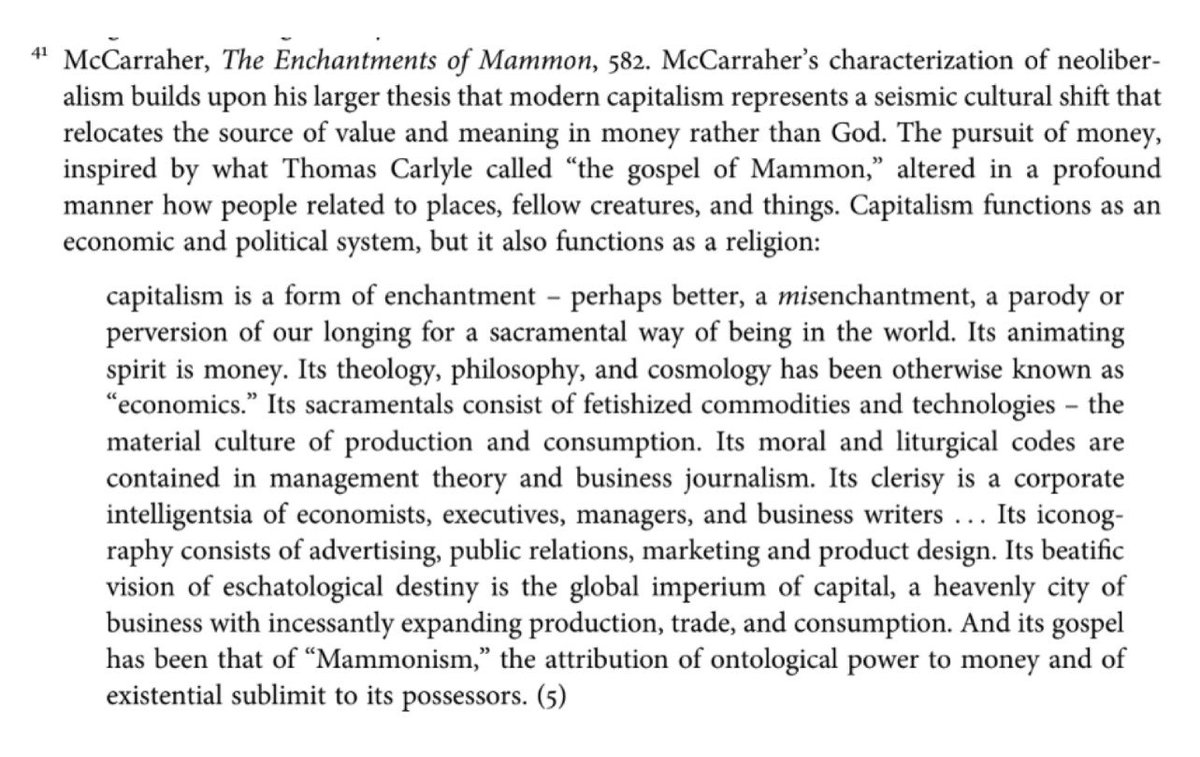
Image description
Extended description
41 McCarraher, The Enchantments of Mammon, 582. McCarraher’s characterization of neoliberalism builds upon his larger thesis that modern capitalism represents a seismic cultural shift that relocates the source of value and meaning in money rather than God. The pursuit of money, inspired by what Thomas Carlyle called “the gospel of Mammon,” altered in a profound manner how people related to places, fellow creatures, and things. Capitalism functions as economic and political system, but it also functions as a religion: capitalism is a form of enchantment – perhaps better, a misenchantment, a parody or perversion of our longing for a sacramental way of being in the world. Its animating spirit is money. Its theology, philosophy, and cosmology has been otherwise known as “economics.” Its sacramentals consist of fetishized commodities and technologies – the material culture of production and consumption. Its moral and liturgical codes are contained in management theory and business journalism. Its clerisy is a corporate intelligentsia of economists, executives, managers, and business writers ... Its iconography consists of advertising, public relations, marketing and product design. Its beatific vision of eschatological destiny is the global imperium of capital, a heavenly city of business with incessantly expanding production, trade, and consumption. And its gospel has been that of “Mammonism,” the attribution of ontological power to money and of existential sublimit to its possessors. (5)
Open original document