
@FrontPorchRepub Tessa’s piece opens a further eschatological question. What occurs when language rooted in bodies, places, cultures and living relations becomes more than resistance to dehumanization and speaks as Spirit-borne address from within resurrection already inaugurating in history?
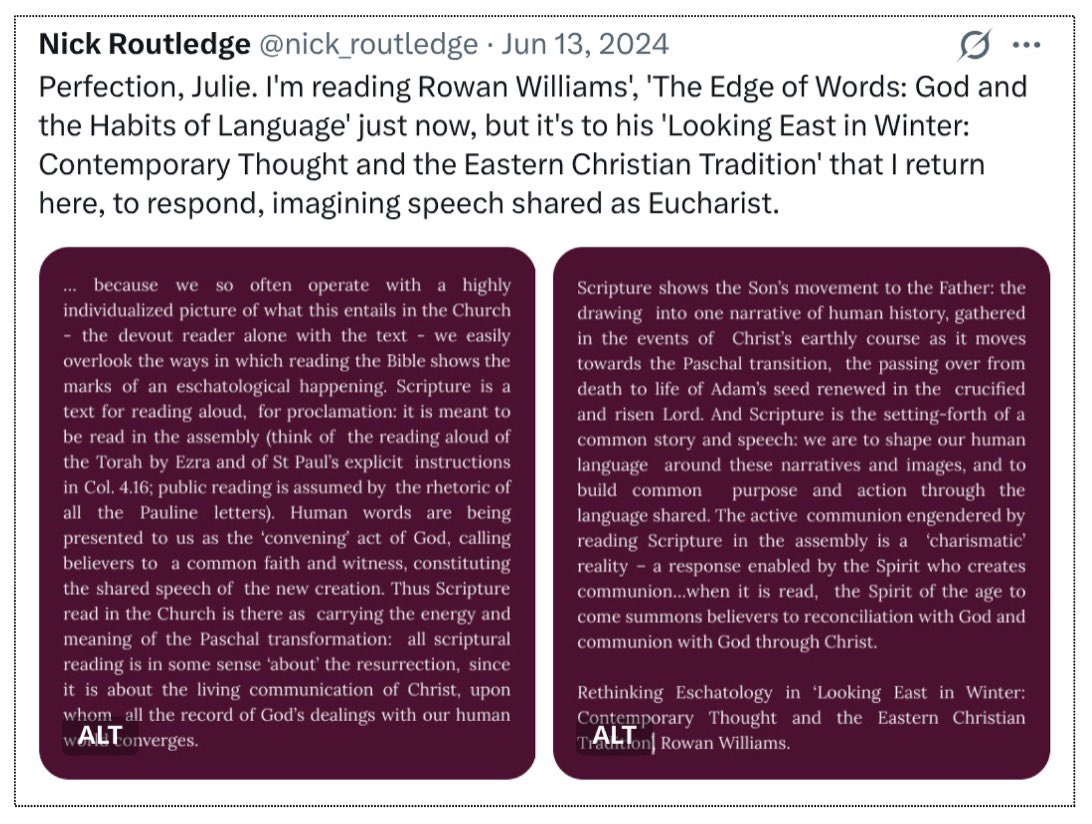
Image description
Extended description
Perfection, Julie. I'm reading Rowan Williams', 'The Edge of Words: God and the Habits of Language' just now, but it's to his 'Looking East in Winter: Contemporary Thought and the Eastern Christian Tradition' that I return here, to respond, imagining speech shared as Eucharist. … because we so often operate with a highly individualized picture of what this entails in the Church - the devout reader alone with the text - we easily overlook the ways in which reading the Bible shows the marks of an eschatological happening. Scripture is a text for reading aloud, for proclamation: it is meant to be read in the assembly (think of the reading aloud of the Torah by Ezra and of St Paul’s explicit instructions in Col. 4.16; public reading is assumed by the rhetoric of all the Pauline letters). Human words are being presented to us as the ‘convening’ act of God, calling believers to a common faith and witness, constituting the shared speech of the new creation. Thus Scripture read in the Church is there as carrying the energy and meaning of the Paschal transformation: all scriptural reading is in some sense ‘about’ the resurrection, since it is about the living communication of Christ, upon whom all the record of God’s dealings with our human world converges. Scripture shows the Son’s movement to the Father: the drawing into one narrative of human history, gathered in the events of Christ’s earthly course as it moves towards the Paschal transition, the passing over from death to life of Adam’s seed renewed in the crucified and risen Lord. And Scripture is the setting-forth of a common story and speech: we are to shape our human language around these narratives and images, and to build common purpose and action through the language shared. The active communion engendered by reading Scripture in the assembly is a ‘charismatic’ reality – a response enabled by the Spirit who creates communion…when it is read, the Spirit of the age to come summons believers to reconciliation with God and communion with God through Christ. Rethinking Eschatology in ‘Looking East in Winter: Contemporary Thought and the Eastern Christian Tradition’, Rowan Williams.
Open original document@MichaelSau82441 @FrontPorchRepub @jeff_bilbro 5/ Messianic speech, as such, is resurrection entering history as summons. The Word becomes flesh; flesh becomes a new form of life; that life finds language. Arising from the foothold the future has gained in history, its address draws more of history into Incarnation.
View this post’s context →