
@Plough Another take: Schweitzer locates Christianity’s living power beyond the historically reconstructed Jesus; Girard finds its universal significance within the event itself. Perhaps they meet where the event exceeds its moment, its anthropological unveiling still at work in history.
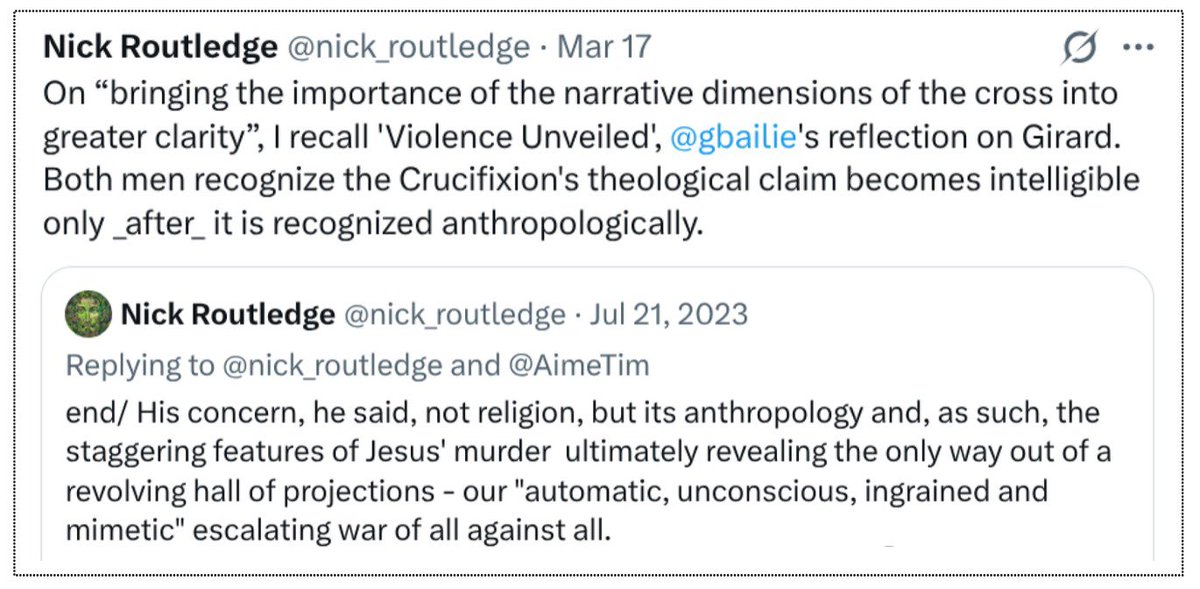
Image description
Original X alt text
On “bringing the importance of the narrative dimensions of the cross into greater clarity”, I recall 'Violence Unveiled', 's reflection on Girard. Both men recognize the Crucifixion's theological claim becomes intelligible only _after_ it is recognized anthropologically. Subtweet: end/ His concern, he said, not religion, but its anthropology and, as such, the staggering features of Jesus' murder ultimately revealing the only way out of a revolving hall of projections - our "automatic, unconscious, ingrained and mimetic" escalating war of all against all.
@sentantiq 2/ In other words, we view the Jesus Event as simultaneously explosive and absorptive. It doesn't arrive as mere information to be catalogued but as an excessive Presence that requires historical duration to become intelligible.
View this post’s context →