
@firstthingsmag Hyperpolitics is the katechon of a catastrophic status quo: restraining not breakdown but genuine interruption, converting the pressure for transformation into a sacrificial succession of mimetic pseudo-events whose perpetual novelty ensures that nothing fundamentally changes.
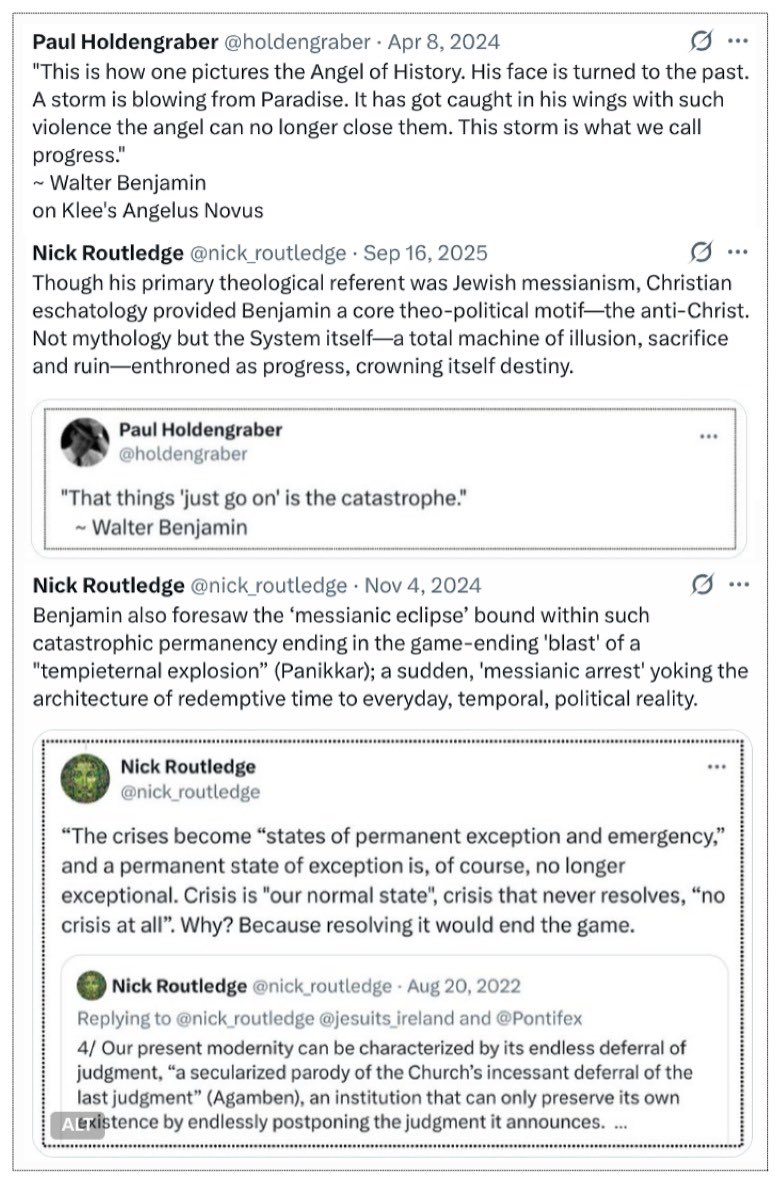
Image description
Extended description
"This is how one pictures the Angel of History. His face is turned to the past. A storm is blowing from Paradise. It has got caught in his wings with such violence the angel can no longer close them. This storm is what we call progress." ~ Walter Benjamin on Klee's Angelus Novus Though his primary theological referent was Jewish messianism, Christian eschatology provided Benjamin a core theo-political motif—the anti-Christ. Not mythology but the System itself—a total machine of illusion, sacrifice and ruin—enthroned as progress, crowning itself destiny. "That things 'just go on' is the catastrophe." ~ Walter Benjamin Benjamin also foresaw the ‘messianic eclipse’ bound within such catastrophic permanency ending in the game-ending 'blast' of a "tempieternal explosion” (Panikkar); a sudden, 'messianic arrest' yoking the architecture of redemptive time to everyday, temporal, political reality. “The crises become “states of permanent exception and emergency,” and a permanent state of exception is, of course, no longer exceptional. Crisis is "our normal state", crisis that never resolves, “no crisis at all”. Why? Because resolving it would end the game. 4/ Our present modernity can be characterized by its endless deferral of judgment, “a secularized parody of the Church’s incessant deferral of the last judgment” (Agamben), an institution that can only preserve its own existence by endlessly postponing the judgment it announces.
Open original document@profntwright 4/ Yet the peril is double. Apocalypticism vulgarizes world-salvation into timetable and spectacle; the religion-complex eclipses it from the other side, confusing the preservation of its own structures of consciousness and power with theological sobriety.
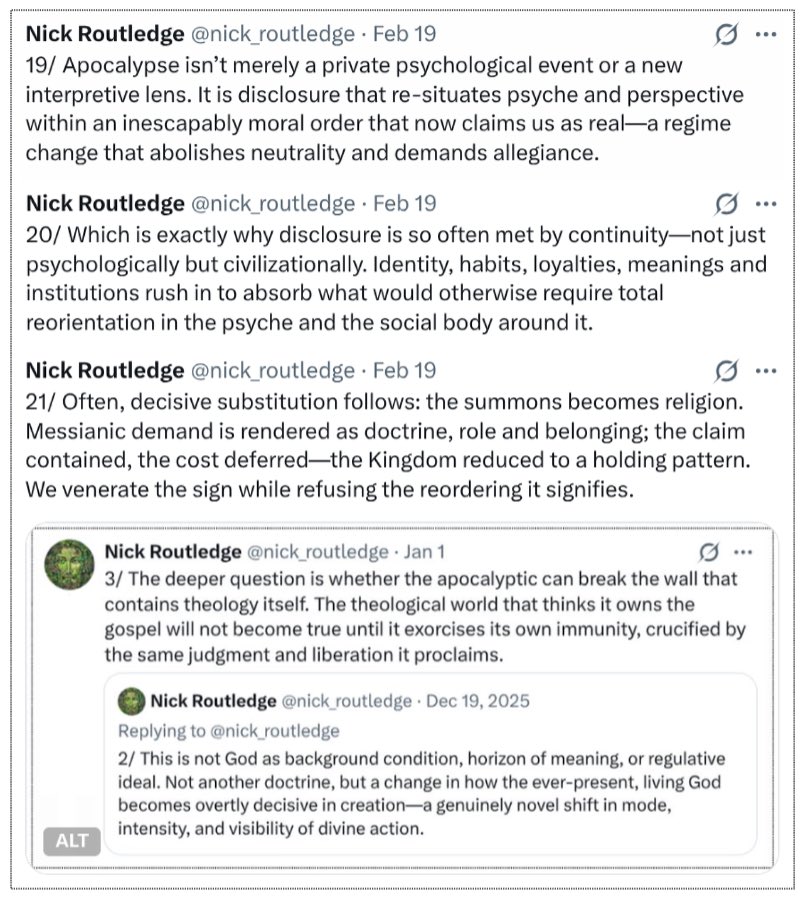
Image description
Extended description
19/ Apocalypse isn’t merely a private psychological event or a new interpretive lens. It is disclosure that re-situates psyche and perspective within an inescapably moral order that now claims us as real—a regime change that abolishes neutrality and demands allegiance. 20/ Which is exactly why disclosure is so often met by continuity—not just psychologically but civilizationally. Identity, habits, loyalties, meanings and institutions rush in to absorb what would otherwise require total reorientation in the psyche and the social body around it. 21/ Often, decisive substitution follows: the summons becomes religion. Messianic demand is rendered as doctrine, role and belonging; the claim contained, the cost deferred—the Kingdom reduced to a holding pattern. We venerate the sign while refusing the reordering it signifies. 3/ The deeper question is whether the apocalyptic can break the wall that contains theology itself. The theological world that thinks it owns the gospel will not become true until it exorcises its own immunity, crucified by the same judgment and liberation it proclaims. 2/ This is not God as background condition, horizon of meaning, or regulative ideal. Not another doctrine, but a change in how the ever-present, living God becomes overtly decisive in creation—a genuinely novel shift in mode, intensity, and visibility of divine action.
Open original document