
@HootenWilson @juliafspa @DanaGioiaPoet @PhilipMetres @PhilKlay @luci_shaw @malcolmguite @ilya_poet @flemingrut 4/ In truth, the prophetic word at its most alive is often closer to fields, forests and food stamps than the literary shelf. Also, written and spoken, it now exceeds the book’s prestige, logistics and physics. The page is no longer the citadel; the tools of witness have changed.
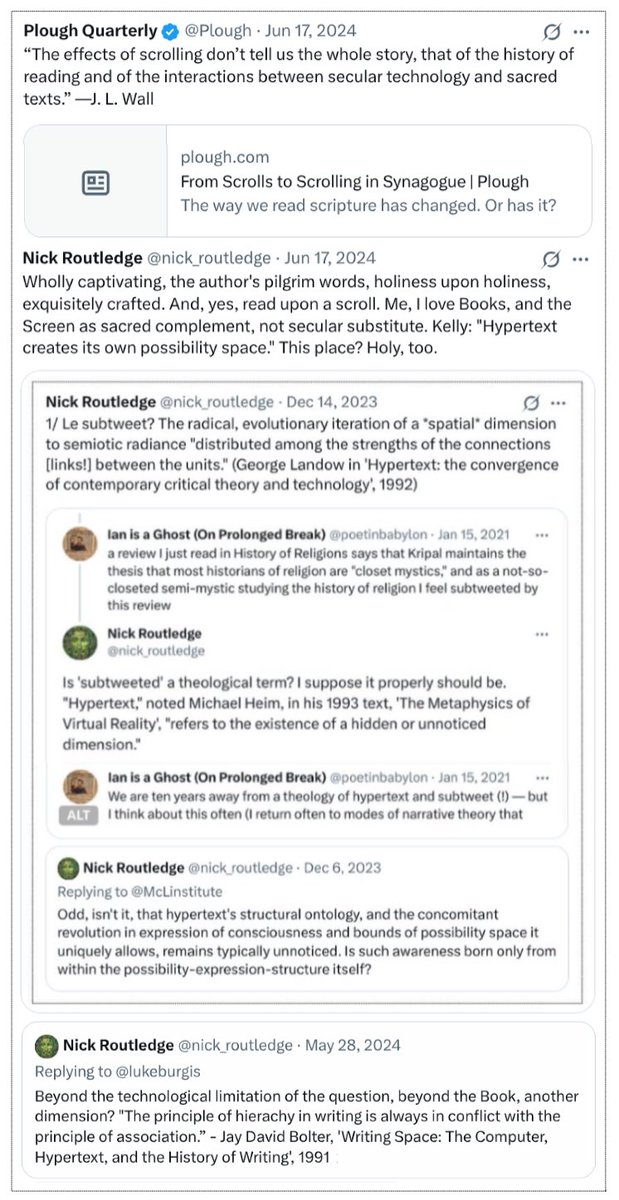
Image description
Extended description
“The effects of scrolling don’t tell us the whole story, that of the history of reading and of the interactions between secular technology and sacred texts.” —J. L. Wall Wholly captivating, the author's pilgrim words, holiness upon holiness, exquisitely crafted. And, yes, read upon a scroll. Me, I love Books, and the Screen as sacred complement, not secular substitute. Kelly: "Hypertext creates its own possibility space." This place? Holy, too. 1/ Le subtweet? The radical, evolutionary iteration of a *spatial* dimension to semiotic radiance "distributed among the strengths of the connections [links!] between the units." (George Landow in 'Hypertext: the convergence of contemporary critical theory and technology', 1992) a review I just read in History of Religions says that Kripal maintains the thesis that most historians of religion are "closet mystics," and as a not-so-closeted semi-mystic studying the history of religion I feel subtweeted by this review Is 'subtweeted' a theological term? I suppose it properly should be. "Hypertext," noted Michael Heim, in his 1993 text, 'The Metaphysics of Virtual Reality', "refers to the existence of a hidden or unnoticed dimension." We are ten years away from a theology of hypertext and subtweet (!) — but I think about this often (I return often to modes of narrative theory that Odd, isn't it, that hypertext's structural ontology, and the concomitant revolution in expression of consciousness and bounds of possibility space it uniquely allows, remains typically unnoticed. Is such awareness born only from within the possibility-expression-structure itself? Subtweet: Beyond the technological limitation of the question, beyond the Book, another dimension? "The principle of hierachy in writing is always in conflict with the principle of association.” - Jay David Bolter, 'Writing Space: The Computer, Hypertext, and the History of Writing', 1991
Open original document@jasonwblakely 2/ But what if philosophy doesn't reach its highest form as thought about reality, but as transfigured participation in it? What if America hasn't produced an Aristotle or Hegel because its deepest metaphysical drama has appeared less as theory to explain than witness to live?
View this post’s context →