
@seenunseenmag 16/ But as a Christian centered on the Second Advent, and loyal to the Abrahamic revolution, I take religious exceptionalism and maximalism—within and between traditions—as realities I’m led to befriend, not fight. My church understands my wide horizon as my Christian witness.
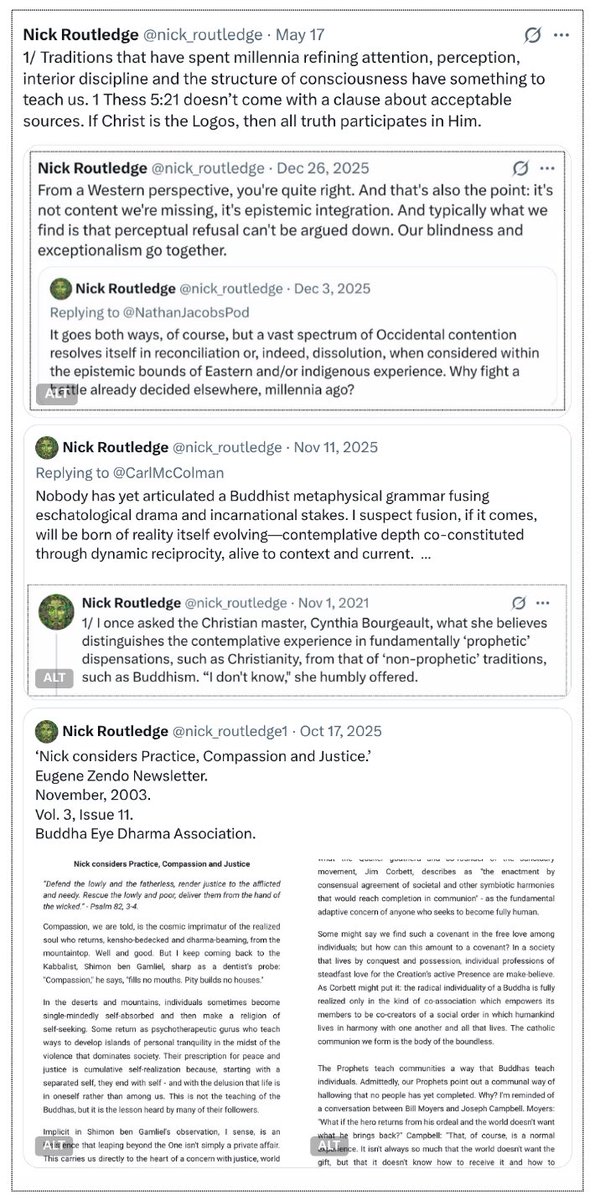
Image description
Extended description
1/ Traditions that have spent millennia refining attention, perception, interior discipline and the structure of consciousness have something to teach us. 1 Thess 5:21 doesn’t come with a clause about acceptable sources. If Christ is the Logos, then all truth participates in Him. @ShirleyStockar2 and @jonkay From a Western perspective, you're quite right. And that's also the point: it's not content we're missing, it's epistemic integration. And typically what we find is that perceptual refusal can't be argued down. Our blindness and exceptionalism go together. It goes both ways, of course, but a vast spectrum of Occidental contention resolves itself in reconciliation or, indeed, dissolution, when considered within the epistemic bounds of Eastern and/or indigenous experience. Why fight a battle already decided elsewhere, millennia ago. Subtweet: Nobody has yet articulated a Buddhist metaphysical grammar fusing eschatological drama and incarnational stakes. I suspect fusion, if it comes, will be born of reality itself evolving—contemplative depth co-constituted through dynamic reciprocity, alive to context and current. 1/ I once asked the Christian master, Cynthia Bourgeault, what she believes distinguishes the contemplative experience in fundamentally ‘prophetic’ dispensations, such as Christianity, from that of ‘non-prophetic’ traditions, such as Buddhism. “I don't know," she humbly offered. Sub-subtweet: ‘Nick considers Practice, Compassion and Justice.’ Eugene Zendo Newsletter. November, 2003. Vol. 3, Issue 11. Buddha Eye Dharma Association.
Open original document@AStratelates @suzania end\ But few are called to advanced, contemplative, psychospiritual rabbit holes. Most believers—and pastors—are simply trying to live faithfully and know scripture a little more deeply. However partial or flawed their efforts, there's immense dignity, grace and mercy there.
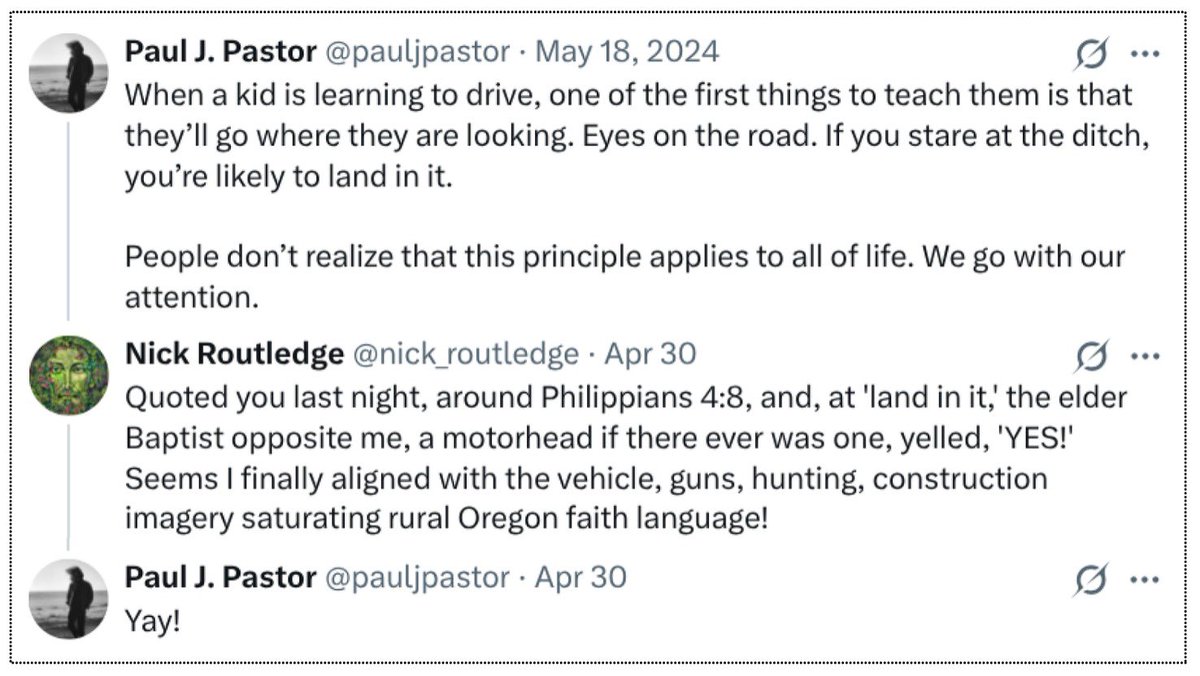
Image description
Original X alt text
When a kid is learning to drive, one of the first things to teach them is that they’ll go where they are looking. Eyes on the road. If you stare at the ditch, you’re likely to land in it. People don’t realize that this principle applies to all of life. We go with our attention.@nick_routledge Quoted you last night, around Philippians 4:8, and, at 'land in it,' the elder Baptist opposite me, a motorhead if there ever was one, yelled, 'YES!' Seems I finally aligned with the vehicle, guns, hunting, construction imagery saturating rural Oregon faith language! Yay!