
@seenunseenmag @profntwright 18/ This is why creatureliness is not incidental to obedience. Watersheds, soils, seeds, foodways, wounds, neighbours, animals, limits, are obedience’s form. Place is not where doctrine is applied; place is where doctrine becomes truthful. Resurrection is only ever local.
@HaddenTurner @affinitytalks 19/ Covenant husbandry, then, is answerable hope in the real—inaugurated eschatology in work boots. Hope that doesn't get its hands dirty isn't hope; it's talk. Hope that refuses limits isn't participation; it's presumption wearing the costume of faithfulness.
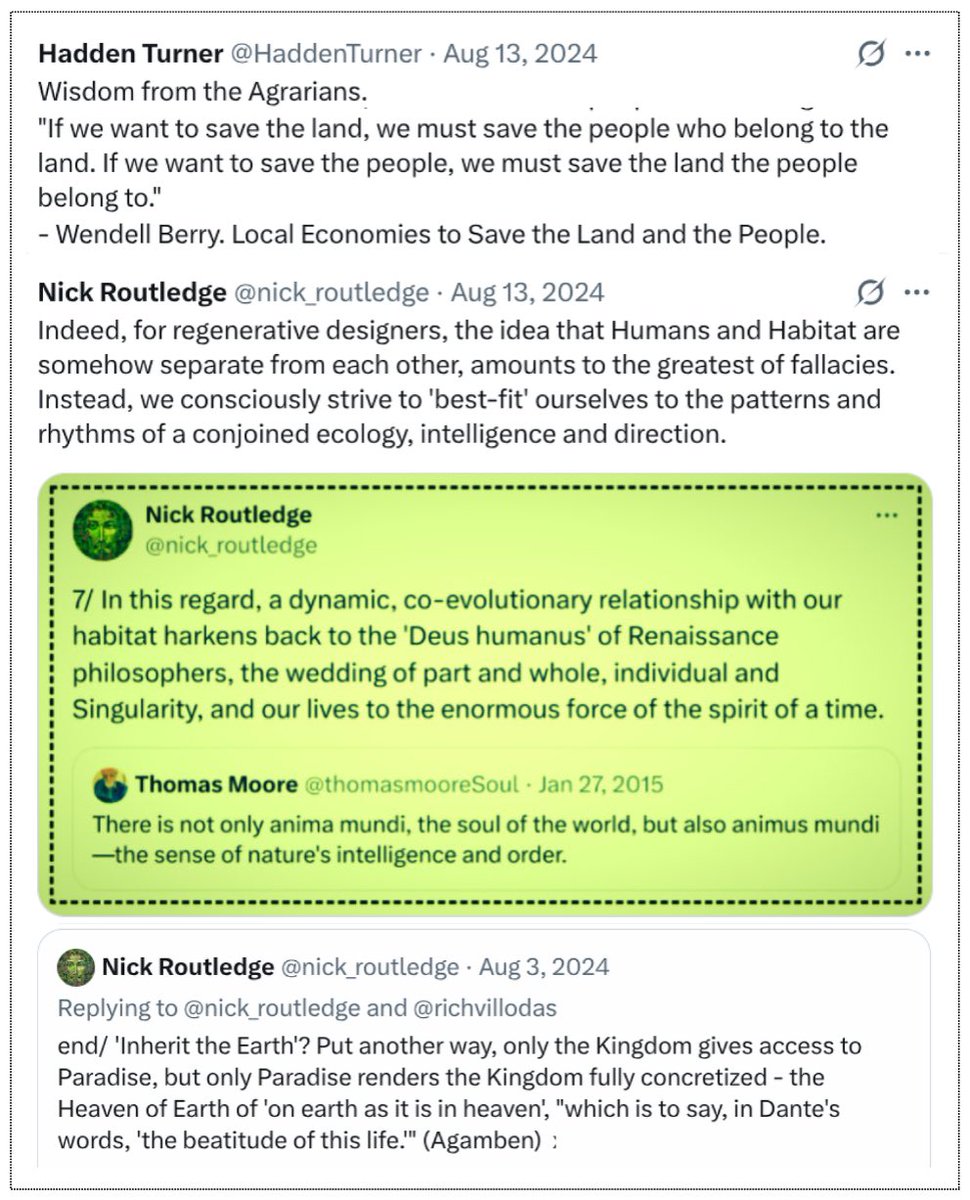
Image description
Extended description
Wisdom from the Agrarians. "If we want to save the land, we must save the people who belong to the land. If we want to save the people, we must save the land the people belong to." - Wendell Berry. Local Economies to Save the Land and the People. Indeed, for regenerative designers, the idea that Humans and Habitat are somehow separate from each other, amounts to the greatest of fallacies. Instead, we consciously strive to 'best-fit' ourselves to the patterns and rhythms of a conjoined ecology, intelligence and direction. 7/ In this regard, a dynamic, co-evolutionary relationship with our habitat harkens back to the 'Deus humanus' of Renaissance philosophers, the wedding of part and whole, individual and Singularity, and our lives to the enormous force of the spirit of a time. There is not only anima mundi, the soul of the world, but also animus mundi—the sense of nature's intelligence and order. Subtweet: end/ 'Inherit the Earth'? Put another way, only the Kingdom gives access to Paradise, but only Paradise renders the Kingdom fully concretized - the Heaven of Earth of 'on earth as it is in heaven', "which is to say, in Dante's words, 'the beatitude of this life.'" (Agamben) []
Open original document