
@PloughBooks 7/ Beneath the modern frame, the sahaja current added another layer: a no-nonsense folk/vernacular stream where bhakti, tantra, yoga, Kabir/Nath/Sant milieus, Bengali Sahajiyā traditions and Kashmiri Rishi Islam joined spiritual realization to ordinary life and social freedom.
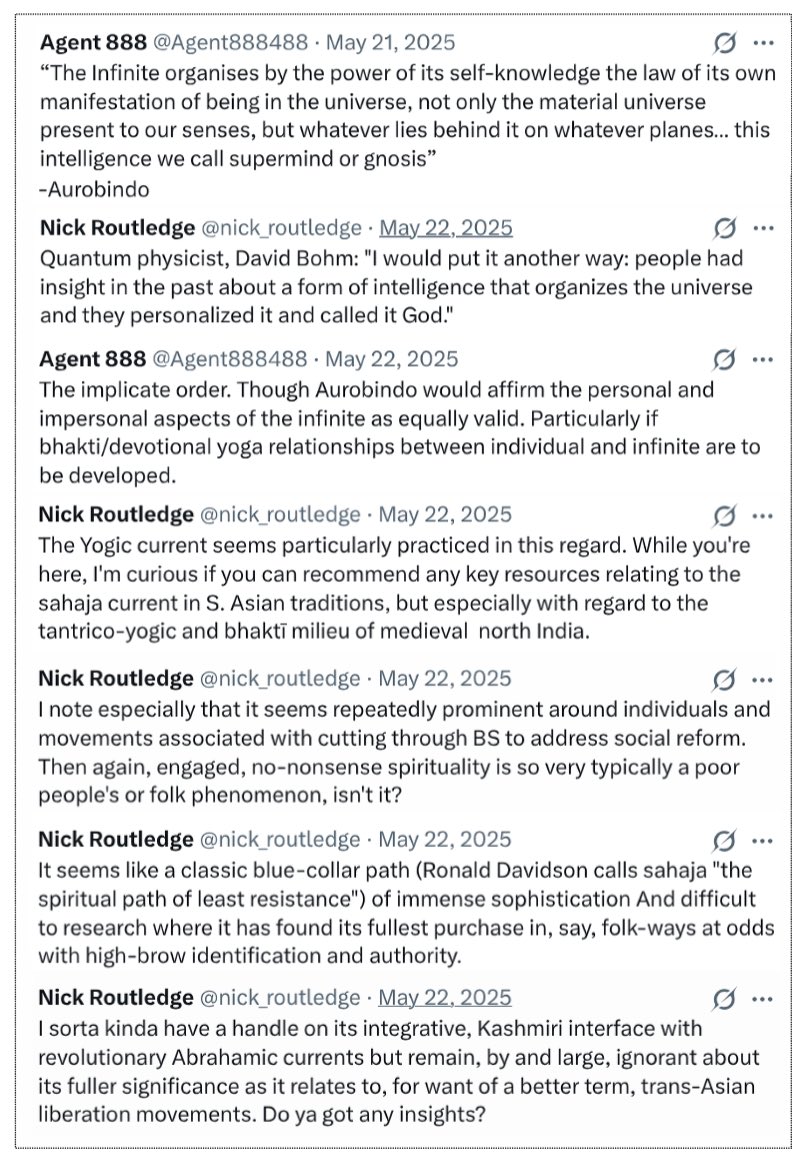
Image description
Extended description
“The Infinite organises by the power of its self-knowledge the law of its own manifestation of being in the universe, not only the material universe present to our senses, but whatever lies behind it on whatever planes… this intelligence we call supermind or gnosis” -Aurobindo Quantum physicist, David Bohm: "I would put it another way: people had insight in the past about a form of intelligence that organizes the universe and they personalized it and called it God." The implicate order. Though Aurobindo would affirm the personal and impersonal aspects of the infinite as equally valid. Particularly if bhakti/devotional yoga relationships between individual and infinite are to be developed. The Yogic current seems particularly practiced in this regard. While you're here, I'm curious if you can recommend any key resources relating to the sahaja current in S. Asian traditions, but especially with regard to the tantrico-yogic and bhaktī milieu of medieval north India. I note especially that it seems repeatedly prominent around individuals and movements associated with cutting through BS to address social reform. Then again, engaged, no-nonsense spirituality is so very typically a poor people's or folk phenomenon, isn't it? It seems like a classic blue-collar path (Ronald Davidson calls sahaja "the spiritual path of least resistance") of immense sophistication And difficult to research where it has found its fullest purchase in, say, folk-ways at odds with high-brow identification and authority. I sorta kinda have a handle on its integrative, Kashmiri interface with revolutionary Abrahamic currents but remain, by and large, ignorant about its fuller significance as it relates to, for want of a better term, trans-Asian liberation movements. Do ya got any insights?
Open original document