
@PloughBooks 2/ In part, the positive field includes Vivekananda, Aurobindo Ghose, Anushilan Samiti, Jugantar, Gandhi and Ambedkar: divergent, often antagonistic trajectories, yet each treating liberation as formation—against empire, caste, humiliation and every complex normalizing bondage.
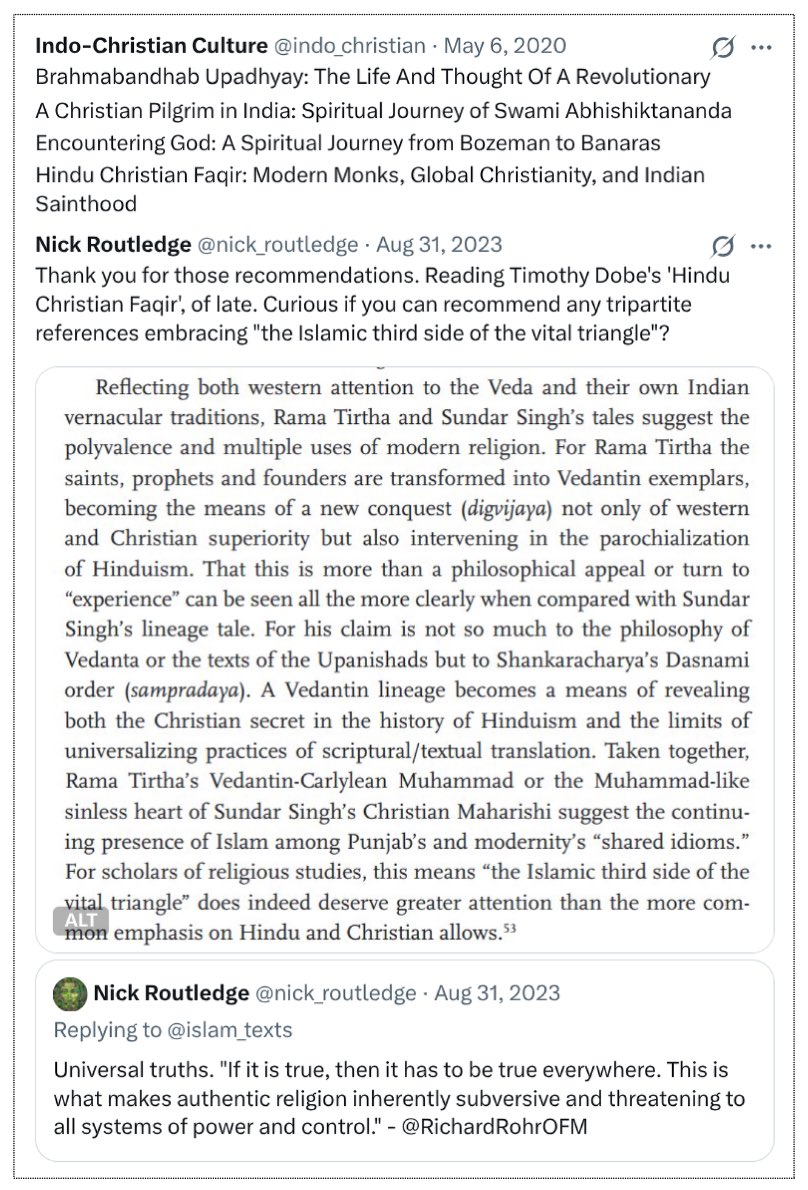
Image description
Extended description
Brahmabandhab Upadhyay: The Life And Thought Of A Revolutionary A Christian Pilgrim in India: Spiritual Journey of Swami Abhishiktananda Encountering God: A Spiritual Journey from Bozeman to Banaras Hindu Christian Faqir: Modern Monks, Global Christianity, and Indian Sainthood Thank you for those recommendations. Reading Timothy Dobe's 'Hindu Christian Faqir', of late. Curious if you can recommend any tripartite references embracing "the Islamic third side of the vital triangle"? That this is more than a philosophical appeal or turn to “experience” can be seen all the more clearly when compared with Sundar Singh’s lineage tale. For his claim is not so much to the philosophy of Vedanta or the texts of the Upanishads but to Shankaracharya’s Dasnami order (sampradaya). A Vedantin lineage becomes a means of revealing both the Christian secret in the history of Hinduism and the limits of universalizing practices of scriptural/textual translation. Taken together, Rama Tirtha's Vedantin-Carlylean Muhammad or the Muhammad-like sinless heart of Sundar Singh’s Christian Maharishi suggest the continuing presence of Islam among Punjab’s and modernity’s “shared idioms.” For scholars of religious studies, this means “the Islamic third side of the vital triangle” does indeed deserve greater attention than the more com- mon emphasis on Hindu and Christian allows. Quote tweet: Universal truths. "If it is true, then it has to be true everywhere. This is what makes authentic religion inherently subversive and threatening to all systems of power and control."
Open original document