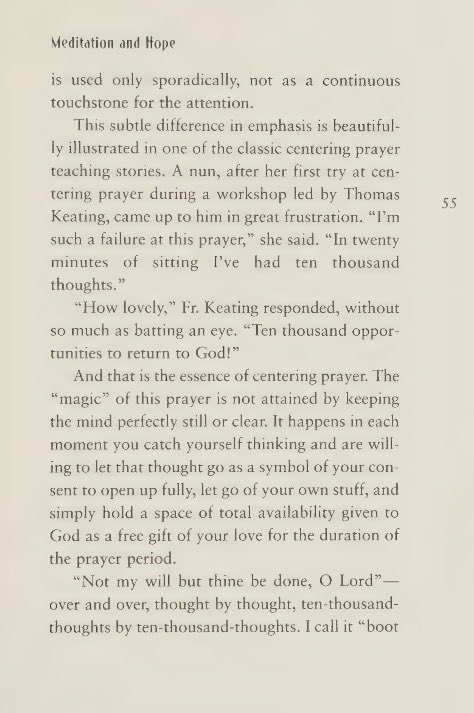
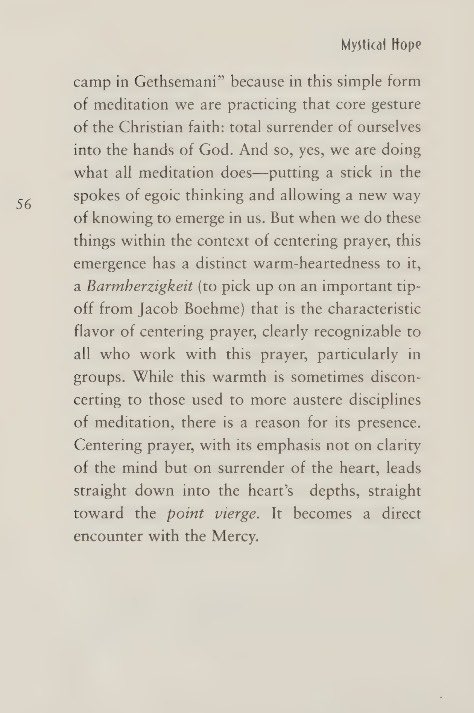
Noted. Few descriptions of centering prayer are as brief, lucid, and spiritually exact as this one from Cynthia Bourgeault, a contemporary master of the Christian contemplative tradition. @cac_abq @prayerofconsent
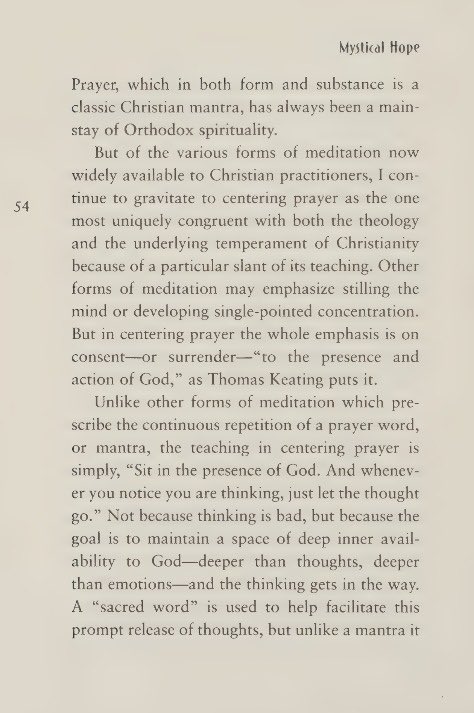
Image description
Extended description
– Excerpt from Cynthia Bourgeault’s Mystical Hope : Trusting in the Mercy of God Prayer, which in both form and substance is a classic Christian mantra, has always been a mainstay of Orthodox spirituality. But of the various forms of meditation now widely available to Christian practitioners, I continue to gravitate to centering prayer as the one most uniquely congruent with both the theology and the underlying temperament of Christianity because of a particular slant of its teaching. Other forms of meditation may emphasize stilling the mind or developing single-pointed concentration. But in centering prayer the whole emphasis is on consent—or surrender—“to the presence and action of God,” as Thomas Keating puts it. Unlike other forms of meditation which prescribe the continuous repetition of a prayer word, or mantra, the teaching in centering prayer is simply, “Sit in the presence of God. And whenever you notice you are thinking, just let the thought go.” Not because thinking is bad, but because the goal is to maintain a space of deep inner availability to God—deeper than thoughts, deeper than emotions—and the thinking gets in the way. A “sacred word” is used to help facilitate this prompt release of thoughts, but unlike a mantra it is used only sporadically, not as a continuous touchstone for the attention. This subtle difference in emphasis is beautifully illustrated in one of the classic centering prayer teaching stories. A nun, after her first try at centering prayer during a workshop led by Thomas Keating, came up to him in great frustration. “I’m such a failure at this prayer,” she said. “In twenty minutes of sitting I’ve had ten thousand thoughts.” “How lovely,” Fr. Keating responded, without so much as batting an eye. “Ten thousand opportunities to return to God!” And that is the essence of centering prayer. The “magic” of this prayer is not attained by keeping the mind perfectly still or clear. It happens in each moment you catch yourself thinking and are willing to let that thought go as a symbol of your consent to open up fully, let go of your own stuff, and simply hold a space of total availability given to God as a free gift of your love for the duration of the prayer period. “Not my will but thine be done, O Lord”—over and over, thought by thought, ten-thousand-thoughts by ten-thousand-thoughts. I call it “boot camp in Gethsemani” because in this simple form of meditation we are practicing that core gesture of the Christian faith: total surrender of ourselves into the hands of God. And so, yes, we are doing what all meditation does—putting a stick in the spokes of egoic thinking and allowing a new way of knowing to emerge in us. But when we do these things within the context of centering prayer, this emergence has a distinct warm-heartedness to it, a Barmherzigkeit (to pick up on an important tip off from Jacob Boehme) that is the characteristic flavor of centering prayer, clearly recognizable to all who work with this prayer, particularly in groups. While this warmth is sometimes disconcerting to those used to more austere disciplines of meditation, there is a reason for its presence. Centering prayer, with its emphasis not on clarity of the mind but on surrender of the heart, leads straight down into the heart’s depths, straight toward the point vierge. It becomes a direct encounter with the Mercy.
Open original document