
@Plough 1/3 The distinction between recovering “higher times” (Taylor) alongside ordinary time, and ordinary time itself as internally open to eternity, is worth sharpening. This, after all, is the messianic counter-move: time broken open to its eternal depth. Panikkar, not unwise, here.
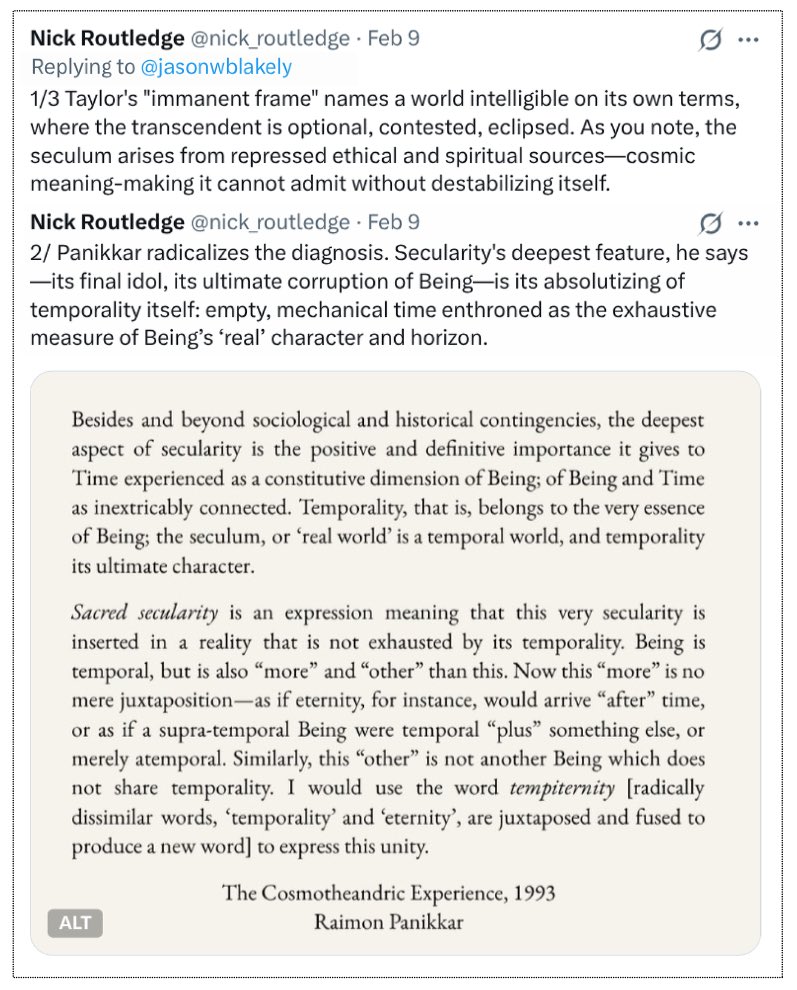
Image description
Extended description
Except from thread here: 1/3 Taylor's "immanent frame" names a world intelligible on its own terms, where the transcendent is optional, contested, eclipsed. As you note, the seculum arises from repressed ethical and spiritual sources—cosmic meaning-making it cannot admit without destabilizing itself. 2/ Panikkar radicalizes the diagnosis. Secularity's deepest feature, he says—its final idol, its ultimate corruption of Being—is its absolutizing of temporality itself: empty, mechanical time enthroned as the exhaustive measure of Being’s ‘real’ character and horizon. Besides and beyond sociological and historical contingencies, the deepest aspect of secularity is the positive and definitive importance it gives to Time experienced as a constitutive dimension of Being; of Being and Time as inextricably connected. Temporality, that is, belongs to the very essence of Being; the seculum, or ‘real world’ is a temporal world, and temporality its ultimate character. Sacred secularity is an expression meaning that this very secularity is inserted in a reality that is not exhausted by its temporality. Being is temporal, but is also “more” and “other” than this. Now this “more” is no mere juxtaposition—as if eternity, for instance, would arrive “after” time, or as if a supra-temporal Being were temporal “plus” something else, or merely atemporal. Similarly, this “other” is not another Being which does not share temporality. I would use the word tempiternity [radically dissimilar words, ‘temporality’ and ‘eternity’, are juxtaposed and fused to produce a new word] to express this unity. The Cosmotheandric Experience, 1993 Raimon Panikkar
Open original document@jasonwblakely end\ The messianic response is the counter-move: "tempieternity"—not presence alone (mere 'living in the now') nor postponement ('after') but time re-opened to eternity within itself, temporality transfigured by way of the "small gate through which the messiah enters" (Benjamin).
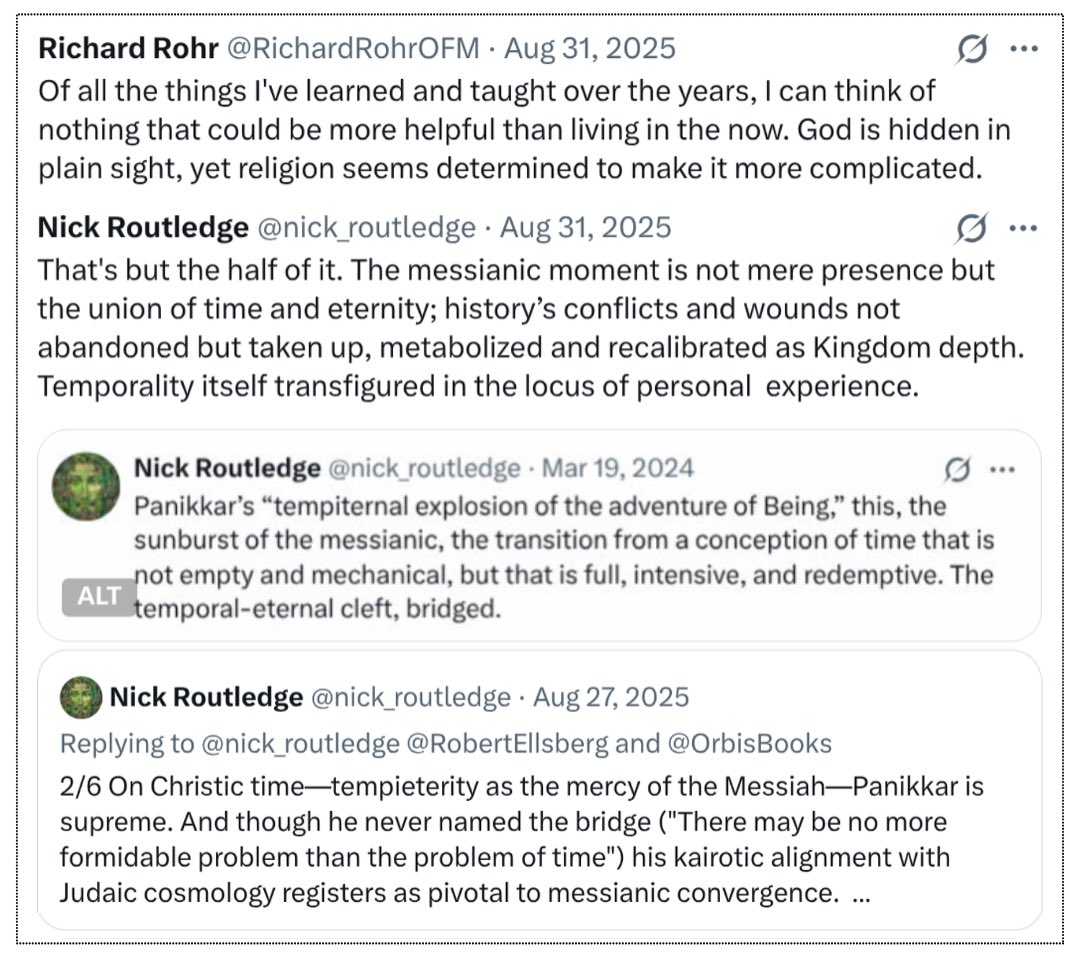
Image description
Extended description
Of all the things I've learned and taught over the years, I can think of nothing that could be more helpful than living in the now. God is hidden in plain sight, yet religion seems determined to make it more complicated. That's but the half of it. The messianic moment is not mere presence but the union of time and eternity; history’s conflicts and wounds not abandoned but taken up, metabolized and recalibrated as Kingdom depth. Temporality itself transfigured in the locus of personal experience. Panikkar’s “tempiternal explosion of the adventure of Being,” this, the sunburst of the messianic, the transition from a conception of time that is not empty and mechanical, but that is full, intensive, and redemptive. The temporal-eternal cleft, bridged. Subtweet: 2/6 On Christic time—tempieterity as the mercy of the Messiah—Panikkar is supreme. And though he never named the bridge ("There may be no more formidable problem than the problem of time") his kairotic alignment with Judaic cosmology registers as pivotal to messianic convergence.
Open original document