
@thebafflermag end/ And yes, Asian pears have emerged as a favorite for us, too. The trees themselves possess an uncommon charm: copper-boned in winter, vigorous to the edge of unruly, fragile under the hand, and often startlingly elegant once their force has been gathered rather than subdued.
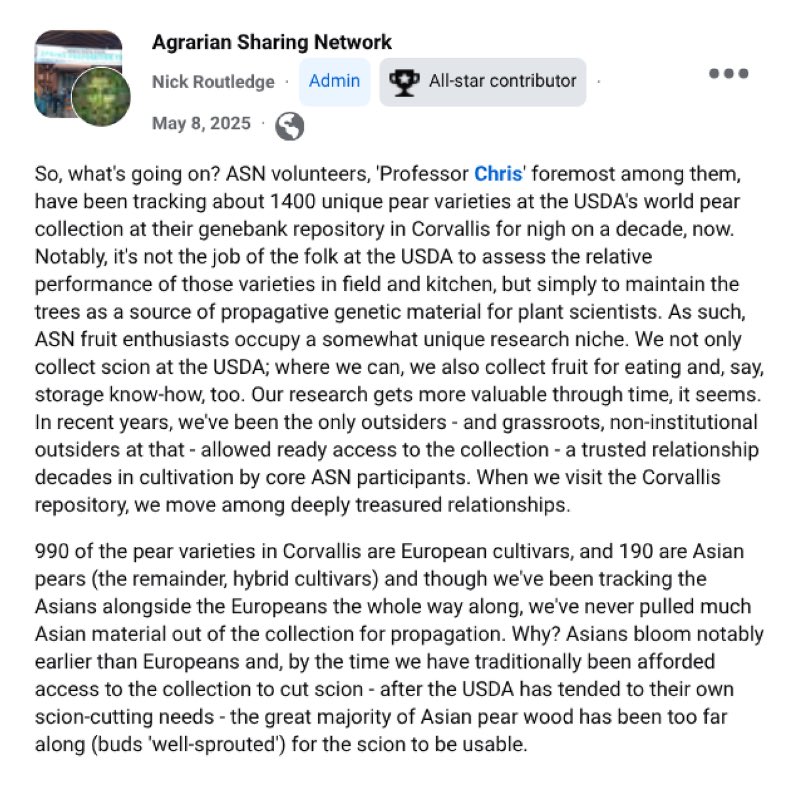
Image description
Original X alt text
Full alt-text for the three images:
Extended description
So, what's going on? ASN volunteers, 'Professor Chris' foremost among them, have been tracking about 1400 unique pear varieties at the USDA's world pear collection at their genebank repository in Corvallis for nigh on a decade, now. Notably, it's not the job of the folk at the USDA to assess the relative performance of those varieties in field and kitchen, but simply to maintain the trees as a source of propagative genetic material for plant scientists. As such, ASN fruit enthusiasts occupy a somewhat unique research niche. We not only collect scion at the USDA; where we can, we also collect fruit for eating and, say, storage know-how, too. Our research gets more valuable through time, it seems. In recent years, we've been the only outsiders - and grassroots, non-institutional outsiders at that - allowed ready access to the collection - a trusted relationship decades in cultivation by core ASN participants. When we visit the Corvallis repository, we move among deeply treasured relationships. 990 of the pear varieties in Corvallis are European cultivars, and 190 are Asian pears (the remainder, hybrid cultivars) and though we've been tracking the Asians alongside the Europeans the whole way along, we've never pulled much Asian material out of the collection for propagation. Why? Asians bloom notably earlier than Europeans and, by the time we have traditionally been afforded access to the collection to cut scion - after the USDA has tended to their own scion-cutting needs - the great majority of Asian pear wood has been too far along (buds 'well-sprouted') for the scion to be usable. This year, however, for the very first time, we were provided access to the repository earlier than usual - early enough to catch the Asians before bud push. So, after long years of waiting, we finally struck, cutting about 30 varieties we've identified as holding most promise. Asian pear diversity is all over the map - the modern Asian pear genome represents a pretty tight pyriform cluster. The diversity of our choices is broad and will be for many, I suspect, surprising - for example, where most of the Asians we've collected have juicy and crunchy fruit - traits familiarly associated with Asians - some have melty flesh, akin to common Europeans. Pear culture and breeding may well precede that of apples globally, and East Asia, of course, has a longer history than any other region in this regard. Ya Li and Chien Pa Li, two well-known and highly regarded pears we've collected, have histories extending back to traditional Chinese horticulture where pears have been grown for over 3,000 years. To our understanding, Ya Li, the most popular pear in China, may not only be the oldest extant pear variety in the world, but the oldest variety of any clonal crop in unbroken cultivation. Many of the other varieties we cut scion on - ancients through moderns selected for their performance in field and kitchen - are little known and extremely difficult to access. Given the rare confluence of circumstances affording us access to the Asians this year, we're making a special effort to keep the material within our pattern of embrace, moving forward. The photograph? We have commitments from two biodiversity-geeks within our network to carry copies of the collection forward, through the years. So, we've grafted the material up and are providing copies of each of the 30 or so varieties for sites in Elmira, OR, and Lorane, OR. Spreading deliberately-stewarded diversity clusters into welcoming hands and ground throughout our network is a tried and tested technique we've used to rescue/free extremely valuable diversity pools, previously. Sadly, many of our previous efforts have also floundered as collections have been taken from us. This time round, the New Earth Stewards collective has stepped up and I'm confident the material will remain freely available through the years. We'll keep the new grafts in large, well-watered pots in the shade for a few weeks, feeding occasionally, before planting out. Not only is this an easy, safe way to move the material around and hold it well, prior to transplanting in nursery rows, we also find keeping the newly grafted trees in a part-sun/shaded location for a few weeks significantly reduces stress on the new graft unions and, typically, notably improves quantity and quality of graft-take. And the stars of the show? Chien Pa Li, Chojuro, Czui, Daisui Li, Doitsu, Hosui, Jilin Market, Kikisui, Korean Giant, Koyama, Ling Li, Lin Yue Xian, Mishirashu, Nijiseiki, Okusankichi, Ping Guo Li (RP), Ping Ding Li, Seigyoku , Seuri Li, Shinseiki, Shinsui, Shu Li, Sion Siu Li, Syan Li, Szumi, Tang Li, Ta Shien Sui Li, Tse Li/Tsu Li, Xue Ha Li, Ya Li, Yoinashi, Zao Su Li
Open original document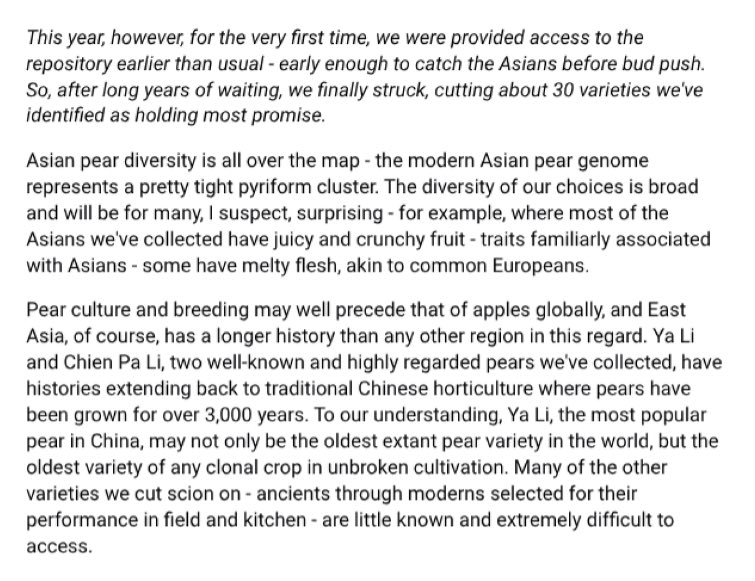
Image description
Extended description
So, what's going on? ASN volunteers, 'Professor Chris' foremost among them, have been tracking about 1400 unique pear varieties at the USDA's world pear collection at their genebank repository in Corvallis for nigh on a decade, now. Notably, it's not the job of the folk at the USDA to assess the relative performance of those varieties in field and kitchen, but simply to maintain the trees as a source of propagative genetic material for plant scientists. As such, ASN fruit enthusiasts occupy a somewhat unique research niche. We not only collect scion at the USDA; where we can, we also collect fruit for eating and, say, storage know-how, too. Our research gets more valuable through time, it seems. In recent years, we've been the only outsiders - and grassroots, non-institutional outsiders at that - allowed ready access to the collection - a trusted relationship decades in cultivation by core ASN participants. When we visit the Corvallis repository, we move among deeply treasured relationships. 990 of the pear varieties in Corvallis are European cultivars, and 190 are Asian pears (the remainder, hybrid cultivars) and though we've been tracking the Asians alongside the Europeans the whole way along, we've never pulled much Asian material out of the collection for propagation. Why? Asians bloom notably earlier than Europeans and, by the time we have traditionally been afforded access to the collection to cut scion - after the USDA has tended to their own scion-cutting needs - the great majority of Asian pear wood has been too far along (buds 'well-sprouted') for the scion to be usable. This year, however, for the very first time, we were provided access to the repository earlier than usual - early enough to catch the Asians before bud push. So, after long years of waiting, we finally struck, cutting about 30 varieties we've identified as holding most promise. Asian pear diversity is all over the map - the modern Asian pear genome represents a pretty tight pyriform cluster. The diversity of our choices is broad and will be for many, I suspect, surprising - for example, where most of the Asians we've collected have juicy and crunchy fruit - traits familiarly associated with Asians - some have melty flesh, akin to common Europeans. Pear culture and breeding may well precede that of apples globally, and East Asia, of course, has a longer history than any other region in this regard. Ya Li and Chien Pa Li, two well-known and highly regarded pears we've collected, have histories extending back to traditional Chinese horticulture where pears have been grown for over 3,000 years. To our understanding, Ya Li, the most popular pear in China, may not only be the oldest extant pear variety in the world, but the oldest variety of any clonal crop in unbroken cultivation. Many of the other varieties we cut scion on - ancients through moderns selected for their performance in field and kitchen - are little known and extremely difficult to access. Given the rare confluence of circumstances affording us access to the Asians this year, we're making a special effort to keep the material within our pattern of embrace, moving forward. The photograph? We have commitments from two biodiversity-geeks within our network to carry copies of the collection forward, through the years. So, we've grafted the material up and are providing copies of each of the 30 or so varieties for sites in Elmira, OR, and Lorane, OR. Spreading deliberately-stewarded diversity clusters into welcoming hands and ground throughout our network is a tried and tested technique we've used to rescue/free extremely valuable diversity pools, previously. Sadly, many of our previous efforts have also floundered as collections have been taken from us. This time round, the New Earth Stewards collective has stepped up and I'm confident the material will remain freely available through the years. We'll keep the new grafts in large, well-watered pots in the shade for a few weeks, feeding occasionally, before planting out. Not only is this an easy, safe way to move the material around and hold it well, prior to transplanting in nursery rows, we also find keeping the newly grafted trees in a part-sun/shaded location for a few weeks significantly reduces stress on the new graft unions and, typically, notably improves quantity and quality of graft-take. And the stars of the show? Chien Pa Li, Chojuro, Czui, Daisui Li, Doitsu, Hosui, Jilin Market, Kikisui, Korean Giant, Koyama, Ling Li, Lin Yue Xian, Mishirashu, Nijiseiki, Okusankichi, Ping Guo Li (RP), Ping Ding Li, Seigyoku , Seuri Li, Shinseiki, Shinsui, Shu Li, Sion Siu Li, Syan Li, Szumi, Tang Li, Ta Shien Sui Li, Tse Li/Tsu Li, Xue Ha Li, Ya Li, Yoinashi, Zao Su Li
Open original document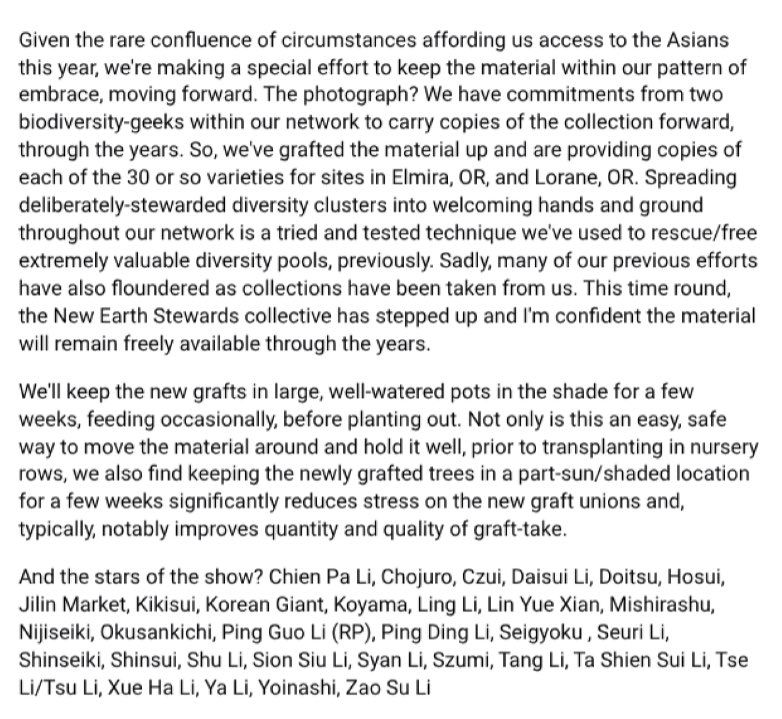
Image description
Extended description
So, what's going on? ASN volunteers, 'Professor Chris' foremost among them, have been tracking about 1400 unique pear varieties at the USDA's world pear collection at their genebank repository in Corvallis for nigh on a decade, now. Notably, it's not the job of the folk at the USDA to assess the relative performance of those varieties in field and kitchen, but simply to maintain the trees as a source of propagative genetic material for plant scientists. As such, ASN fruit enthusiasts occupy a somewhat unique research niche. We not only collect scion at the USDA; where we can, we also collect fruit for eating and, say, storage know-how, too. Our research gets more valuable through time, it seems. In recent years, we've been the only outsiders - and grassroots, non-institutional outsiders at that - allowed ready access to the collection - a trusted relationship decades in cultivation by core ASN participants. When we visit the Corvallis repository, we move among deeply treasured relationships. 990 of the pear varieties in Corvallis are European cultivars, and 190 are Asian pears (the remainder, hybrid cultivars) and though we've been tracking the Asians alongside the Europeans the whole way along, we've never pulled much Asian material out of the collection for propagation. Why? Asians bloom notably earlier than Europeans and, by the time we have traditionally been afforded access to the collection to cut scion - after the USDA has tended to their own scion-cutting needs - the great majority of Asian pear wood has been too far along (buds 'well-sprouted') for the scion to be usable. This year, however, for the very first time, we were provided access to the repository earlier than usual - early enough to catch the Asians before bud push. So, after long years of waiting, we finally struck, cutting about 30 varieties we've identified as holding most promise. Asian pear diversity is all over the map - the modern Asian pear genome represents a pretty tight pyriform cluster. The diversity of our choices is broad and will be for many, I suspect, surprising - for example, where most of the Asians we've collected have juicy and crunchy fruit - traits familiarly associated with Asians - some have melty flesh, akin to common Europeans. Pear culture and breeding may well precede that of apples globally, and East Asia, of course, has a longer history than any other region in this regard. Ya Li and Chien Pa Li, two well-known and highly regarded pears we've collected, have histories extending back to traditional Chinese horticulture where pears have been grown for over 3,000 years. To our understanding, Ya Li, the most popular pear in China, may not only be the oldest extant pear variety in the world, but the oldest variety of any clonal crop in unbroken cultivation. Many of the other varieties we cut scion on - ancients through moderns selected for their performance in field and kitchen - are little known and extremely difficult to access. Given the rare confluence of circumstances affording us access to the Asians this year, we're making a special effort to keep the material within our pattern of embrace, moving forward. The photograph? We have commitments from two biodiversity-geeks within our network to carry copies of the collection forward, through the years. So, we've grafted the material up and are providing copies of each of the 30 or so varieties for sites in Elmira, OR, and Lorane, OR. Spreading deliberately-stewarded diversity clusters into welcoming hands and ground throughout our network is a tried and tested technique we've used to rescue/free extremely valuable diversity pools, previously. Sadly, many of our previous efforts have also floundered as collections have been taken from us. This time round, the New Earth Stewards collective has stepped up and I'm confident the material will remain freely available through the years. We'll keep the new grafts in large, well-watered pots in the shade for a few weeks, feeding occasionally, before planting out. Not only is this an easy, safe way to move the material around and hold it well, prior to transplanting in nursery rows, we also find keeping the newly grafted trees in a part-sun/shaded location for a few weeks significantly reduces stress on the new graft unions and, typically, notably improves quantity and quality of graft-take. And the stars of the show? Chien Pa Li, Chojuro, Czui, Daisui Li, Doitsu, Hosui, Jilin Market, Kikisui, Korean Giant, Koyama, Ling Li, Lin Yue Xian, Mishirashu, Nijiseiki, Okusankichi, Ping Guo Li (RP), Ping Ding Li, Seigyoku , Seuri Li, Shinseiki, Shinsui, Shu Li, Sion Siu Li, Syan Li, Szumi, Tang Li, Ta Shien Sui Li, Tse Li/Tsu Li, Xue Ha Li, Ya Li, Yoinashi, Zao Su Li
Open original document@clothofnature In a similar vein, I love this image of a fallen Asian pear, Seuri Li, an exquisite corpse: skin gone from sun-gold to perfect, speckled black, without the rot disturbing a single, immaculate curve.
View this post’s context →