
@iyad_elbaghdadi end\ What approaches bears both terror and mercy, the end of one world and the unveiling of what follows. Not the victory of one complex over another, but their common overthrow under revelation itself. Parousia, Qiyāmah, Geulah: the false Abrahamic felled and reborn, in concert.
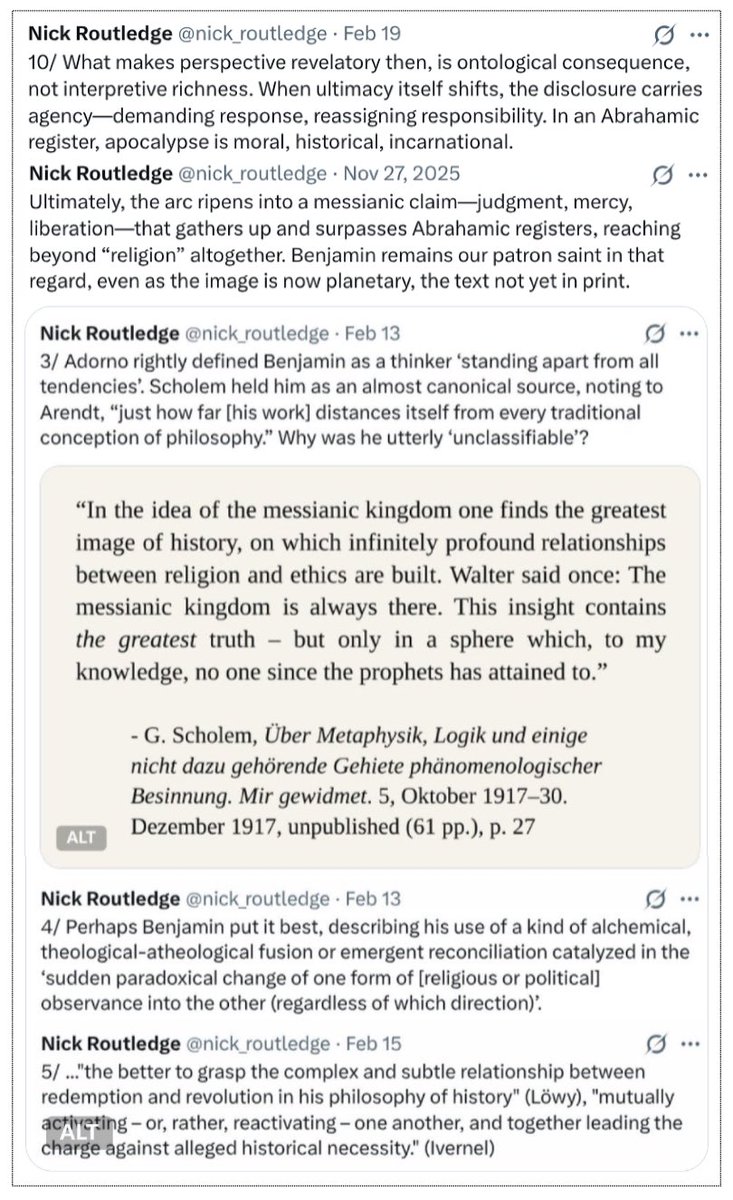
Image description
Extended description
10/ What makes perspective revelatory then, is ontological consequence, not interpretive richness. When ultimacy itself shifts, the disclosure carries agency—demanding response, reassigning responsibility. In an Abrahamic register, apocalypse is moral, historical, incarnational. Ultimately, the arc ripens into a messianic claim—judgment, mercy, liberation—that gathers up and surpasses Abrahamic registers, reaching beyond “religion” altogether. Benjamin remains our patron saint in that regard, even as the image is now planetary, the text not yet in print. 3/ Adorno rightly defined Benjamin as a thinker ‘standing apart from all tendencies’. Scholem held him as an almost canonical source, noting to Arendt, “just how far [his work] distances itself from every traditional conception of philosophy.” Why was he utterly ‘unclassifiable’? “In the idea of the messianic kingdom one finds the greatest image of history, on which infinitely profound relationships between religion and ethics are built. Walter said once: The messianic kingdom is always there. This insight contains the greatest truth – but only in a sphere which, to my knowledge, no one since the prophets has attained to.” - G. Scholem, Über Metaphysik, Logik und einige nicht dazu gehörende Gehiete phänomenologischer Besinnung. Mir gewidmet. 5, Oktober 1917–30. Dezember 1917, unpublished (61 pp.), p. 27 4/ Perhaps Benjamin put it best, describing his use of a kind of alchemical, theological-atheological fusion or emergent reconciliation catalyzed in the ‘sudden paradoxical change of one form of [religious or political] observance into the other (regardless of which direction)’. 5/ ..."the better to grasp the complex and subtle relationship between redemption and revolution in his philosophy of history" (Löwy), "mutually activating – or, rather, reactivating – one another, and together leading the charge against alleged historical necessity." (Ivernel)
Open original document@MassimoFaggioli It goes both ways. The experiment has scaled: what the Holy Land exposes as warped eschatologies now detonates globally. Kirwan proposes an “Abrahamic revolution”—shared revelation that goes out from Jerusalem and must come home there as the messianic return of planetary peace.
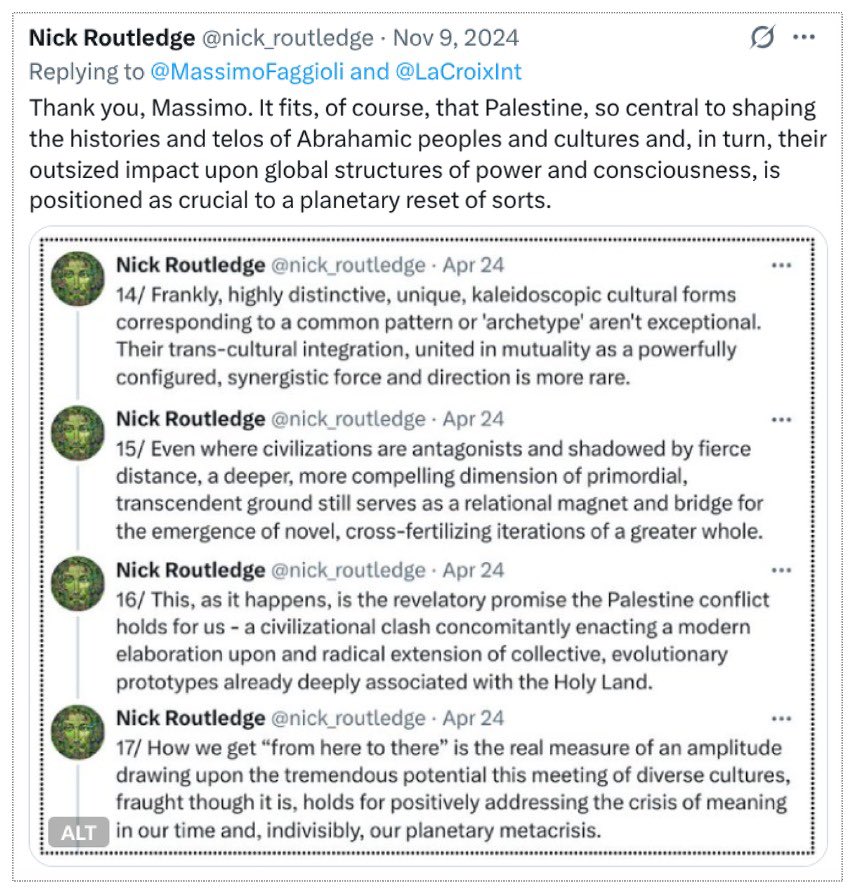
Image description
Extended description
@MassimoFaggioli and @LaCroixInt Thank you, Massimo. It fits, of course, that Palestine, so central to shaping the histories and telos of Abrahamic peoples and cultures and, in turn, their outsized impact upon global structures of power and consciousness, is positioned as crucial to a planetary reset of sorts. 14/ Frankly, highly distinctive, unique, kaleidoscopic cultural forms corresponding to a common pattern or 'archetype' aren't exceptional. Their trans-cultural integration, united in mutuality as a powerfully configured, synergistic force and direction is more rare. 15/ Even where civilizations are antagonists and shadowed by fierce distance, a deeper, more compelling dimension of primordial, transcendent ground still serves as a relational magnet and bridge for the emergence of novel, cross-fertilizing iterations of a greater whole. 16/ This, as it happens, is the revelatory promise the Palestine conflict holds for us - a civilizational clash concomitantly enacting a modern elaboration upon and radical extension of collective, evolutionary prototypes already deeply associated with the Holy Land. 17/ How we get “from here to there” is the real measure of an amplitude drawing upon the tremendous potential this meeting of diverse cultures, fraught though it is, holds for positively addressing the crisis of meaning in our time and, indivisibly, our planetary metacrisis.
Open original document