
@Plough 9/ The Synoptics—Mark especially—repeatedly present confrontation with the demonic as structural and systemic, not merely individual moral failure. In the Gerasene demoniac, “Legion” names a political-spiritual order speaking through a human being: “for we are many.”
16/ If apocalypse were just seeing, we could teach it like logic. But the obstacle isn’t clarity but consequence—and a world still built to protect a refusal. Apocalypse carries cost. Innocence collapses. What counts as sanity resets. Life becomes answerable to what we now know.
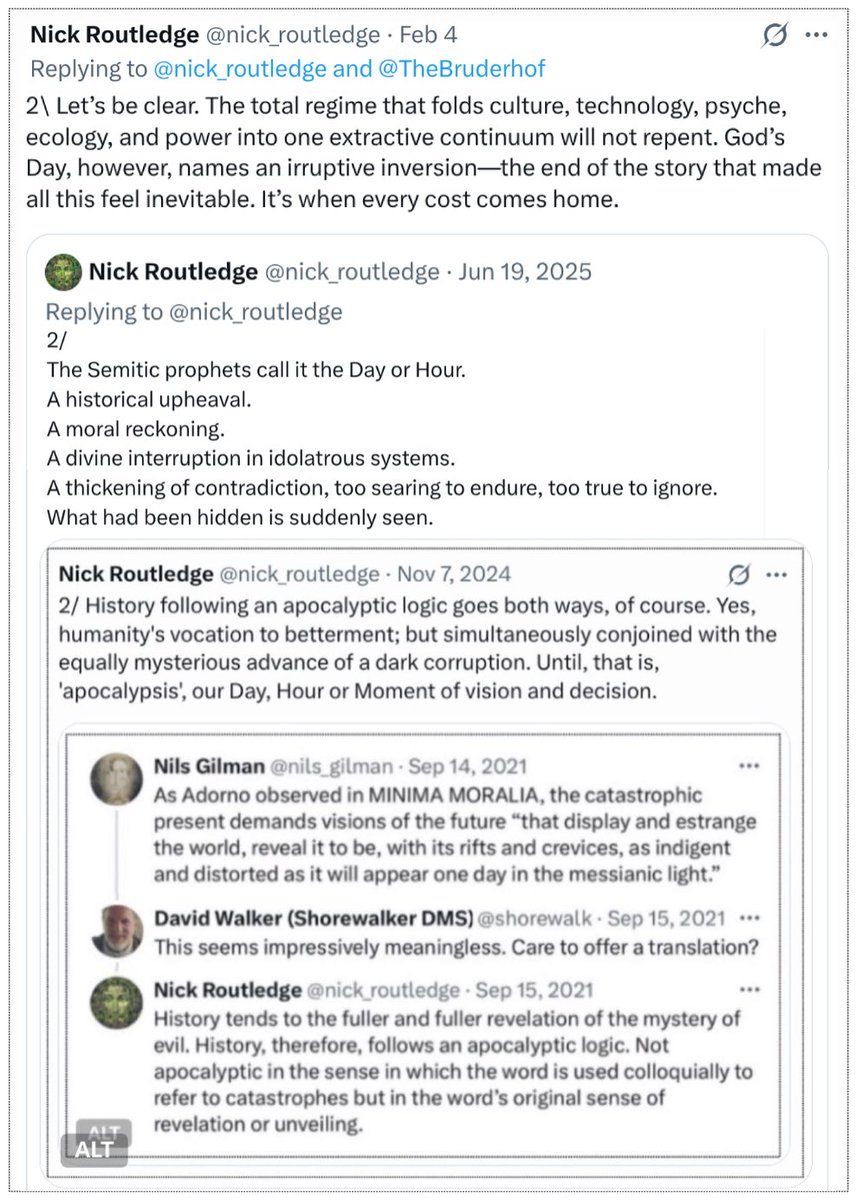
Image description
Extended description
2\ Let’s be clear. The total regime that folds culture, technology, psyche, ecology, and power into one extractive continuum will not repent. God’s Day, however, names an irruptive inversion—the end of the story that made all this feel inevitable. It’s when every cost comes home. Subtweet: 2/ The Semitic prophets call it the Day or Hour. A historical upheaval. A moral reckoning. A divine interruption in idolatrous systems. A thickening of contradiction, too searing to endure, too true to ignore. What had been hidden is suddenly seen. 2/ History following an apocalyptic logic goes both ways, of course. Yes, humanity's vocation to betterment; but simultaneously conjoined with the equally mysterious advance of a dark corruption. Until, that is, 'apocalypsis', our Day, Hour or Moment of vision and decision. As Adorno observed in MINIMA MORALIA, the catastrophic present demands visions of the future “that display and estrange the world, reveal it to be, with its rifts and crevices, as indigent and distorted as it will appear one day in the messianic light.” This seems impressively meaningless. Care to offer a translation? History tends to the fuller and fuller revelation of the mystery of evil. History, therefore, follows an apocalyptic logic. Not apocalyptic in the sense in which the word is used colloquially to refer to catastrophes but in the word’s original sense of revelation or unveiling.
Open original document