
@Plough 7/ Here, Ellul’s citation is revealing. His actual critique was far more corrosive than Moore allows, arguing that the Church had itself become technique: a sociological institution running on the same logic as every other power system, merely baptized in scriptural language.
18/ The Spell isn't just “out there.” It’s a pact between powers: the secular administering bodies and budgets; religion, meaning and conscience. The result is an immanent frame that feels closed—"reality as it is", “the reasonable” as sacrificial; Mammon's demand as inevitable.
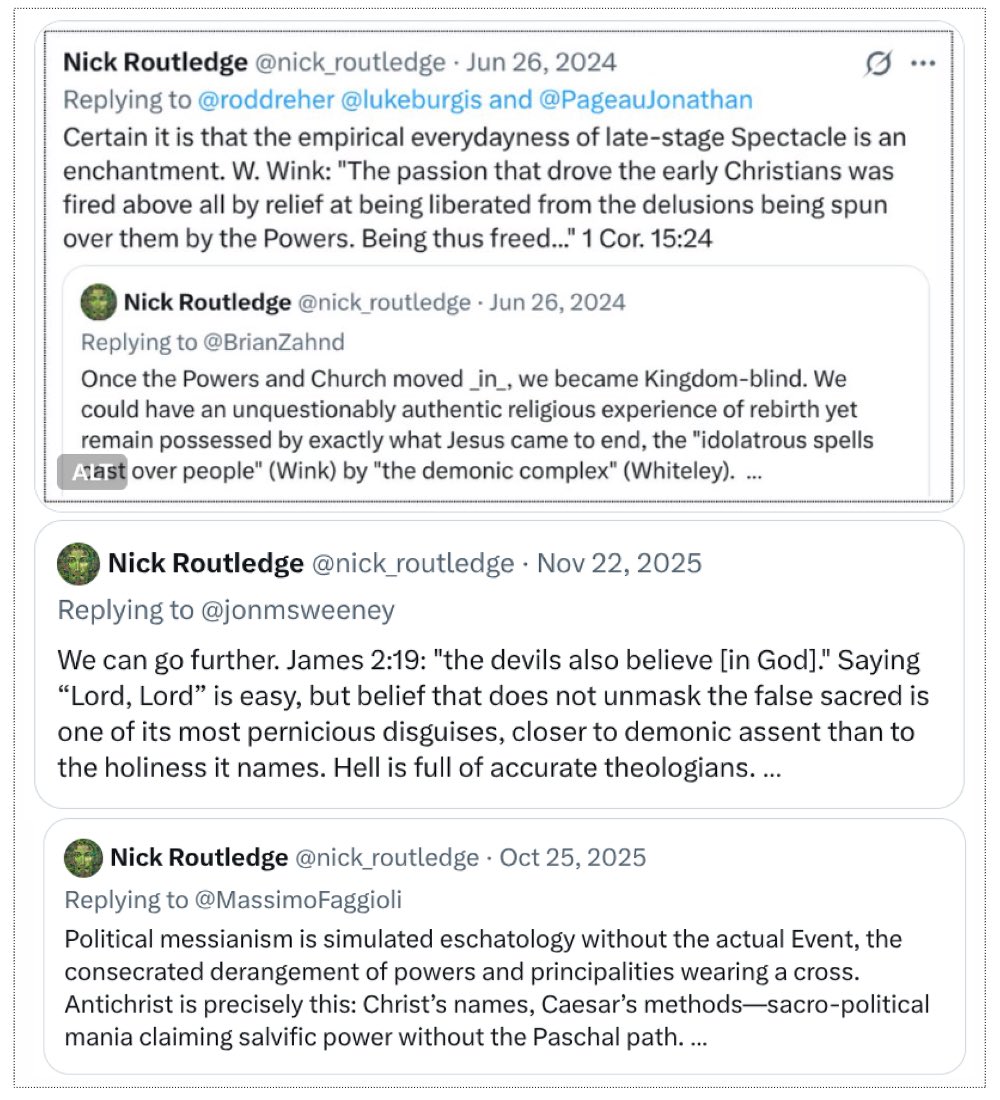
Image description
Extended description
Image of tweet: @nick_routledge Certain it is that the empirical everydayness of late-stage Spectacle is an enchantment. W. Wink: "The passion that drove the early Christians was fired above all by relief at being liberated from the delusions being spun over them by the Powers. Being thus freed..." 1 Cor. 15:24 Once the Powers and Church moved _in_, we became Kingdom-blind. We could have an unquestionably authentic religious experience of rebirth yet remain possessed by exactly what Jesus came to end, the "idolatrous spells cast over people" (Wink) by "the demonic complex" Quote tweet: We can go further. James 2:19: "the devils also believe [in God]." Saying “Lord, Lord” is easy, but belief that does not unmask the false sacred is one of its most pernicious disguises, closer to demonic assent than to the holiness it names. Hell is full of accurate theologians. Political messianism is simulated eschatology without the actual Event, the consecrated derangement of powers and principalities wearing a cross. Antichrist is precisely this: Christ’s names, Caesar’s methods—sacro-political mania claiming salvific power without the Paschal path.
Open original document