
RT @nick_routledge: @AStratelates @suzania 1/ Traditions that have spent millennia refining attention, perception, interior discipline and the structure of consciousness have something to teach us. 1 Thess 5:21 doesn’t come with a clause about acceptable sources. If Christ is the Logos, then all truth participates in Him.
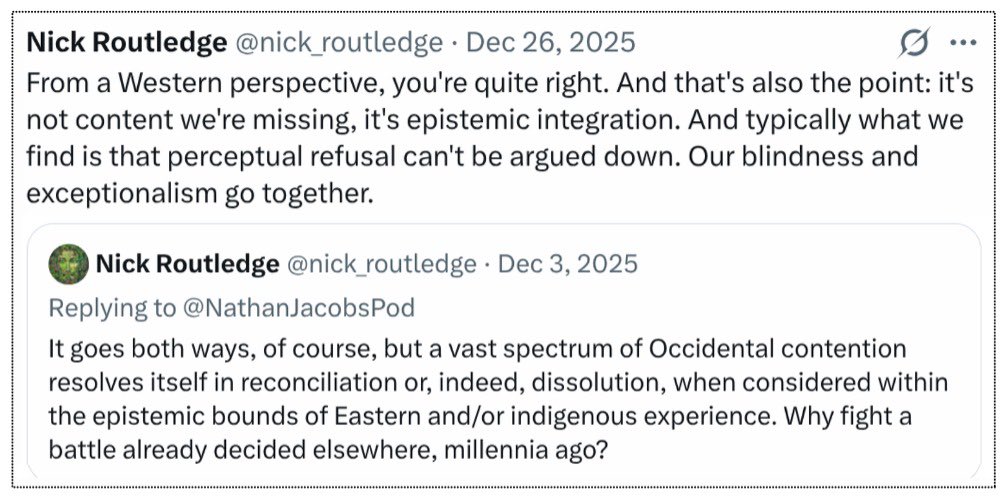
Image description
Original X alt text
Copy of tweet here: @ShirleyStockar2 and @jonkay From a Western perspective, you're quite right. And that's also the point: it's not content we're missing, it's epistemic integration. And typically what we find is that perceptual refusal can't be argued down. Our blindness and exceptionalism go together. Subtweet: It goes both ways, of course, but a vast spectrum of Occidental contention resolves itself in reconciliation or, indeed, dissolution, when considered within the epistemic bounds of Eastern and/or indigenous experience. Why fight a battle already decided elsewhere, millennia ago?
@CarlMcColman Nobody has yet articulated a Buddhist metaphysical grammar fusing eschatological drama and incarnational stakes. I suspect fusion, if it comes, will be born of reality itself evolving—contemplative depth co-constituted through dynamic reciprocity, alive to context and current.
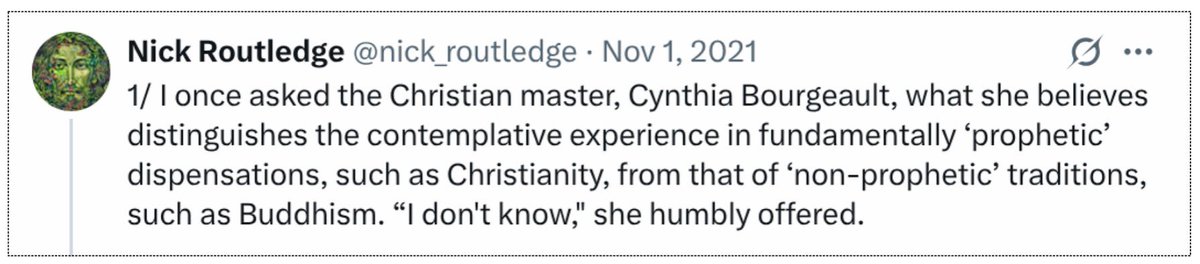
Image description
Original X alt text
Copy of tweet here: 1/ I once asked the Christian master, Cynthia Bourgeault, what she believes distinguishes the contemplative experience in fundamentally ‘prophetic’ dispensations, such as Christianity, from that of ‘non-prophetic’ traditions, such as Buddhism. “I don't know," she humbly offered.