
@FrontPorchRepub end\ This exchange—this reciprocity—is, I think, the deep structure of incarnate life. The sacred is not above the clay. It is what the clay alone, pressed against long enough, teaches—matter is not the obstacle but the way through, the hands its pilgrim, the ground its shrine.
@HaddenTurner @affinitytalks end\ It seems fitting that today is 'Plough Monday'—the year’s anointing: scent of turned earth and shared bread, sweat as prayer, hands as liturgy. Cross-shaped work, quietly faithful—Paradise and Kingdom collapsing into one incarnate Yes, refusing mastery, refusing escape.
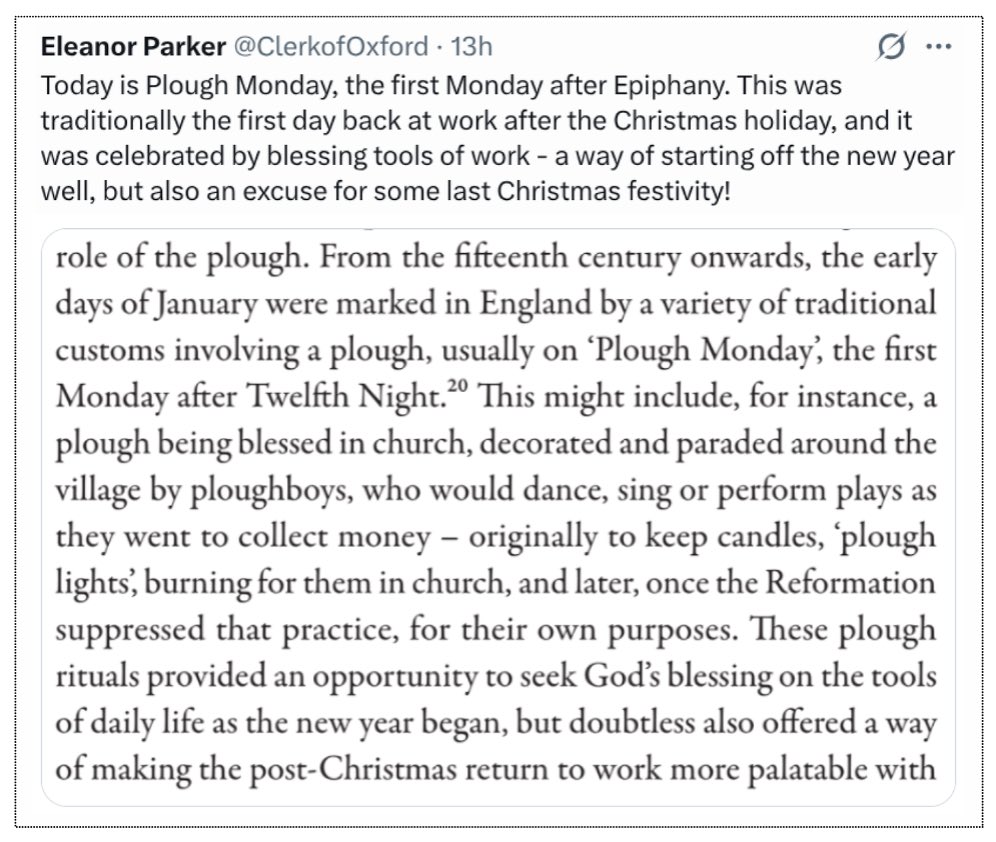
Image description
Extended description
Eleanor Parker Today is Plough Monday, the first Monday after Epiphany. This was traditionally the first day back at work after the Christmas holiday, and it was celebrated by blessing tools of work - a way of starting off the new year well, but also an excuse for some last Christmas festivity! …role of the plough. From the fifteenth century onwards, the early days of January were marked in England by a variety of traditional customs involving a plough, usually on ‘Plough Monday, the first Monday after Twelfth Night.” This might include, for instance, a plough being blessed in church, decorated and paraded around the village by ploughboys, who would dance, sing or perform plays as they went to collect money — originally to keep candles, ‘plough lights, burning for them in church, and later, once the Reformation suppressed that practice, for their own purposes. These plough rituals provided an opportunity to seck God's blessing on the tools of daily life as the new year began, but doubtless also offered a way of making the post-Christmas return to work more palatable with…
Open original document