
@suzania McLuhan averred that any technology, pushed to extremes, generates the opposite of its promise. The mediated abstraction of truth is no exception. At their limit, anti-incarnational powers no longer secure reality but sever themselves from it, their logic consumed from within.
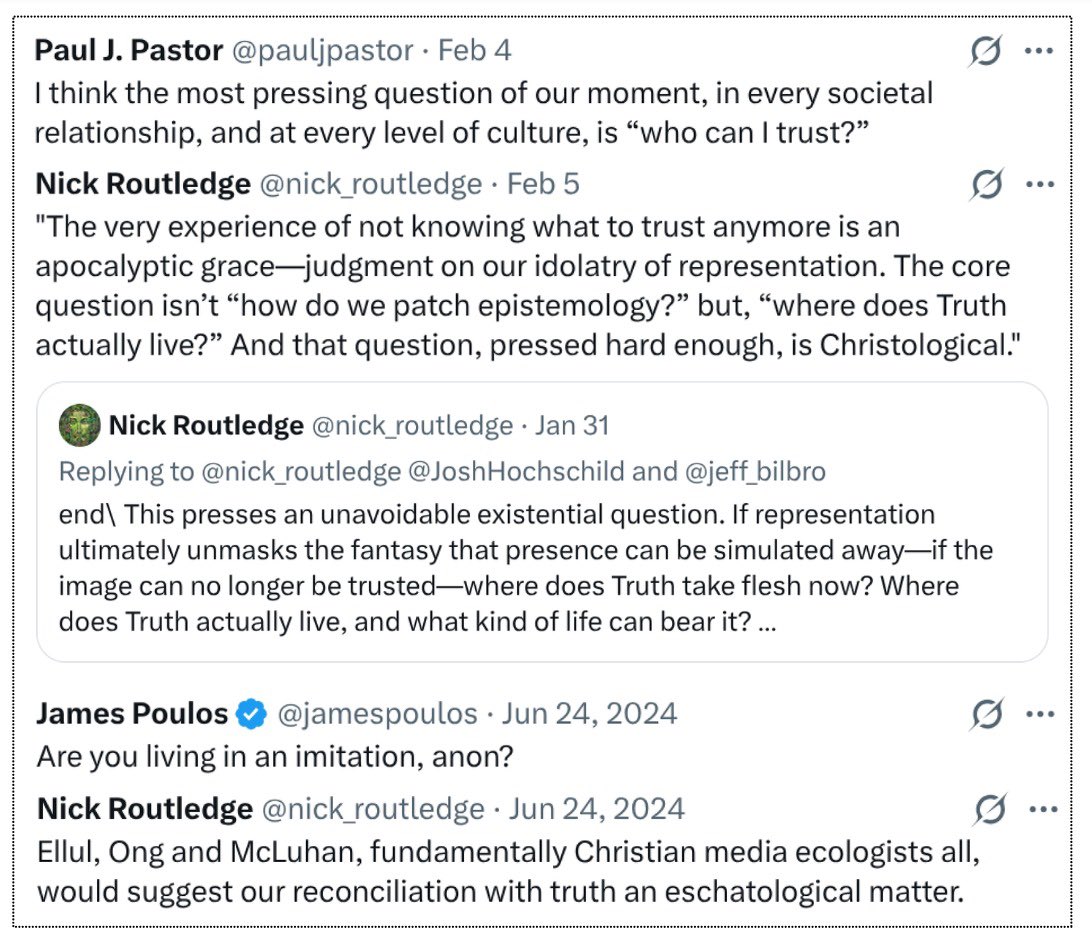
Image description
Original X alt text
Alt-txt available here:
Extended description
I think the most pressing question of our moment, in every societal relationship, and at every level of culture, is “who can I trust?” "The very experience of not knowing what to trust anymore is an apocalyptic grace—judgment on our idolatry of representation. The core question isn’t “how do we patch epistemology?” but, “where does Truth actually live?” And that question, pressed hard enough, is Christological." end\ This presses an unavoidable existential question. If representation ultimately unmasks the fantasy that presence can be simulated away—if the image can no longer be trusted—where does Truth take flesh now? Where does Truth actually live, and what kind of life can bear it? – Are you living in an imitation, anon? Ellul, Ong and McLuhan, fundamentally Christian media ecologists all, would suggest our reconciliation with truth an eschatological matter.
Open original document@tenshi_anna The case can be made that Negarestani's concept of intelligence as a normative achievement—built and maintained through costly, friction-laden, mutually accountable practices—offers a precise secular cognate to an eschatological conception of what trust habitats are and require.
View this post’s context →