
@ClarkeMicah @Smithey21026 Where common sense, decency, and, above all, a disciplined moral and ontological vision are recoded as pathology, the inversion does its own revealing. Folk disclose themselves more clearly than they imagine.
@NoyOrly The deeper lesson is how Iran repeatedly scales the death penalty to reconstitute political order from within. While different in magnitude from 1988's mass executions, the 2025 surge held to the same template—eliminating those cast as threats to the regime's theocratic mandate.
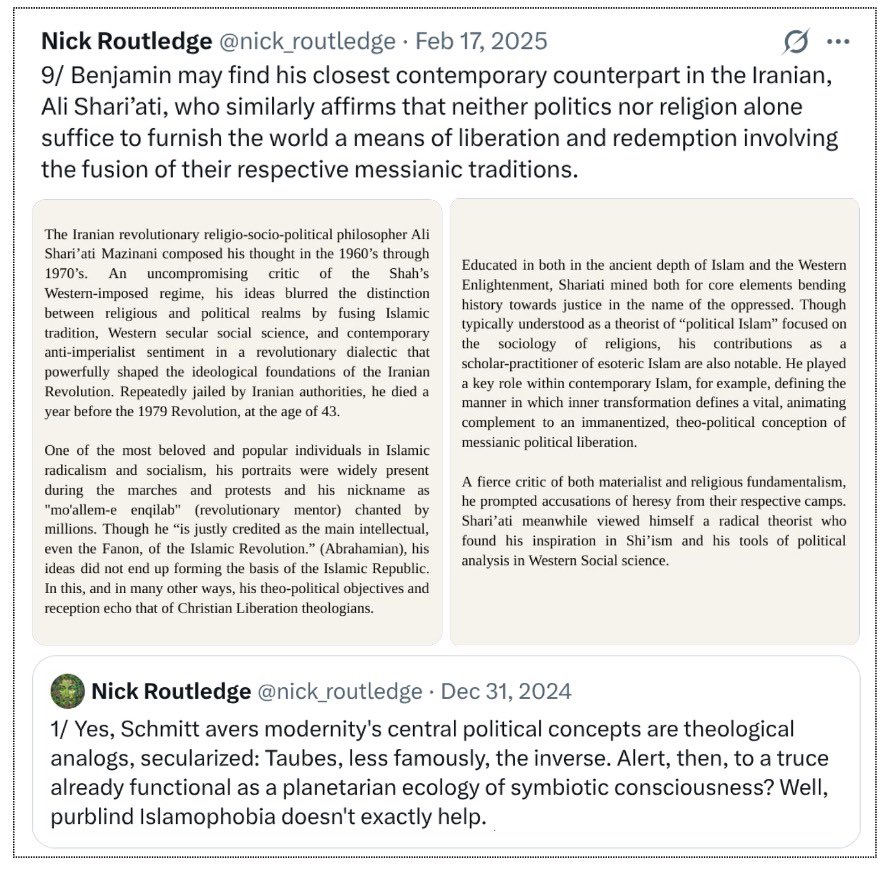
Image description
Extended description
9/ Benjamin may find his closest contemporary counterpart in the Iranian, Ali Shari’ati, who similarly affirms that neither politics nor religion alone suffice to furnish the world a means of liberation and redemption involving the fusion of their respective messianic traditions. Images: The Iranian revolutionary religio-socio-political philosopher Ali Shari’ati Mazinani composed his thought in the 1960’s through 1970’s. An uncompromising critic of the Shah’s regime, his ideas blurred the distinction between religious and political realms by fusing Islamic tradition, Western secular social science, and contemporary anti-imperialist sentiment in a revolutionary dialectic that powerfully shaped the ideological foundations of the Iranian Revolution. Repeatedly jailed by Iranian authorities, he died a year before the 1979 Revolution, at the age of 43. One of the most beloved and popular individuals in Islamic radicalism and socialism, his portraits were widely present during the marches and protests and his nickname as "mo'allem-e enqilab" (revolutionary mentor) chanted by millions. Though he “is justly credited as the main intellectual, even the Fanon, of the Islamic Revolution.” (Abrahamian), his ideas did not end up forming the basis of the Islamic Republic. In this, and in many other ways, his theo-political objectives and reception echo that of Christian Liberation theologians. Educated in both in the ancient depth of Islam and the Western Enlightenment, Shariati mined both for core elements bending history towards justice in the name of the oppressed. Though typically understood as a theorist of “political Islam” focused on the sociology of religions, his contributions as a scholar-practitioner of esoteric Islam are also notable. He played a key role within contemporary Islam, for example, defining the manner in which inner transformation defines a vital, animating complement to an immanentized, theo-political conception of messianic political liberation. A fierce critic of both materialist and religious fundamentalism, he prompted accusations of heresy from their respective camps. Shari’ati meanwhile viewed himself a radical theorist who found his inspiration in Shi’ism and his tools of political analysis in Western Social science. Subtweet: 1/ Yes, Schmitt avers modernity's central political concepts are theological analogs, secularized: Taubes, less famously, the inverse. Alert, then, to a truce already functional as a planetarian ecology of symbiotic consciousness? Well, purblind Islamophobia doesn't exactly help.
Open original document