
@suzania @Plough The pressure from below of an indigenous perspective would be most refreshing and likely, surprising. Also, the always remarkable Catherine Keller, on the subject of intercarnation/entanglement, could perhaps describe a bridge between identity's horizontal and vertical planes.
6/ Every collapse unveils the alternative. Incarnation is apocalypse—love unveiled as the law of reality. Empire is unmasked, solidarity revealed, and history itself bent toward liberation. Entanglement is exposed as the condition of being itself.
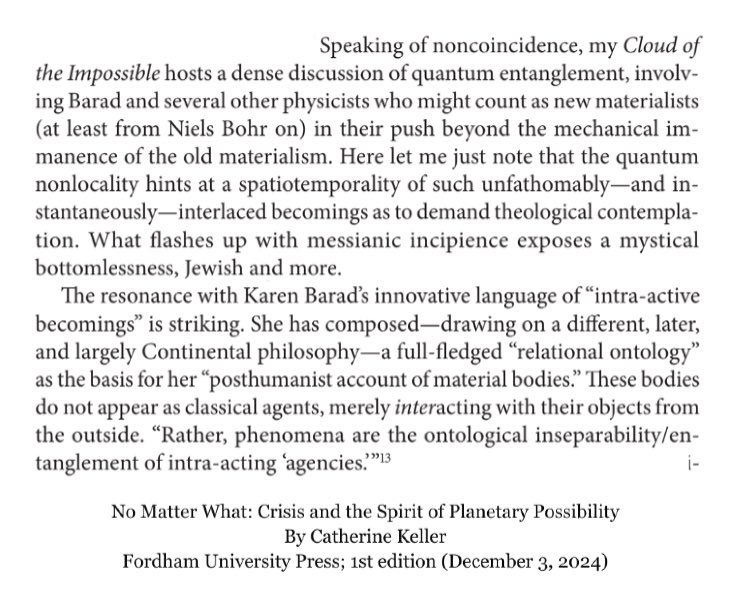
Image description
Original X alt text
Speaking of noncoincidence, my Cloud of the Impossible hosts a dense discussion of quantum entanglement, involving Barad and several other physicists who might count as new materialists in their push beyond the mechanical immanence of the old materialism. Here let me just note that the quantum nonlocality hints at a spatiotemporality of such unfathomably—and instantaneously—interlaced becomings as to demand theological contemplation. What flashes up with messianic incipience exposes a mysticalbottomlessness, Jewish and more. The resonance with Karen Barad’s innovative language of “intra-active becomings” is striking. She has composed—drawing on a later, and largely Continental philosophy—a full-fledged “relational ontology” as the basis for her “posthumanist account of material bodies.” These bodies do not appear as classical agents, merely interacting with their objects from the outside. “Rather, phenomena are the ontological inseparability/entanglement of intra-acting ‘agencies.
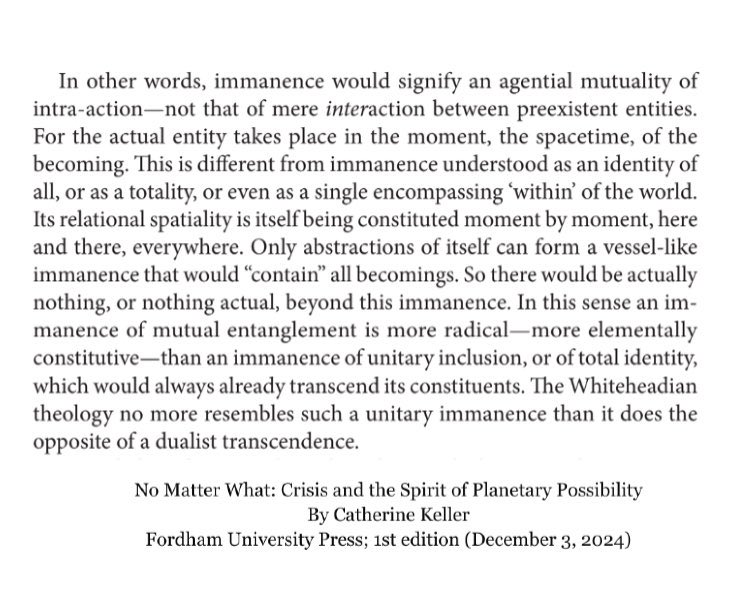
Image description
Original X alt text
In other words, immanence would signify an agential mutuality of intra-action—not that of mere interaction between preexistent entities. For the actual entity takes place in the moment, the spacetime, of the becoming. This is different from immanence understood as an identity of all, or as a totality, or even as a single encompassing ‘within’ of the world. Its relational spatiality is itself being constituted moment by moment, here and there, everywhere. Only abstractions of itself can form a vessel-like immanence that would “contain” all becomings. So there would be actually nothing, or nothing actual, beyond this immanence. In this sense an immanence of mutual entanglement is more radical —more elementally constitutive—than an immanence of unitary inclusion, or of total identity, which would always already transcend its constituents. The Whiteheadian theology no more resembles such a unitary immanence than it does the opposite of a dualist transcendence.