
Nick Routledge@nick_routledge
Reply to @serbiaireland

@serbiaireland True as testimony, partial as verdict. Spoken from inside a specific seeing, at cost, after long watching, the claim has the weight of earned judgment. Yet seeing the monsters doesn't place us outside the field. It situates us inside the reckoning. The parousia exposes everyone.
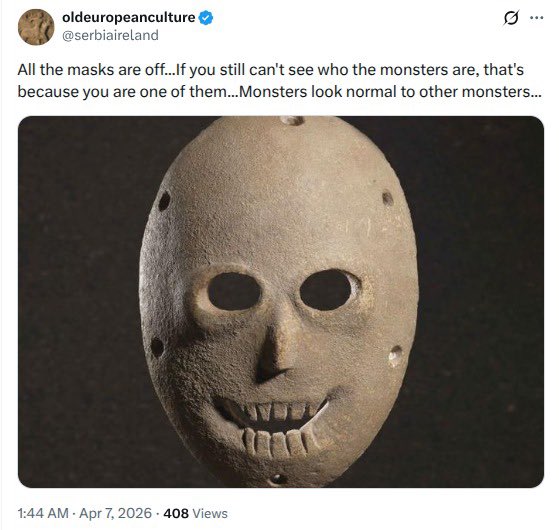
oldeuropeanculture
All the masks are off...If you still can't see who the monsters are, that's because you are one of them...Monsters look normal to other monsters...

Photograph of mask
Image description

Original X alt text

oldeuropeanculture All the masks are off...If you still can't see who the monsters are, that's because you are one of them...Monsters look normal to other monsters... Photograph of mask

Quoted or linked post

Nick Routledge@nick_routledge · 19 Feb 2026

29/ The Parousia is not another disclosure offered for acceptance or refusal. It is the collapse of conditions making sustained non-recognition possible—cultural buffers, institutional mediation, and the illusion of distance that makes rejection of truth psychologically 'viable.'
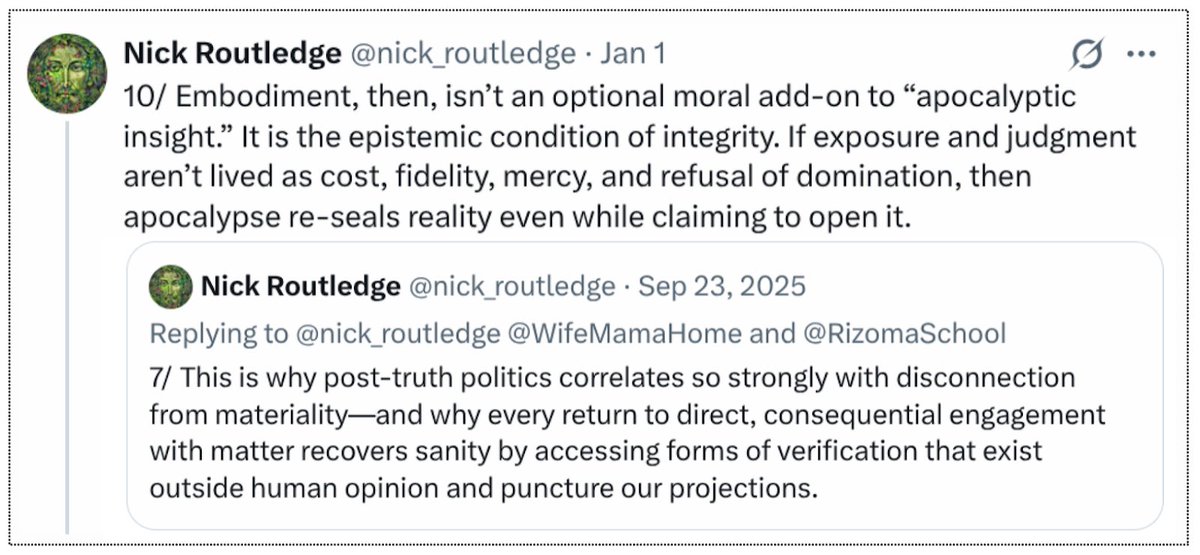
Copy of tweet here:

10/ Embodiment, then, isn’t an optional moral add-on to “apocalyptic insight.” It is the epistemic condition of integrity. If exposure and judgment aren’t lived as cost, fidelity, mercy, and refusal of domination, then apocalypse re-seals reality even while claiming to open it.

Quote tweet:
nick_routledge
7/ This is why post-truth politics correlates so strongly with disconnection from materiality—and why every return to direct, consequential engagement with matter recovers sanity by accessing forms of verification that exist outside human opinion and puncture our projections.
Image description

Original X alt text

Copy of tweet here: 10/ Embodiment, then, isn’t an optional moral add-on to “apocalyptic insight.” It is the epistemic condition of integrity. If exposure and judgment aren’t lived as cost, fidelity, mercy, and refusal of domination, then apocalypse re-seals reality even while claiming to open it. Quote tweet: nick_routledge 7/ This is why post-truth politics correlates so strongly with disconnection from materiality—and why every return to direct, consequential engagement with matter recovers sanity by accessing forms of verification that exist outside human opinion and puncture our projections.

View this post’s context →

Context in the archive

Quoted by@HenryGiroux At some point, "I don't see the evil in it" stops being an admission of blindness and becomes a confession of identity—a diagnosis, not an alibi. The monstrous is only illegible to the monstrous. That gap isn't one of information—what we see—but of being: what people have become.Quoted by@firstthingsmag end\ This coincidence is a meeting place: not because either structure concedes ground, but because both lose the ground their antagonism requires. Messianic accord begins where revelation discredits and transcends the dominative epistemic frame that constitutes them as enemies.