
@mbird12 @profntwright Mary came to mourn matter's defeat. She leaves as the first witness to matter's redemption. The Gardener-King unlocks matter's resurrective capacity, not escape but the whole earth quickened, brought into the life it was made to bear. Planetary parousia completes it. #Easter
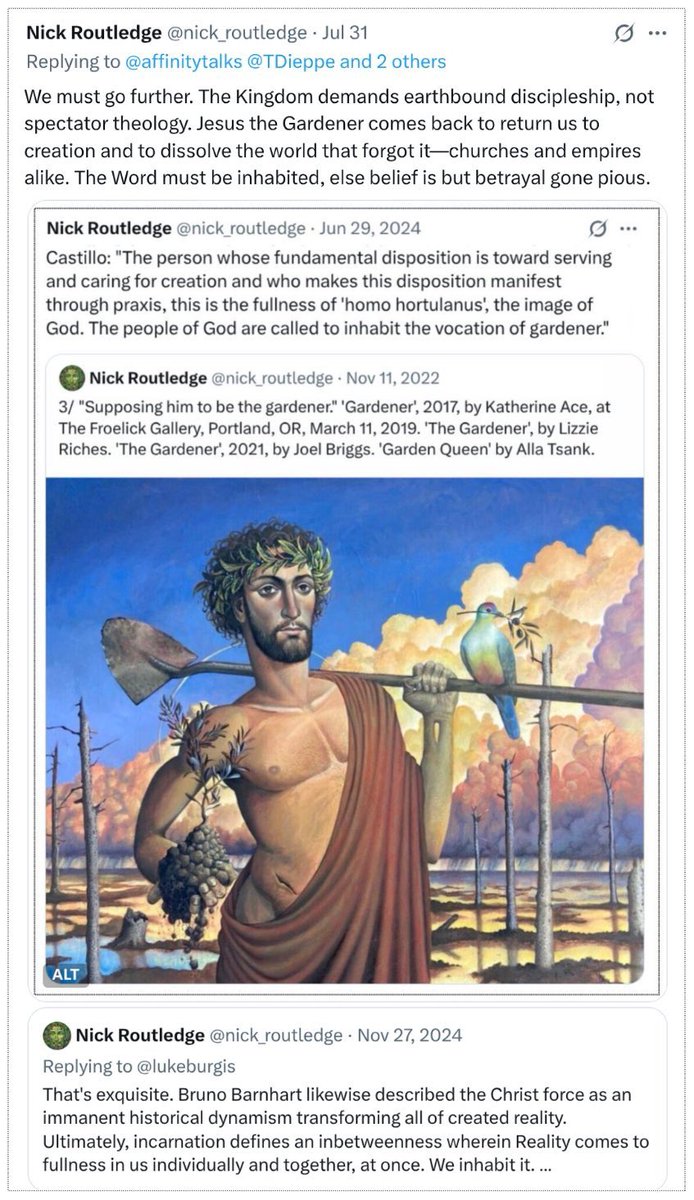
Image description
Extended description
We must go further. The Kingdom demands earthbound discipleship, not spectator theology. Jesus the Gardener comes back to return us to creation and to dissolve the world that forgot it—churches and empires alike. The Word must be inhabited, else belief is but betrayal gone pious. Castillo: "The person whose fundamental disposition is toward serving and caring for creation and who makes this disposition manifest through praxis, this is the fullness of 'homo hortulanus', the image of God. The people of God are called to inhabit the vocation of gardener." 3/ "Supposing him to be the gardener." 'Gardener', 2017, by Katherine Ace, at The Froelick Gallery, Portland, OR, March 11, 2019. 'The Gardener', by Lizzie Riches. 'The Gardener', 2021, by Joel Briggs. 'Garden Queen' by Alla Tsank. Image of Jesus the Eschatological Gardener Subtweet: That's exquisite. Bruno Barnhart likewise described the Christ force as an immanent historical dynamism transforming all of created reality. Ultimately, incarnation defines an inbetweenness wherein Reality comes to fullness in us individually and together, at once. We inhabit it.
Open original document@Plough @BenQuash 14/ This isn't metaphor. When human and earthly repair converge, we're witnessing deep incarnation taking form—the eschaton breaking into present reality. Beauty intensifies because the world is being reconciled to its source, participating more fully in the radiant glory of God.
View this post’s context →