
Kahlil Gibran was born Maronite Christian in Bsharri, Lebanon's "city of churches" and the only location where the Lebanese Cedar still grows natively. "The Maronite Patriarchate would let the rumor of his excommunication wander, but would never officially pronounce it.” Why?
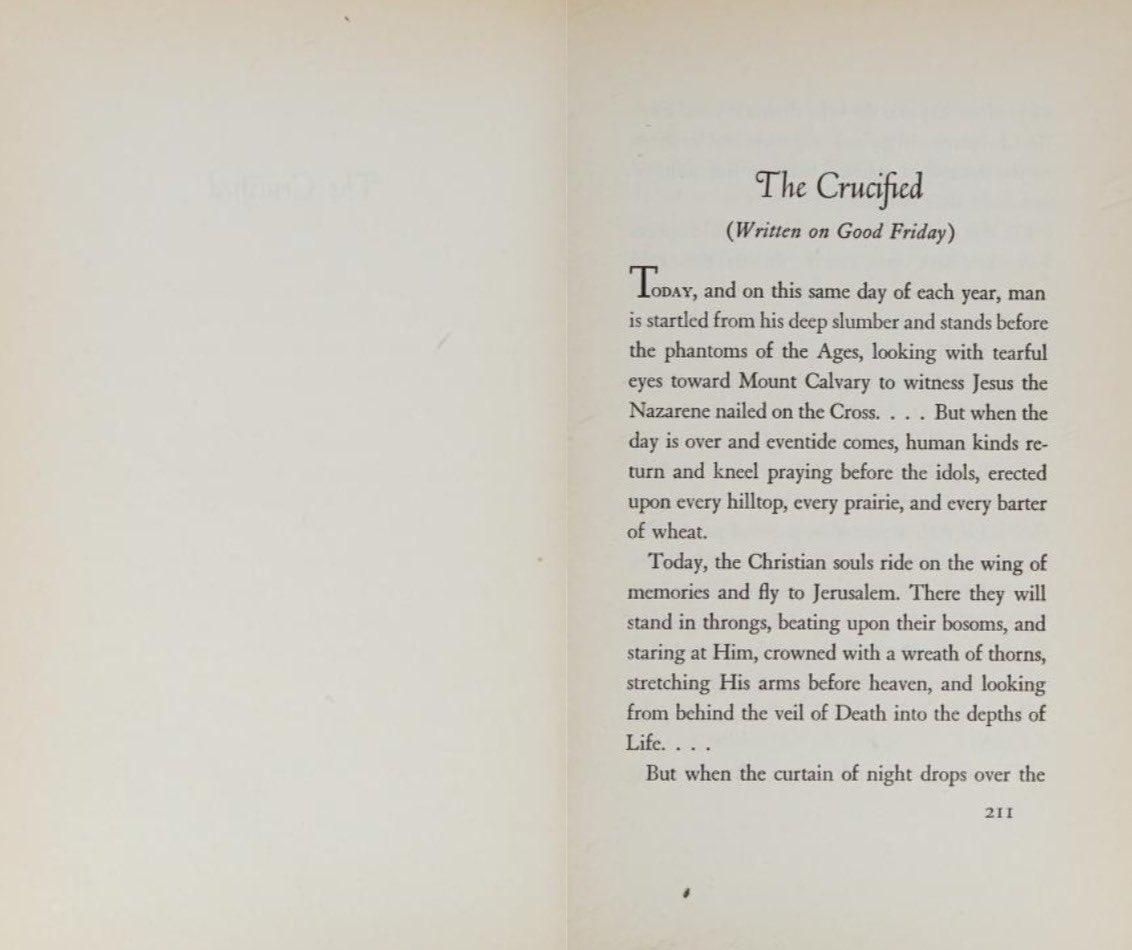
Image description
Extended description
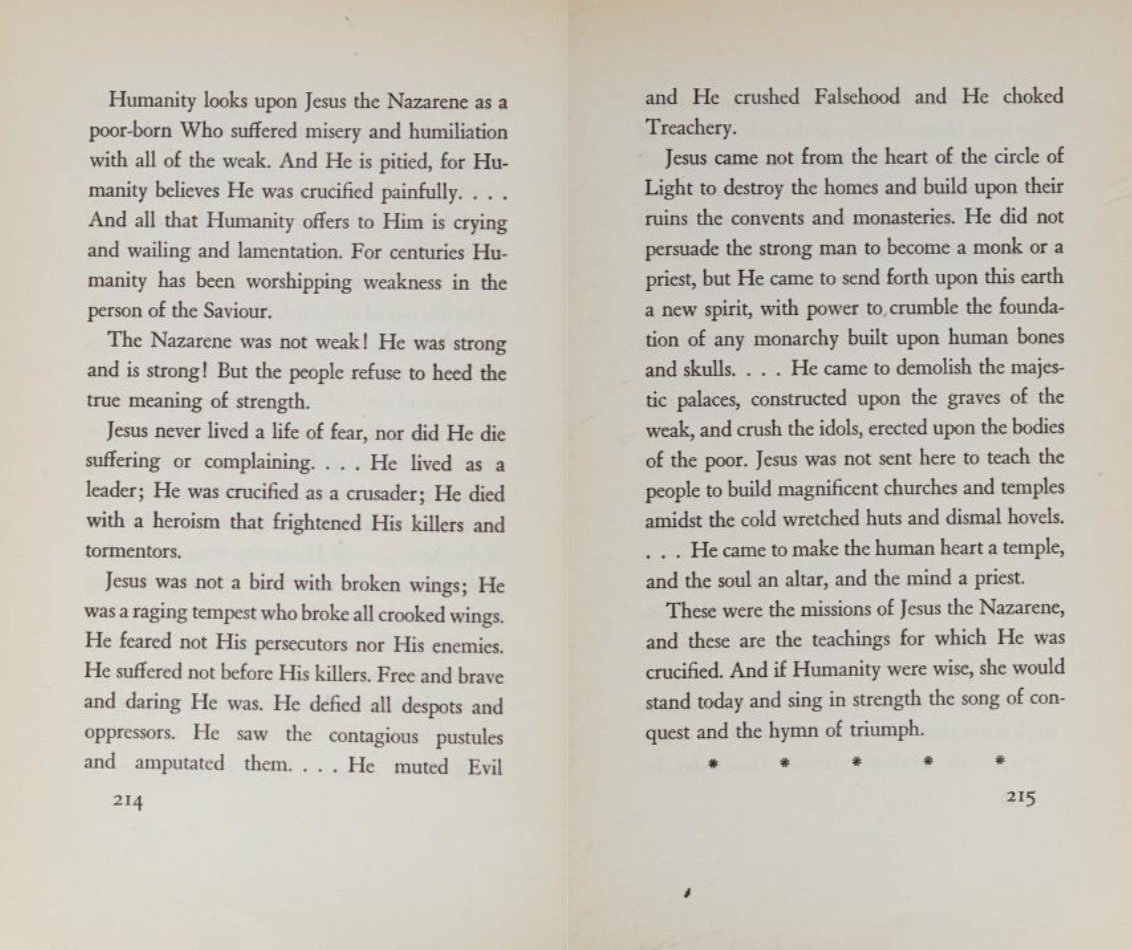
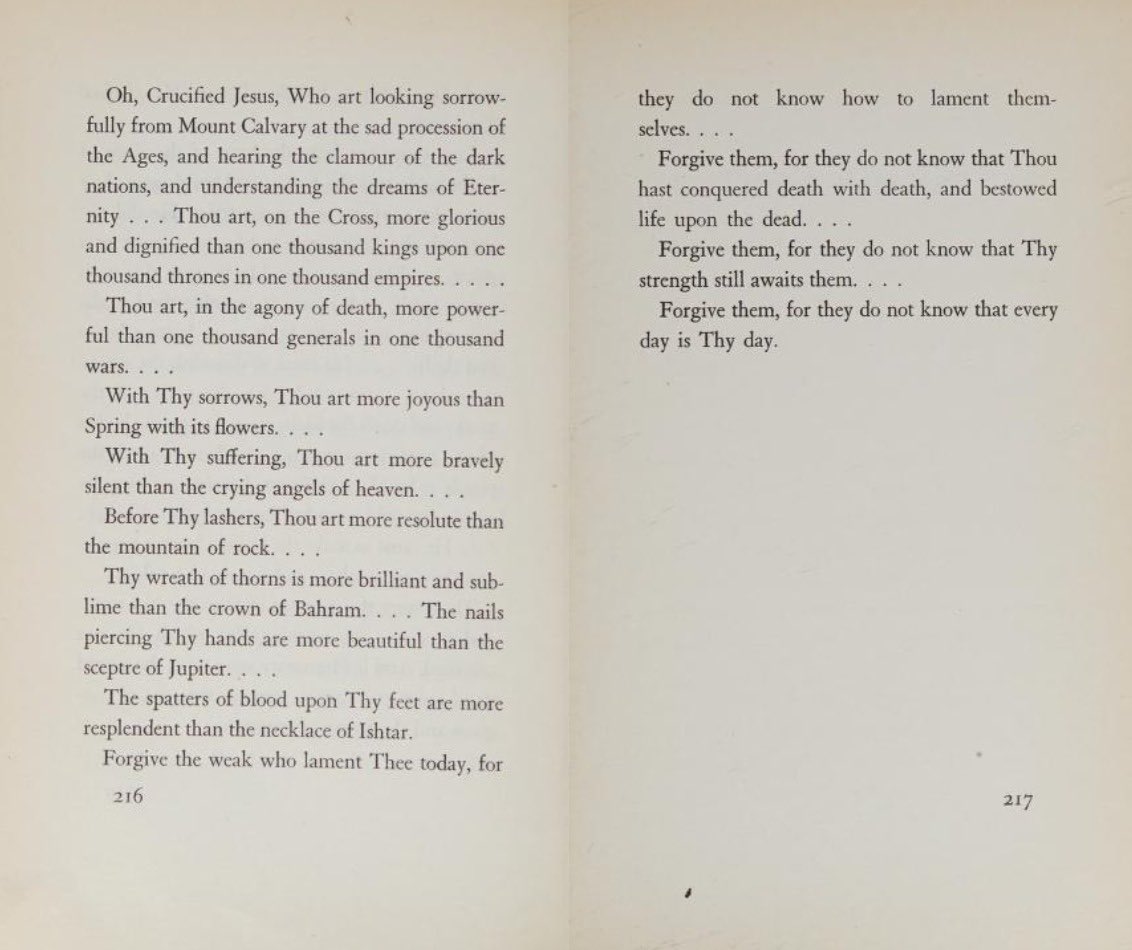
The Crucified, by Kahlil Gibran Written upon Good Friday Today, and on this same day of each year, man is startled from his deep slumber and stands before the phantoms of the Ages, looking with tearful eyes toward Mount Calvary to witness Jesus the Nazarene nailed on the Cross.... But when the day is over and eventide comes, human kinds return and kneel praying before the idols, erected upon every hilltop, every prairie, and every barter of wheat. Today, the Christian souls ride on the wing of memories and fly to Jerusalem. There they will stand in throngs, beating upon their bosoms, and staring at Him, crowned with a wreath of thorns, stretching His arms before heaven, and looking from behind the veil of Death into the depths of Life.... But when the curtain of night drops over the stage of the day and the brief drama is concluded, the Christians will go back in groups and lie down in the shadow of oblivion between the quilts of ignorance and slothfulness. On this one day of each year, the philosophers leave their dark caves, and the thinkers their cold cells, and the poets their imaginary arbors, and all stand reverently upon that silent mountain, listening to the voice of a young man saying of His killers, "Oh Father, forgive them, for they know not what they are doing." But as dark silence chokes the voices of the light, the philosophers and the thinkers and the poets return to their narrow crevices and shroud their souls with meaningless pages of parchment. The women who busy themselves in the splendour of Life will bestir themselves today from their cushions to see the sorrowful woman standing before the Cross like a tender sapling before the raging tempest; and when they approach near to her, they will hear a deep moaning and a painful grief. The young men and women who are racing with the torrent of modern civilization will halt today for a moment, and look backward to see the young Magdalen washing with her tears the blood stains from the feet of a Holy Man suspended between Heaven and Earth; and when their shallow eyes weary of the scene they will depart and soon laugh. On this day of each year, Humanity wakes with the awakening of Spring, and stands crying below the suffering Nazarene; then she closes her eyes and surrenders herself to a deep slumber. But Spring will remain awake, smiling and progressing until merged into Summer, dressed in scented golden raiment. Humanity is a mourner who enjoys lamenting the memories and heroes of the Ages.... If Humanity were possessed of understanding, there would be rejoicing over their glory. Humanity is like a child standing in glee by a wounded beast. Humanity laughs before the strengthening torrent which carries into oblivion the dry branches of the trees, and sweeps away with determination all things not fastened by strength. Humanity looks upon Jesus the Nazarene as a poor-born Who suffered misery and humiliation with all of the weak. And He is pitied, for Humanity believes He was crucified painfully.... And all that Humanity offers to Him is crying and wailing and lamentation. For centuries Humanity has been worshipping weakness in the person of the Saviour. The Nazarene was not weak! He was strong and is strong! But the people refuse to heed the true meaning of strength. Jesus never lived a life of fear, nor did He die suffering or complaining.... He lived as a leader; He was crucified as a crusader; He died with a heroism that frightened His killers and tormentors. Jesus was not a bird with broken wings; He was a raging tempest who broke all crooked wings. He feared not His persecutors nor His enemies. He suffered not before His killers. Free and brave and daring He was. He defied all despots and oppressors. He saw the contagious pustules and amputated them.... He muted Evil and He crushed Falsehood and He choked Treachery. Jesus came not from the heart of the circle of Light to destroy the homes and build upon their ruins the convents and monasteries. He did not persuade the strong man to become a monk or a priest, but He came to send forth upon this earth a new spirit, with power to crumble the foundation of any monarchy built upon human bones and skulls.... He came to demolish the majestic palaces, constructed upon the graves of the weak, and crush the idols, erected upon the bodies of the poor. Jesus was not sent here to teach the people to build magnificent churches and temples amidst the cold wretched huts and dismal hovels.... He came to make the human heart a temple, and the soul and altar, and the mind a priest. These were the missions of Jesus the Nazarene, and these are the teachings for which He was crucified. And if Humanity were wise, she would stand today and sing in strength the song of conquest and the hymn of triumph. Oh, Crucified Jesus, Who are looking sorrowfully from Mount Calvary at the sad procession of the Ages, and hearing the clamour of the dark nations, and understanding the dreams of Eternity... Thou art, on the Cross, more glorious and dignified than one thousand kings upon one thousand thrones in one thousand empires.... Thou art, in the agony of death, more powerful than one thousand generals in one thousand wars.... With Thy sorrows, Thou art more joyous than Spring with its flowers.... With Thy suffering, Thou art more bravely silent than the crying angels of heaven.... Before Thy lashers, Thou art more resolute than the mountain of rock.... Thy wreath of thorns is more brilliant and sublime than the crow of Bahram.... The nails piercing Thy hands are more beautiful than the sceptre of Jupiter.... The spatters of blood upon Thy feet are more resplendent than the necklace of Ishtar. Forgive the weak who lament Thee today, for they do not know how to lament themselves.... Forgive them, for they do not know that Thou has conquered death with death, and bestowed life upon the dead.... Forgive them, for they do not know that Thy strength still awaits them.... Forgive them, for they do not know that every day is Thy day. [The Crucified (Arabic: Yasūʿ al-Maṣlūb) was written by Kahlil Gibran as a Good Friday prose meditation and first published on April 14, 1911 in the New York Arabic-language newspaper Mira'at al-Gharb, before being reprinted in 1919 in the Cairo journal Al-Hilal. Despite later mid-20th-century translation efforts around Gibran’s Arabic works (including those by Anthony Rizcallah Ferris), there is no clear evidence that this specific piece was translated into English at that time; it entered English reliably only in the late 20th century through the work of Suheil Bushrui, whose translations—such as those collected in The Vision—are now the standard scholarly source for the full text.]
Open original document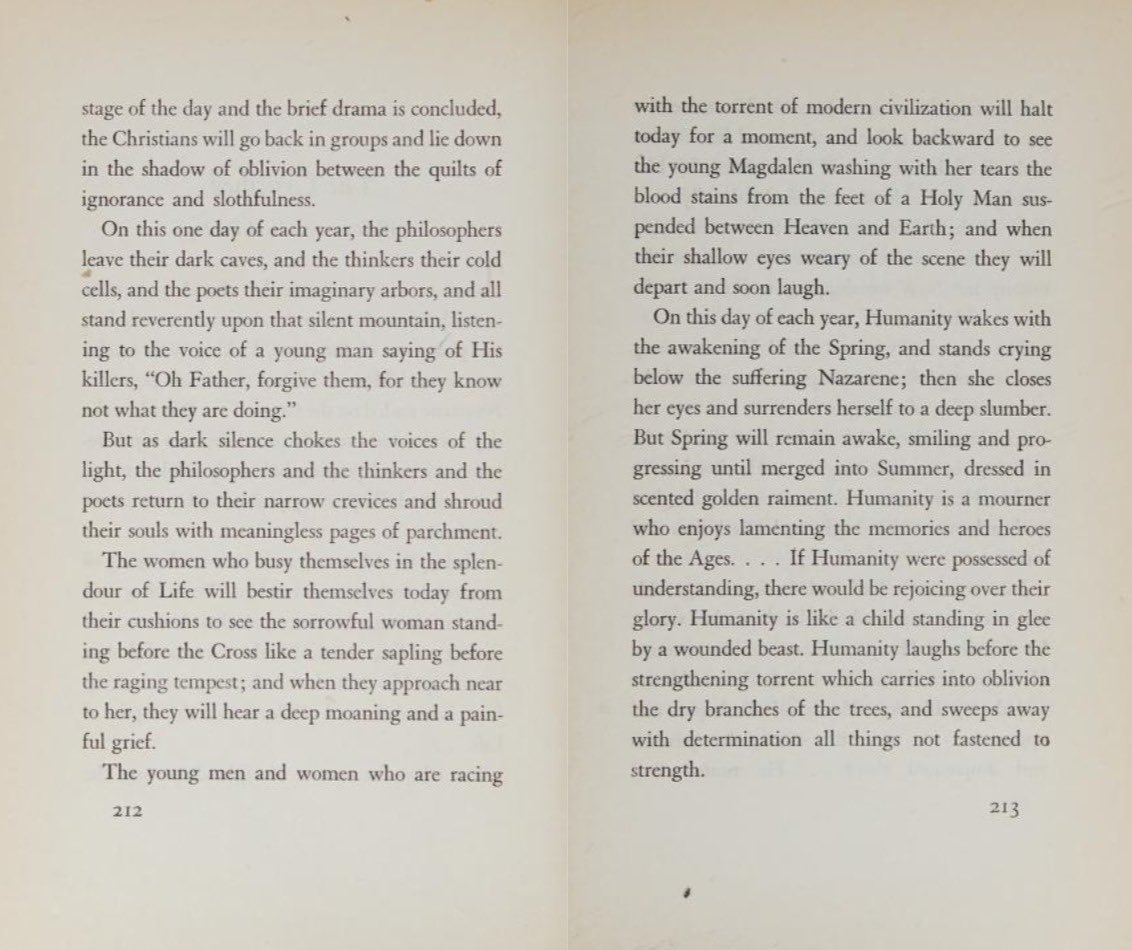
@CACRadicalGrace @brianmclaren "Forgive them, for they do not know that Thy strength still awaits them." For more than a decade now, I've made it a yearly habit to repost this piece, 'The Crucified', penned on #GoodFriday, 1913, by Kahlil Gibran, author of ‘The Prophet'. facebook.com/notes/3273665956062529