
RT @nick_routledge: @plunderedart The exhibition proceeds without the original, just as history itself proceeds without the Messiah's full arrival. For the living, a facsimile must suffice; the real angel remains where history goes to wait: Jerusalem.
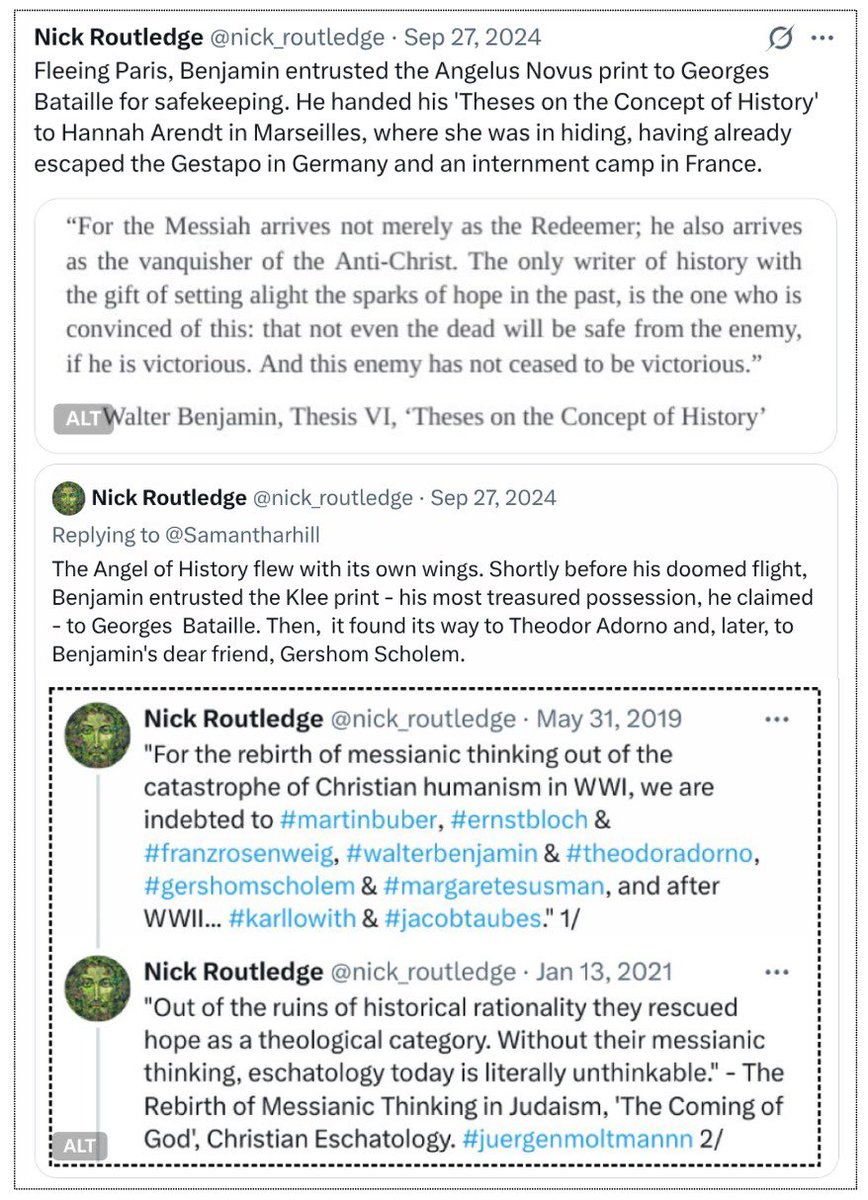
Image description
Extended description
Fleeing Paris, Benjamin entrusted the Angelus Novus print to Georges Bataille for safekeeping. He handed his 'Theses on the Concept of History' to Hannah Arendt in Marseilles, where she was in hiding, having already escaped the Gestapo in Germany and an internment camp in France. “For the Messiah arrives not merely as the Redeemer; he also arrives as the vanquisher of the Anti-Christ. The only writer of history with the gift of setting alight the sparks of hope in the past, is the one who is convinced of this: that not even the dead will be safe from the enemy, if he is victorious. And this enemy has not ceased to be victorious.” Walter Benjamin, Thesis VI, ‘Theses on the Concept of History’ Subtweet: The Angel of History flew with its own wings. Shortly before his doomed flight, Benjamin entrusted the Klee print - his most treasured possession, he claimed - to Georges Bataille. Then, it found its way to Theodor Adorno and, later, to Benjamin's dear friend, Gershom Scholem. "For the rebirth of messianic thinking out of the catastrophe of Christian humanism in WWI, we are indebted to #martinbuber, #ernstbloch & #franzrosenweig, #walterbenjamin & #theodoradorno, #gershomscholem & #margaretesusman, and after WWII... #karllowith & #jacobtaubes." 1/ "Out of the ruins of historical rationality they rescued hope as a theological category. Without their messianic thinking, eschatology today is literally unthinkable." - The Rebirth of Messianic Thinking in Judaism, 'The Coming of God', Christian Eschatology. #juergenmoltmannn 2/
Open original document@trippfuller 🧵1/12 'Opening up a revolutionary chance.' A question. Did Benjamin's messianic/revolutionary thesis ultimately succumb to a Franco-Vichy-Nazi storm uncannily paralleling the global, fascist surge of our time? The gas chambers were, of course, but a year ahead. Context, then.
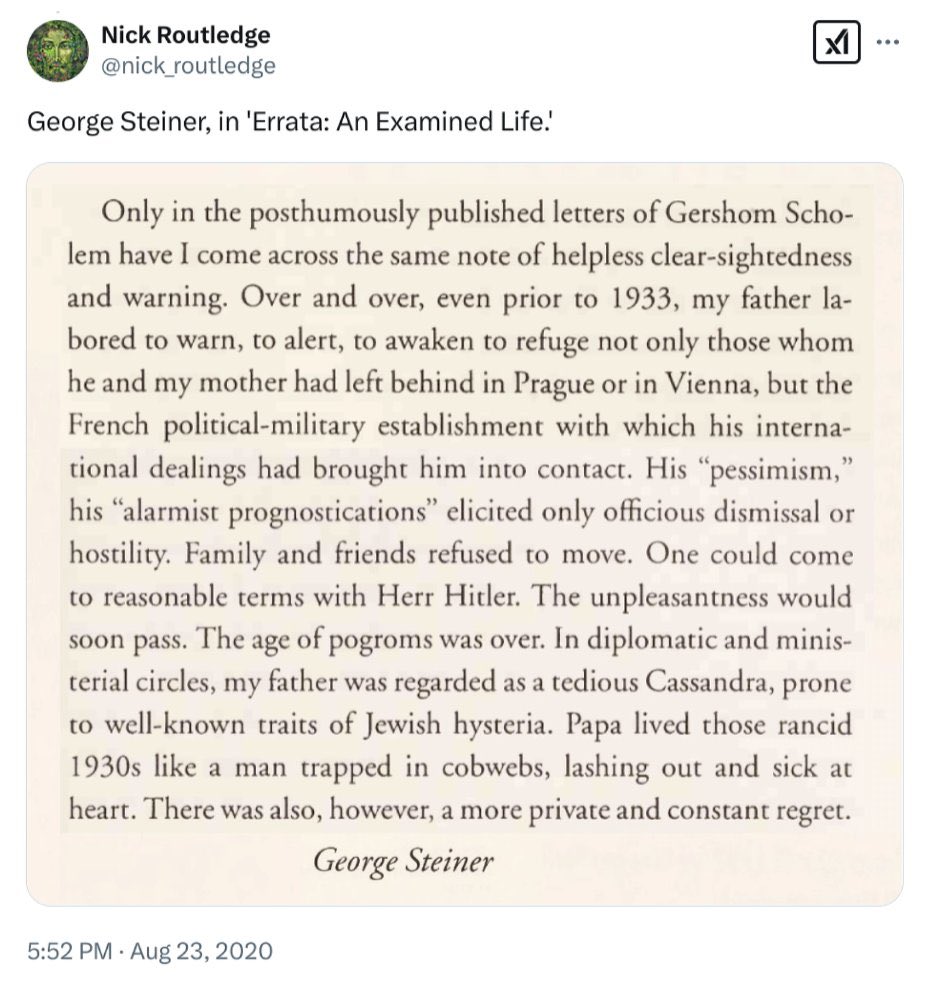
Image description
Original X alt text
Only in the posthumously published letters of Gershom Scholem have I come across the same note of helpless clear-sightedness and warning. Over and over, even prior to 1933, my father labored to warn, to alert, to awaken to refuge not only those whom he and my mother had left behind in Prague or in Vienna, but the French political-military establishment with which his international dealings had brought him into contact. His “pessimism,” his “alarmist prognostications” elicited only officious dismissal or hostility. Family and friends refused to move. One could come to reasonable terms with Herr Hitler. The unpleasantness would soon pass. The age of pogroms was over. In diplomatic and ministerial circles, my father was regarded as a tedious Cassandra, prone to well-known traits of Jewish hysteria. Papa lived those rancid 1930s like a man trapped in cobwebs, lashing out and sick at heart. There was also, however, a more private and constant regret. George Steiner