
@RobDoyle1 Actually, the Shi'ite 'Hidden Imam', and Khidr/Khezr, 'the Green One' of Islamic lore, are two among multiple personifications of a single, multifaceted, planetarian prophetological prototype—what Corbin calls "the rigorous unity of the prophetic Revelatory Principle in history."
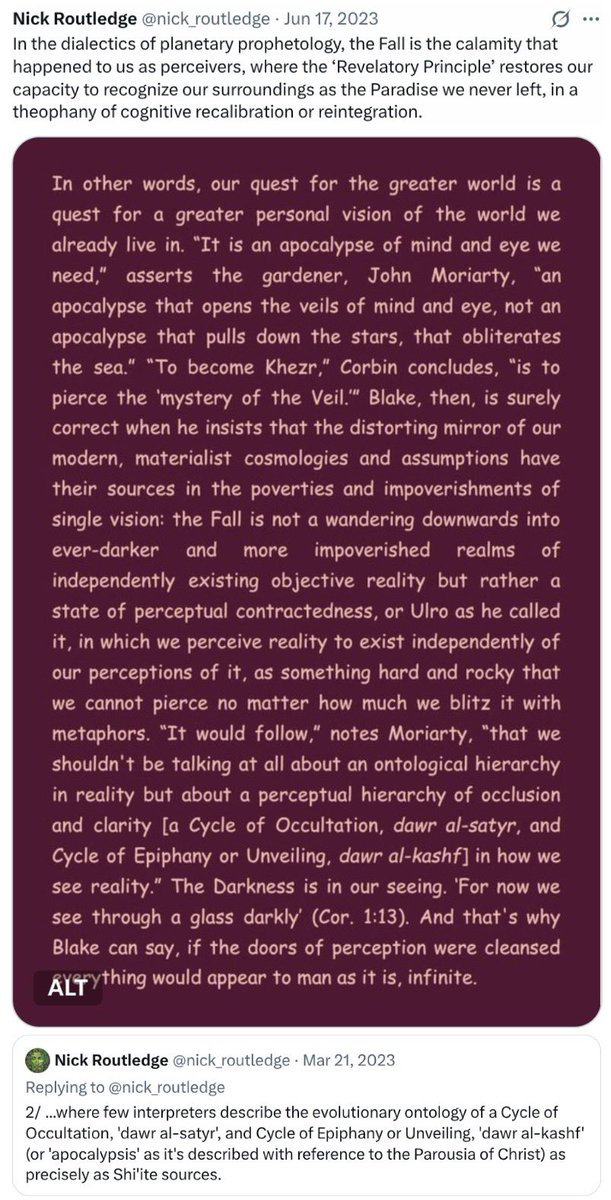
Image description
Extended description
In the dialectics of planetary prophetology, the Fall is the calamity that happened to us as perceivers, where the ‘Revelatory Principle’ restores our capacity to recognize our surroundings as the Paradise we never left, in a theophany of cognitive recalibration or reintegration. “It is an apocalypse of mind and eye we need,” asserts the gardener, John Moriarty, “an apocalypse that opens the veils of mind and eye, not an apocalypse that pulls down the stars, that obliterates the sea.” “To become Khezr,” Corbin concludes, “is to pierce the ‘mystery of the Veil.’ ” Blake, then, is surely correct when he insists that the distorting mirror of our modern, materialist cosmologies and assumptions have their sources in the poverties and impoverishments of single vision: the Fall is not a wandering downwards into ever-darker and more impoverished realms of independently existing objective reality but rather a state of perceptual contractedness, or Ulro as he called it. “It would follow,” notes Moriarty, “that we shouldn't be talking at all about an ontological hierarchy in reality but about a perceptual hierarchy of occlusion and clarity [a Cycle of Occultation, dawr al-satyr, and Cycle of Epiphany or Unveiling, dawr al-kashf] in how we see reality.” Subtweet: 2/ ...where few interpreters describe the evolutionary ontology of a Cycle of Occultation, 'dawr al-satyr', and Cycle of Epiphany or Unveiling, 'dawr al-kashf' (or 'apocalypsis' as it's described with reference to the Parousia of Christ) as precisely as Shi'ite sources.
Open original document@brianmclaren 18/ In ‘Abrahamic’ cultures, the manifestation most fully denoting the Revelatory Principle is Elias, described in the Quran in a plural form, ‘Illyāsīn’ (Q 37 130-131), comprising all figures, real or imaginal, fulfilling the function of universal initiator, authority and guide.
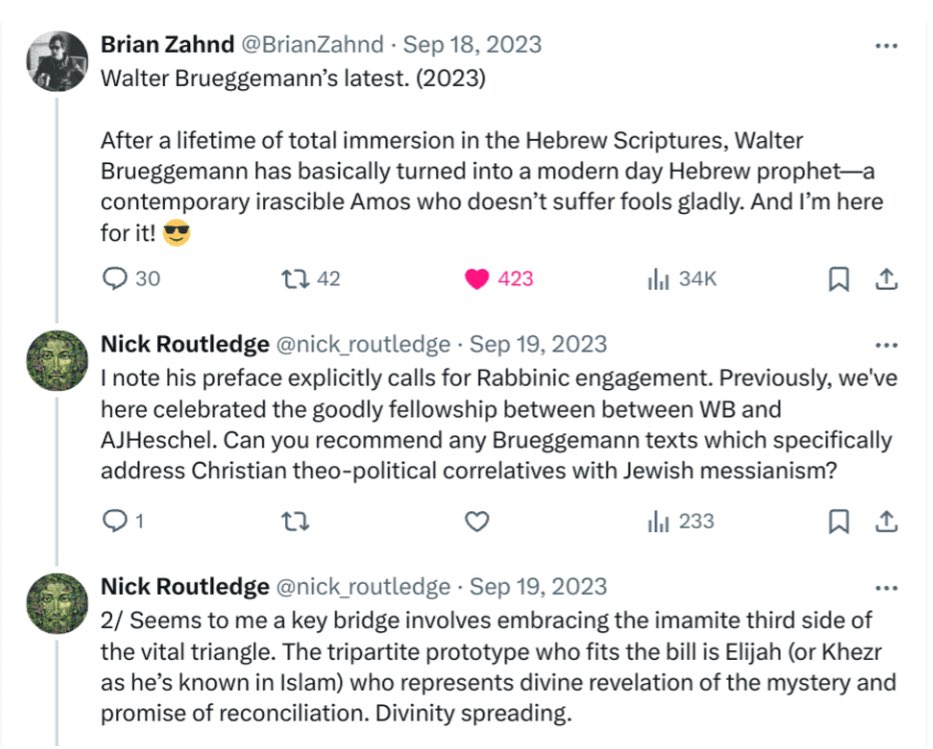
Image description
Original X alt text
Excerpt of tweet thread here: Walter Brueggemann’s latest. (2023) After a lifetime of total immersion in the Hebrew Scriptures, Walter Brueggemann has basically turned into a modern day Hebrew prophet—a contemporary irascible Amos who doesn’t suffer fools gladly. And I’m here for it! 😎 I note his preface explicitly calls for Rabbinic engagement. Previously, we've here celebrated the goodly fellowship between between WB and AJHeschel. Can you recommend any Brueggemann texts which specifically address Christian theo-political correlatives with Jewish messianism? 2/ Seems to me a key bridge involves embracing the imamite third side of the vital triangle. The tripartite prototype who fits the bill is Elijah (or Khezr as he’s known in Islam) who represents divine revelation of the mystery and promise of reconciliation. Divinity spreading.
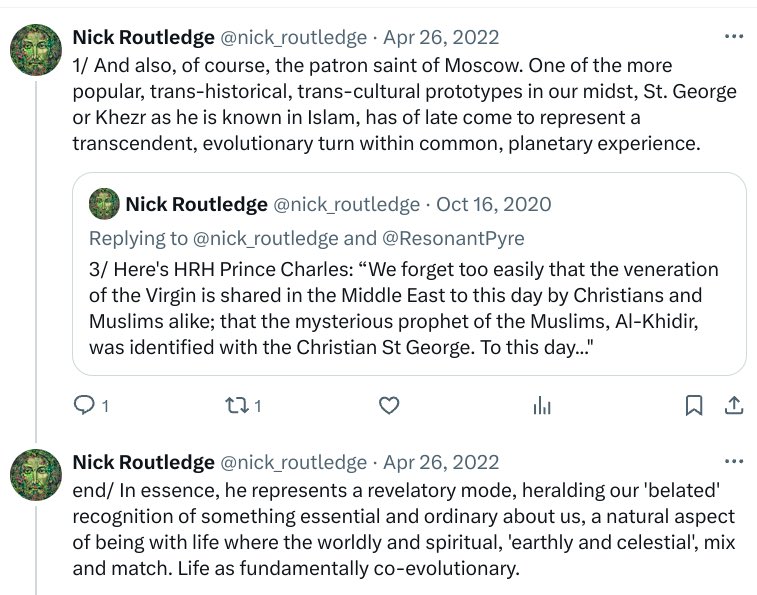
Image description
Original X alt text
Copy of tweet thread here: 1/ And also, of course, the patron saint of Moscow. One of the more popular, trans-historical, trans-cultural prototypes in our midst, St. George or Khezr as he is known in Islam, has of late come to represent a transcendent, evolutionary turn within common, planetary experience. Quote tweet: 3/ Here's HRH Prince Charles: “We forget too easily that the veneration of the Virgin is shared in the Middle East to this day by Christians and Muslims alike; that the mysterious prophet of the Muslims, Al-Khidir, was identified with the Christian St George. To this day..." end/ In essence, he represents a revelatory mode, heralding our 'belated' recognition of something essential and ordinary about us, a natural aspect of being with life where the worldly and spiritual, 'earthly and celestial', mix and match. Life as fundamentally co-evolutionary.
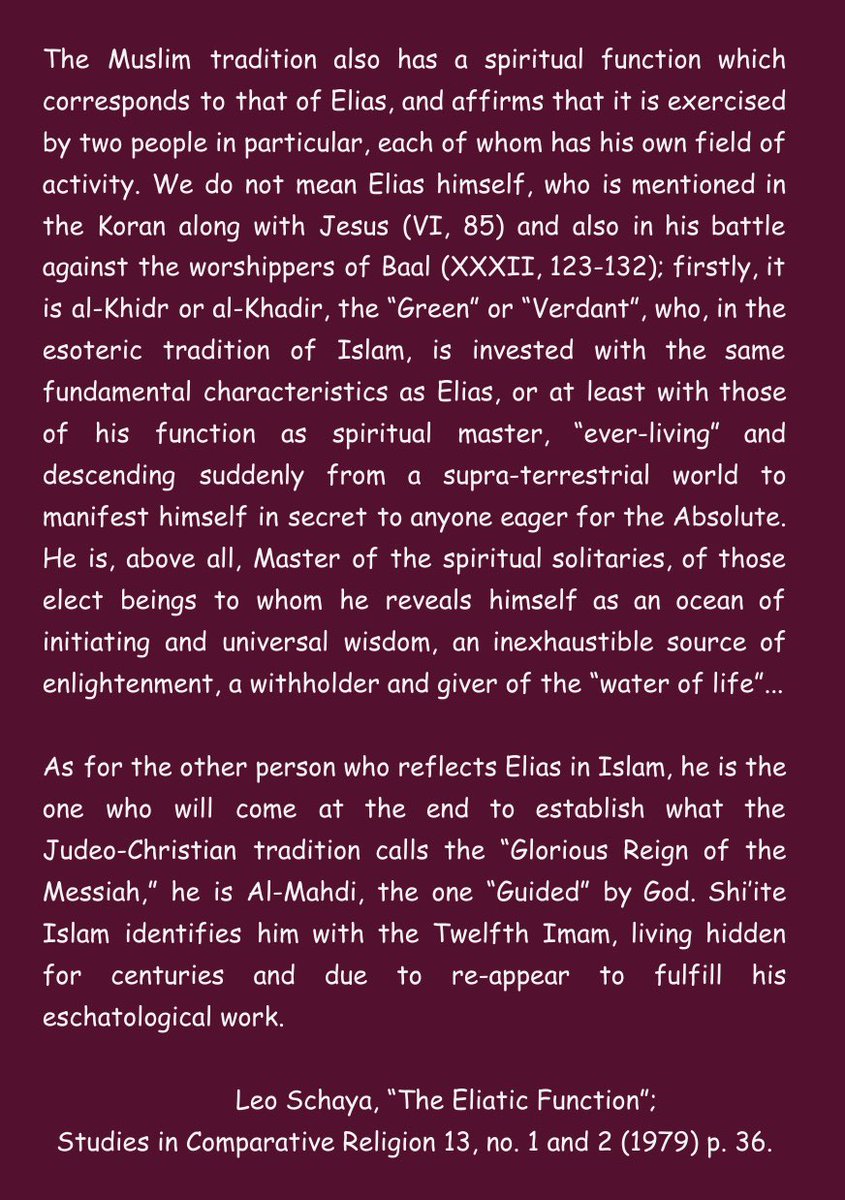
Image description
Original X alt text
The Muslim tradition also has a spiritual function which corresponds to that of Elias, and affirms that it is exercised by two people in particular, each of whom has his own field of activity. We do not mean Elias himself, who is mentioned in the Koran along with Jesus and also in his battle against the worshippers of Baal; firstly, it is al-Khidr who, in the esoteric tradition of Islam, is invested with the same fundamental characteristics as Elias…He is, above all, Master of the spiritual solitaries, of those elect beings to whom he reveals himself as an ocean of initiating and universal wisdom, an inexhaustible source of enlightenment… As for the other person who reflects Elias in Islam, he is the one who will come…to establish what the Judeo-Christian tradition calls the “Glorious Reign of the Messiah,” he is Al-Mahdi, the one “Guided” by God. Shi’ite Islam identifies him with the Twelfth Imam, living hidden for centuries and due to re-appear to fulfill his eschatological work.