
31/ The eschaton is when history's reckoning can no longer be held at bay. The moral grain of the real becomes legible at planetary scale. No prevailing order to hide inside. No religious enclosure to domesticate it. Meaning stands in the open—addressing all, without remainder.
@CarlMcColman Prv. 24:12 is clear enough. God will not be mocked. Adorno: "Knowledge has no light but that shed on the world by redemption." In that seeing, we are no longer deciding but disclosed. This is the Parousia: the eruption that judges by its own presence. What we are stands revealed.
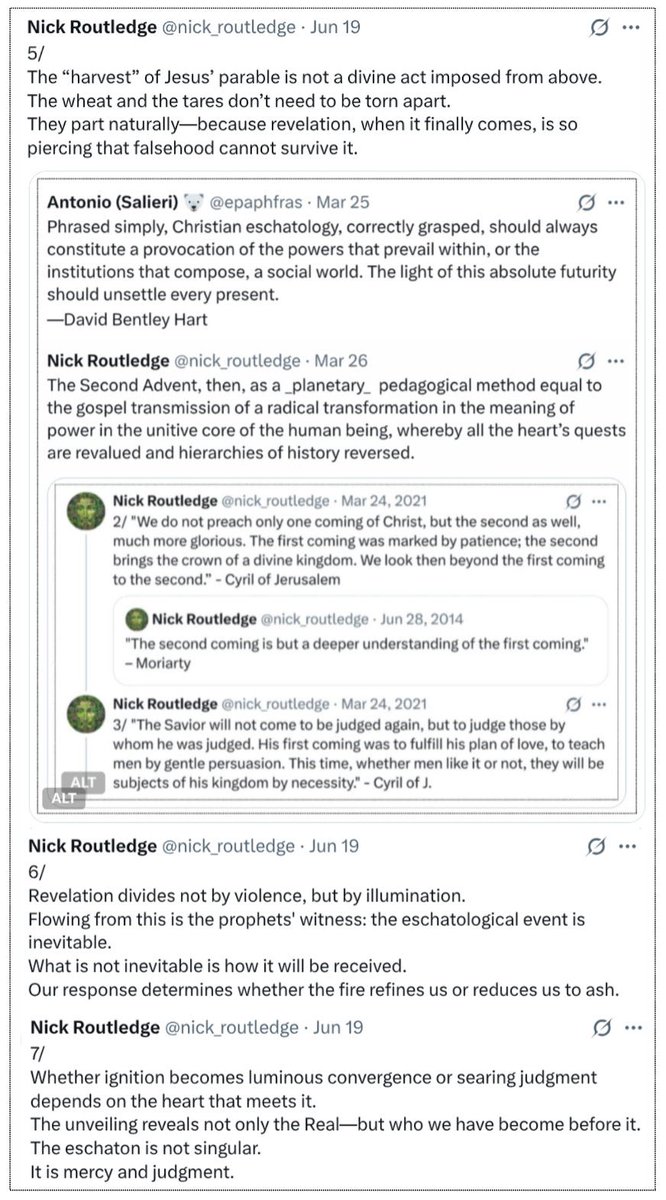
Image description
Extended description
5/ The “harvest” of Jesus’ parable is not a divine act imposed from above. The wheat and the tares don’t need to be torn apart. They part naturally—because revelation, when it finally comes, is so piercing that falsehood cannot survive it. Phrased simply, Christian eschatology, correctly grasped, should always constitute a provocation of the powers that prevail within, or the institutions that compose, a social world. The light of this absolute futurity should unsettle every present. —David Bentley Hart The Second Advent, then, as a _planetary_ pedagogical method equal to the gospel transmission of a radical transformation in the meaning of power in the unitive core of the human being, whereby all the heart’s quests are revalued and hierarchies of history reversed. 2/ "We do not preach only one coming of Christ, but the second as well, much more glorious. The first coming was marked by patience; the second brings the crown of a divine kingdom. We look then beyond the first coming to the second.” - Cyril of Jerusalem "The second coming is but a deeper understanding of the first coming." – Moriarty 3/ "The Savior will not come to be judged again, but to judge those by whom he was judged. His first coming was to fulfill his plan of love, to teach men by gentle persuasion. This time, whether men like it or not, they will be subjects of his kingdom by necessity." - Cyril of J. Tweets: 6/ Revelation divides not by violence, but by illumination. Flowing from this is the prophets' witness: the eschatological event is inevitable. What is not inevitable is how it will be received. Our response determines whether the fire refines us or reduces us to ash. 7/ Whether ignition becomes luminous convergence or searing judgment depends on the heart that meets it. The unveiling reveals not only the Real—but who we have become before it. The eschaton is not singular. It is mercy and judgment. Radiance for some. Rupture for others.
Open original document