
27/ But even the logic we've traced—the scandal of non-coercive awakening—has its own eschatological horizon. The very structure of optionality applies not to eternal features of consciousness, but to the conditions that are themselves temporary, marks of the age between Advents.
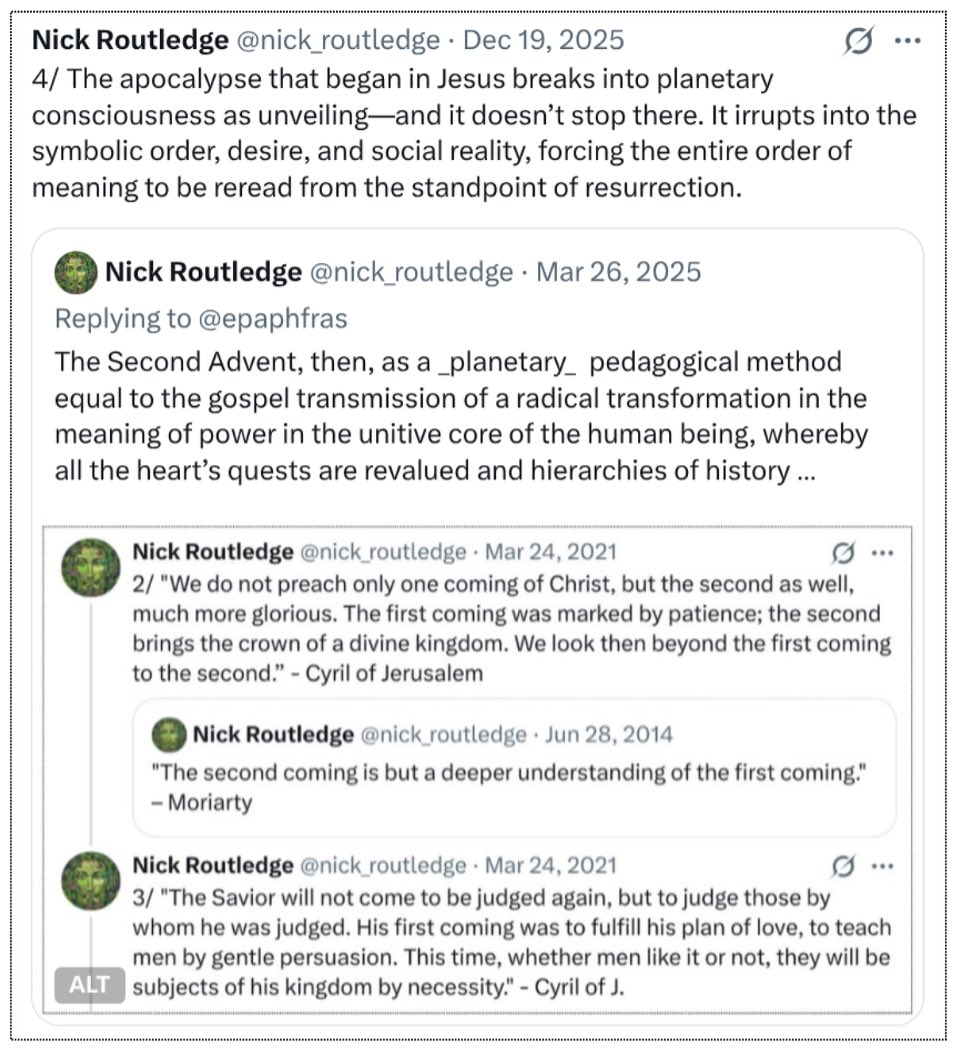
Image description
Extended description
4/ The apocalypse that began in Jesus breaks into planetary consciousness as unveiling—and it doesn’t stop there. It irrupts into the symbolic order, desire, and social reality, forcing the entire order of meaning to be reread from the standpoint of resurrection. Quote tweet: The Second Advent, then, as a _planetary_ pedagogical method equal to the gospel transmission of a radical transformation in the meaning of power in the unitive core of the human being, whereby all the heart’s quests are revalued and hierarchies of history reversed. A 2/ "We do not preach only one coming of Christ, but the second as well, much more glorious. The first coming was marked by patience; the second brings the crown of a divine kingdom. We look then beyond the first coming to the second.” - Cyril of Jerusalem Quote tweet: "The second coming is but a deeper understanding of the first coming." – Moriarty 3/ "The Savior will not come to be judged again, but to judge those by whom he was judged. His first coming was to fulfill his plan of love, to teach men by gentle persuasion. This time, whether men like it or not, they will be subjects of his kingdom by necessity." - Cyril of J.
Open original document1/8 The messianic claim isn’t explanatory—it can't be reduced to social evolution, ideology, myth, or collective psychology. It is operative: an Advent where the living God becomes newly manifest in history, a fresh expression of divine power reordering reality from within.
View this post’s context →