
@JoshHochschild Klima exposes the anti-incarnational logic of our moment: sever meaning from embodied reality and we get total mediation, simulated coherence, and systemic trust collapse. Ultimately, the consequence is eschatological: a forced separation between what can and cannot be mediated.
@lukeburgis Good and evil aren’t symmetric powers. In a trust crisis—this moment—evil is less “having bad ideas” than the systematic loosening of reality-bonds. It is anti-incarnational. The wheat and tares parable presumes a real eschatonic separation as the revelation becomes unignorable.
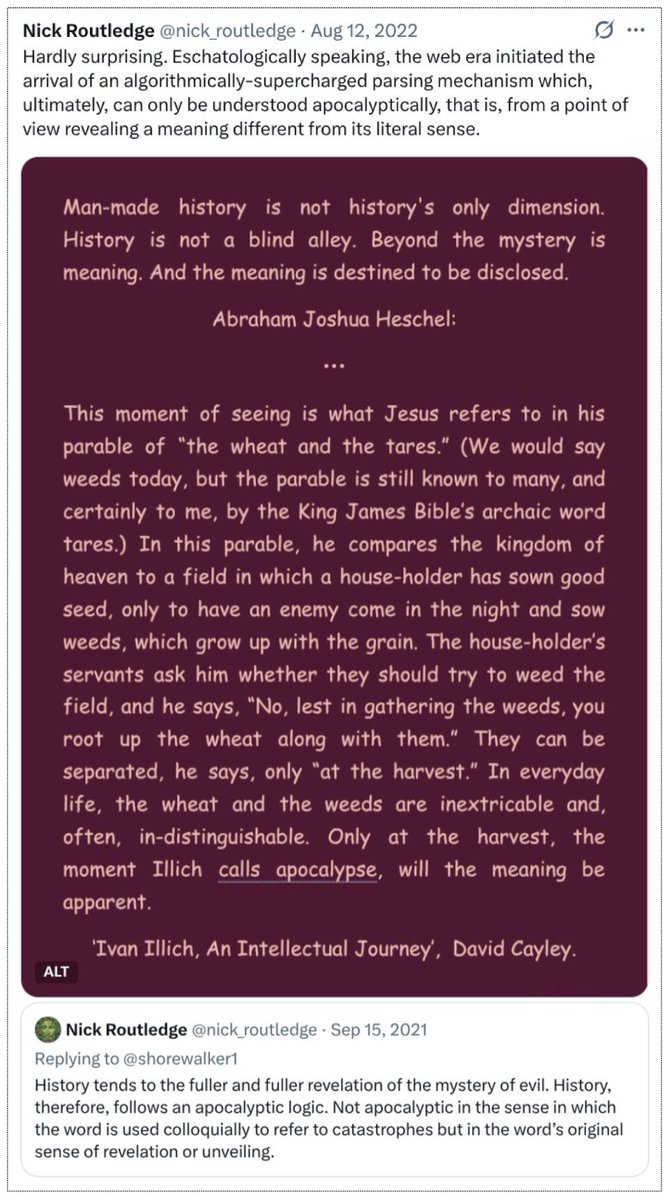
Image description
Extended description
Hardly surprising. Eschatologically speaking, the web era initiated the arrival of an algorithmically-supercharged parsing mechanism which, ultimately, can only be understood apocalyptically, that is, from a point of view revealing a meaning different from its literal sense. Man-made history is not history's only dimension. History is not a blind alley. Beyond the mystery is meaning. And the meaning is destined to be disclosed. - Abraham Joshua Heschel This moment of seeing is what Jesus refers to in his parable of “the wheat and the tares.” (We would say weeds today, but the parable is still known to many, and certainly to me, by the King James Bible’s archaic word tares.) In this parable, he compares the kingdom of heaven to a field in which a house-holder has sown good seed, only to have an enemy come in the night and sow weeds, which grow up with the grain. The house-holder’s servants ask him whether they should try to weed the field, and he says, “No, lest in gathering the weeds, you root up the wheat along with them.” They can be separated, he says, only “at the harvest.” In everyday life, the wheat and the weeds are inextricable and, often, in-distinguishable. Only at the harvest, the moment Illich calls apocalypse, will the meaning be apparent. - Ivan Illich, An Intellectual JourneyDavid Cayley. Subtweet: History tends to the fuller and fuller revelation of the mystery of evil. History, therefore, follows an apocalyptic logic. Not apocalyptic in the sense in which the word is used colloquially to refer to catastrophes but in the word’s original sense of revelation or unveiling.
Open original document