
@jasonwblakely 2/ Panikkar radicalizes the diagnosis. Secularity's deepest feature, he says—its final idol, its ultimate corruption of Being—is its absolutizing of temporality itself: empty, mechanical time enthroned as the exhaustive measure of Being’s ‘real’ character and horizon.
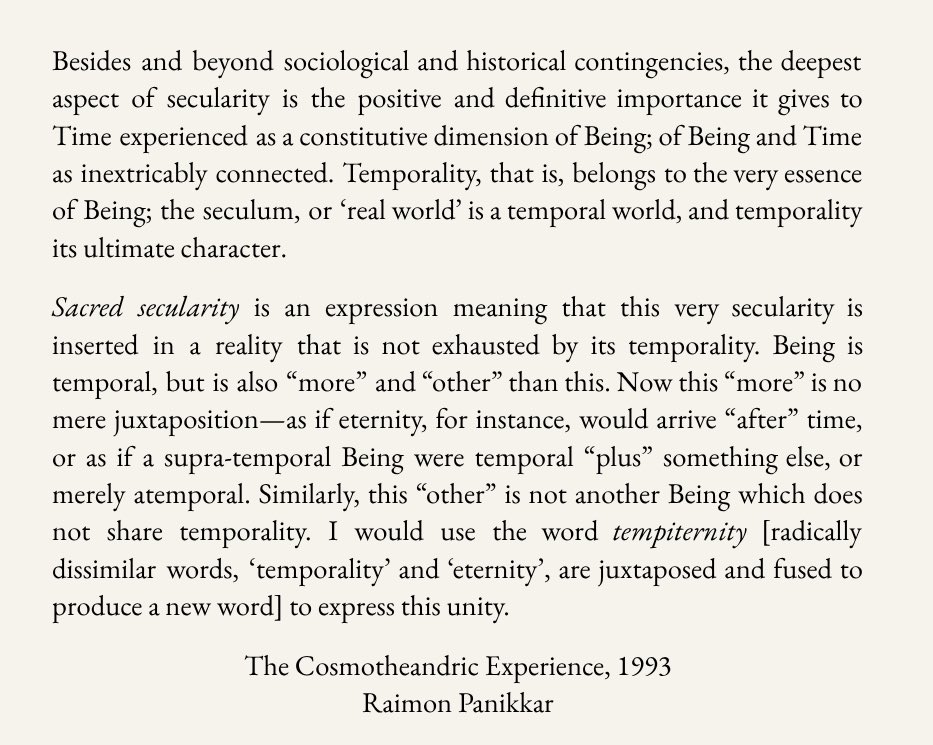
Image description
Extended description
Besides and beyond sociological and historical contingencies, the deepest aspect of secularity is the positive and definitive importance it gives to Time experienced as a constitutive dimension of Being; of Being and Time as inextricably connected. Temporality, that is, belongs to the very essence of Being; the seculum, or ‘real world’ is a temporal world, and temporality its ultimate character. Sacred secularity is an expression meaning that this very secularity is inserted in a reality that is not exhausted by its temporality. Being is temporal, but is also “more” and “other” than this. Now this “more” is no mere juxtaposition—as if eternity, for instance, would arrive “after” time, or as if a supra-temporal Being were temporal “plus” something else, or merely atemporal. Similarly, this “other” is not another Being which does not share temporality. I would use the word tempiternity [radically dissimilar words, ‘temporality’ and ‘eternity’, are juxtaposed and fused to produce a new word] to express this unity. The Cosmotheandric Experience, 1993 Raimon Panikkar
Open original document