
@pauljpastor "The very experience of not knowing what to trust anymore is an apocalyptic grace—judgment on our idolatry of representation. The core question isn’t “how do we patch epistemology?” but, “where does Truth actually live?” And that question, pressed hard enough, is Christological."
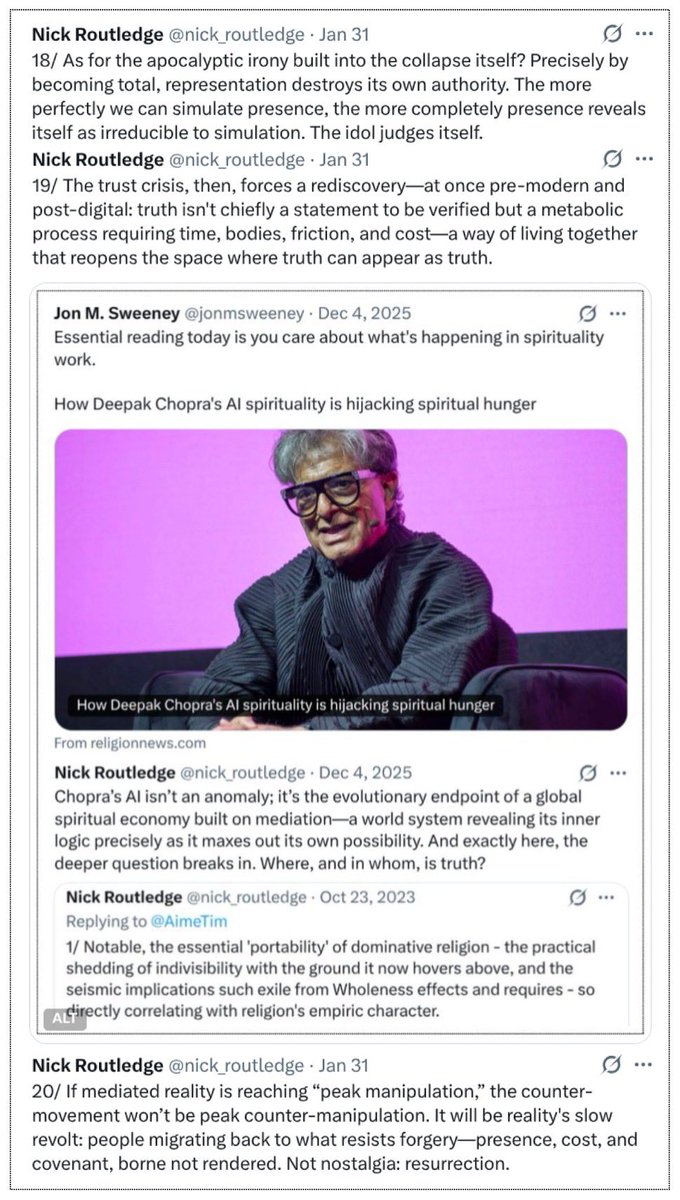
Image description
Extended description
18/ As for the apocalyptic irony built into the collapse itself? Precisely by becoming total, representation destroys its own authority. The more perfectly we can simulate presence, the more completely presence reveals itself as irreducible to simulation. The idol judges itself. 19/ The trust crisis, then, forces a rediscovery—at once pre-modern and post-digital: truth isn't chiefly a statement to be verified but a metabolic process requiring time, bodies, friction, and cost—a way of living together that reopens the space where truth can appear as truth. Essential reading today is you care about what's happening in spirituality work. How Deepak Chopra's AI spirituality is hijacking spiritual hunger Chopra’s AI isn’t an anomaly; it’s the evolutionary endpoint of a global spiritual economy built on mediation—a world system revealing its inner logic precisely as it maxes out its own possibility. And exactly here, the deeper question breaks in. Where, and in whom, is truth? 1/ Notable, the essential 'portability' of dominative religion - the practical shedding of indivisibility with the ground it now hovers above, and the seismic implications such exile from Wholeness effects and requires - so directly correlating with religion's empiric character. 20/ If mediated reality is reaching “peak manipulation,” the counter-movement won’t be peak counter-manipulation. It will be reality's slow revolt: people migrating back to what resists forgery—presence, cost, and covenant, borne not rendered. Not nostalgia: resurrection.
Open original document@JoshHochschild @jeff_bilbro end\ This presses an unavoidable existential question. If representation ultimately unmasks the fantasy that presence can be simulated away—if the image can no longer be trusted—where does Truth take flesh now? Where does Truth actually live, and what kind of life can bear it?
View this post’s context →